
Let’s be honest.
Most companies today talk about sustainability because they have to — not because they fully understand it.
Words like net zero, ESG, carbon footprint, and BRSR show up in annual reports, presentations, and investor decks. But ask a simple operational question:
“What exactly is our environmental cost?”
And the room often goes silent.
This is precisely where environmental costing enters the picture.
So, What is Environmental Costing?
In simple language:
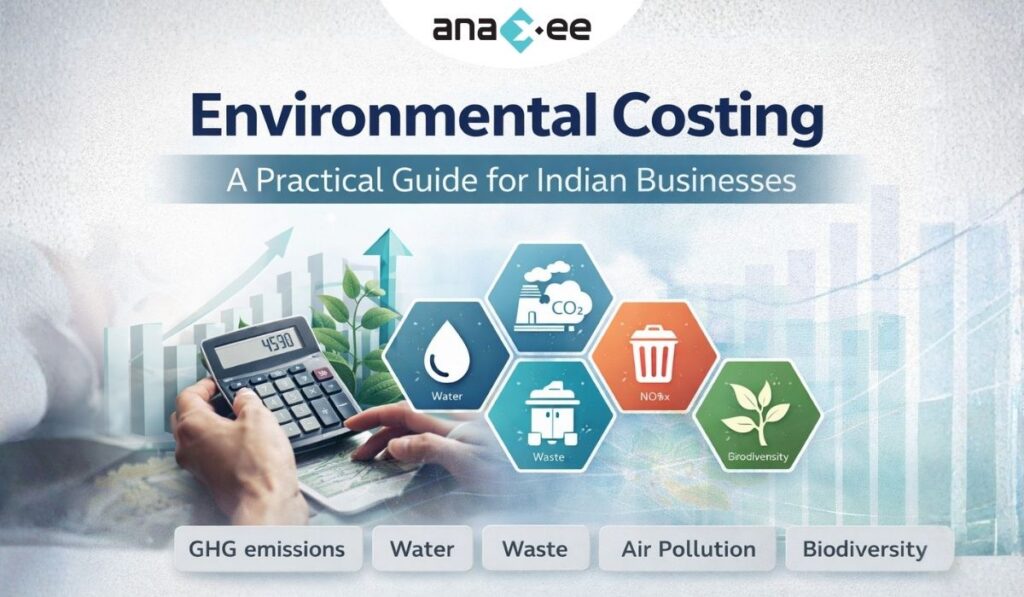
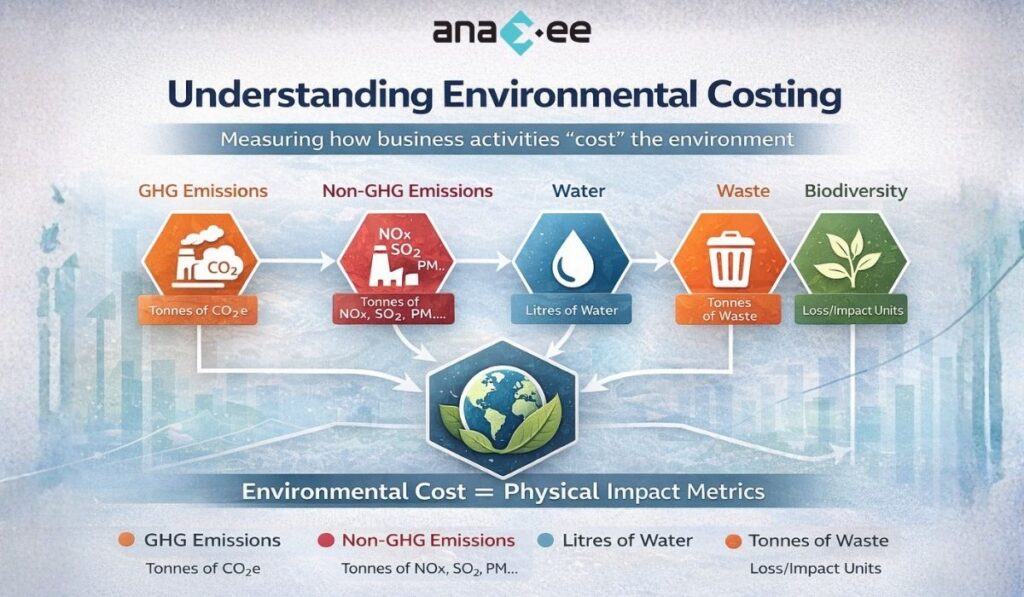
Environmental costing is the process of measuring how much your business activities “cost” the environment.
Not in rupees.
Not in dollars.
But in physical impact units.
Think:
- Tonnes of CO₂ equivalent (GHGs)
- Litres of water consumed
- Tonnes of waste generated
- Units of air pollutants (NOx, SOx, PM)
- Impact on biodiversity
The Guidance Note on Environmental Costing by ICMAI frames this beautifully by highlighting one key idea:
Every business activity has a financial cost — and an environmental cost. R_GuidanceEnvironmentalCosting
We’ve spent decades perfecting financial bookkeeping. Environmental bookkeeping is now catching up.
Environmental Impact vs Environmental Cost
These terms are often mixed up.
Environmental Impact → What effect do your operations have
Environmental Cost → That impact is quantified and recorded
For example:
| Activity | Impact | Environmental Cost |
|---|---|---|
| Diesel usage | GHG emissions | kgCO₂e |
| Factory cooling | Water use | Litres |
| Packaging | Plastic waste | Tonnes |
| Chimney output | NOx/SOx | Absolute units |
Environmental costing turns vague statements into measurable numbers.
Why This Suddenly Matters
Because pressure is no longer optional.
Businesses are now being pushed by:
- Regulators
- Investors
- Customers
- Supply chain partners
In India, SEBI’s BRSR mandate requires environmental disclosures from top listed companies. And increasingly, value chain partners are being pulled into Scope 3 reporting.
Translation?
Even if you’re not listed, you’re not insulated.
Beyond Carbon Accounting
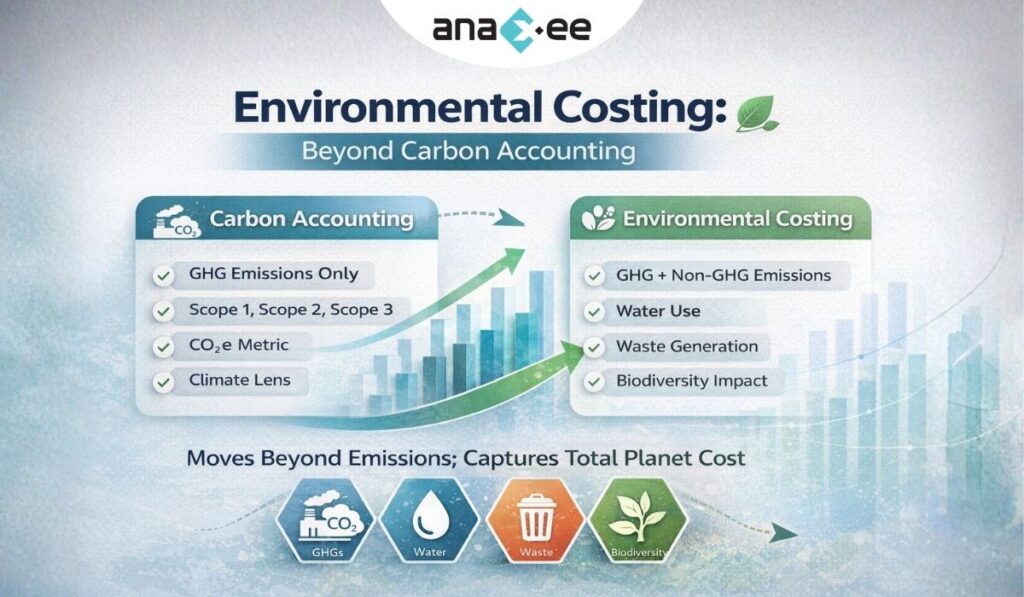
Here’s a common mistake:
Many companies think sustainability = carbon footprint.
But environmental costing is multi-dimensional:
1️⃣ GHG Emissions
2️⃣ Non-GHG Emissions
3️⃣ Water
4️⃣ Waste
5️⃣ Biodiversity
Carbon is just one slice of the pie.
Ignoring the rest creates blind spots:
- Water-intensive operations
- Hidden waste leakage
- Air pollution liabilities
- Ecological risks
Enter the HEC Framework
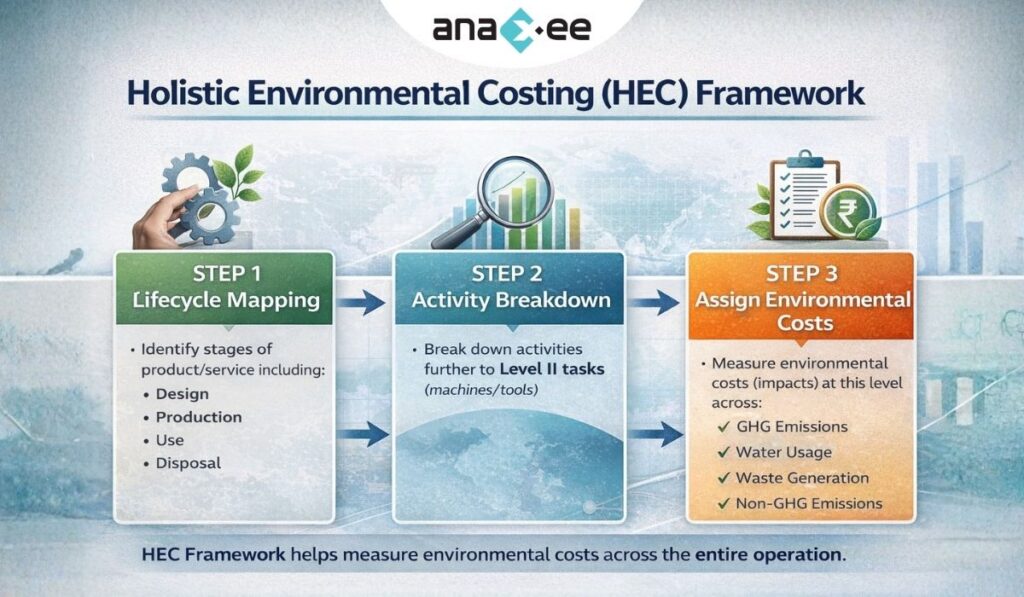
ICMAI proposes the Holistic Environmental Costing (HEC) Framework R_GuidanceEnvironmentalCosting.
Instead of random data collection, HEC applies structured thinking:
Step 1 → Lifecycle Mapping
Step 2 → Activity Breakdown
Step 3 → Assign Environmental Costs
This mirrors traditional cost accounting logic — but applied to environmental impacts.
Lifecycle Thinking Changes Everything
Most companies measure what happens inside their walls.
HEC asks:
- What about design decisions?
- Supplier emissions?
- Product usage impact?
- End-of-life disposal?
Example:
An automobile manufacturer may not emit during driving — but the product certainly does.
Who owns that impact?
Technically → Customer
Practically → Shared responsibility
Environmental Costing is Also a Risk Tool
This isn’t just reporting compliance.
Environmental costing helps identify:
✔ Inefficiencies
✔ Resource leakages
✔ Regulatory exposure
✔ Climate vulnerabilities
If lubricant purchase ≠ lubricant consumption → something’s wrong.
If water use intensity rising → operational risk.
If waste generation inconsistent → process instability.
What Happens Without Environmental Costing
You get:
❌ Patchy ESG data
❌ Greenwashing accusations
❌ Poor investor confidence
❌ Weak sustainability strategy
❌ Surprise compliance shocks
And worse:
Decisions based on assumptions, not evidence.
Final Thought
Environmental costing is not a “CSR exercise.”
It is management intelligence.
Just like financial costing helps you understand profitability, environmental costing helps you understand sustainability performance and risk.
Companies that adopt this early gain:
- Better reporting credibility
- Stronger ESG positioning
- Clear mitigation pathways
- Competitive advantage
Because eventually:
Those who cannot measure impact will struggle to justify growth.