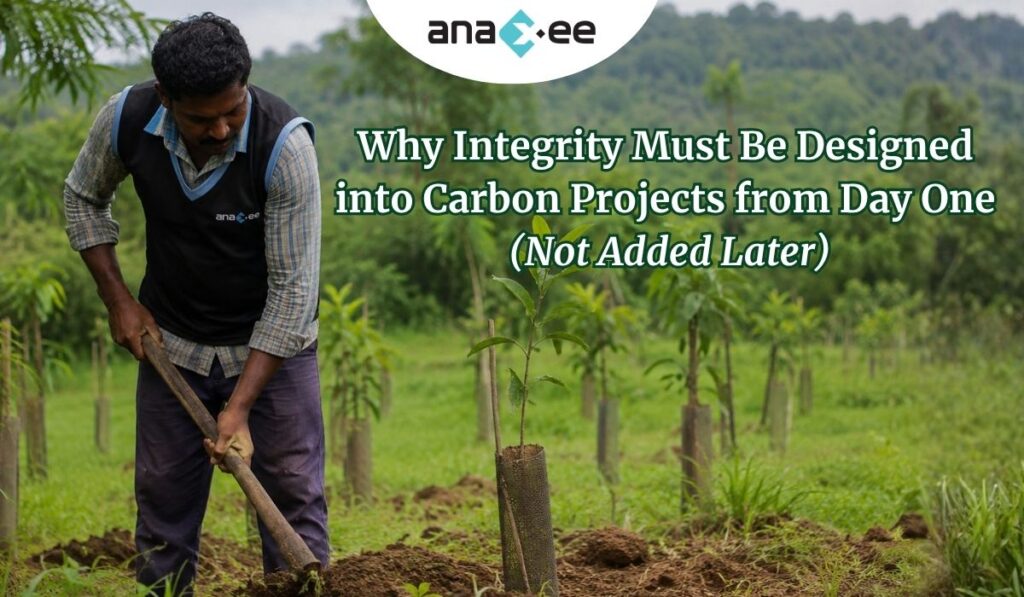

Why Integrity Must Be Designed into Carbon Projects from Day One
“Integrity is not something that you can add later. It has to be built in at the design stage of the project.”
This idea sounds simple. Almost obvious.
And yet, a large part of the carbon market still behaves as if integrity can be layered in after execution.
It cannot.
Not in a meaningful way. Not in a way that survives scrutiny. And definitely not in a way that builds long-term trust with credit buyers.
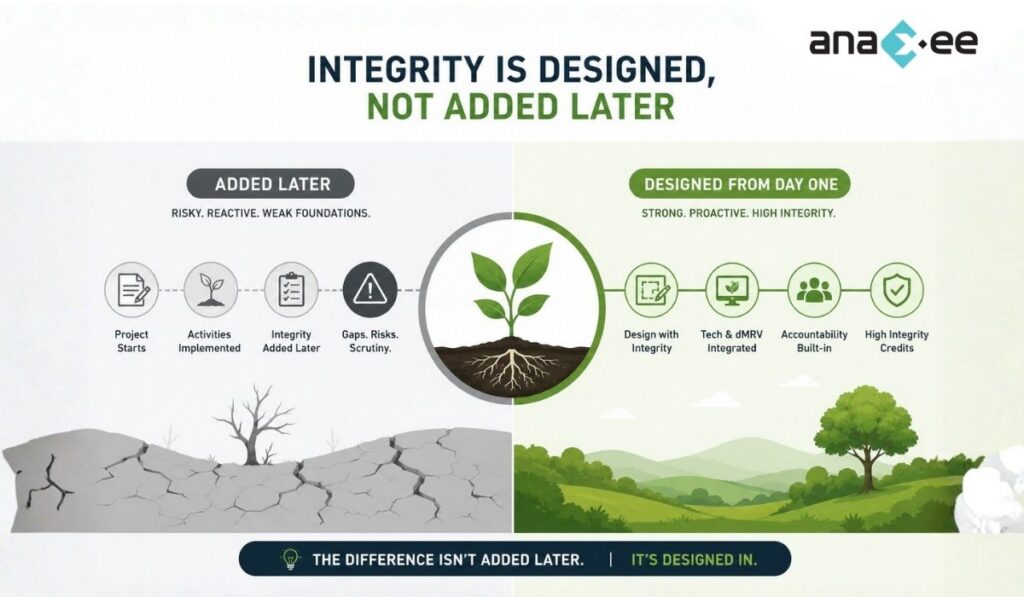
The reality is straightforward: in carbon projects, integrity is a design decision—not a correction mechanism.
The Cost of Getting It Wrong
Many projects begin with good intent. Plantation targets are defined. Activities are planned. Vendors are onboarded. Reports are expected.
But somewhere in this process, a critical assumption is made:
That integrity can be ensured later—during validation, during verification, or through external audits.
This is where things begin to break.
Because by the time a project reaches validation, most of its structural decisions are already locked in:
- Baseline assumptions have been set
- Monitoring systems (or lack of them) are in place
- Data collection practices are already established
- Ground realities have diverged from reported numbers
At this stage, trying to “fix” integrity is not optimization—it is damage control.
And damage control in carbon projects is expensive, slow, and often incomplete.
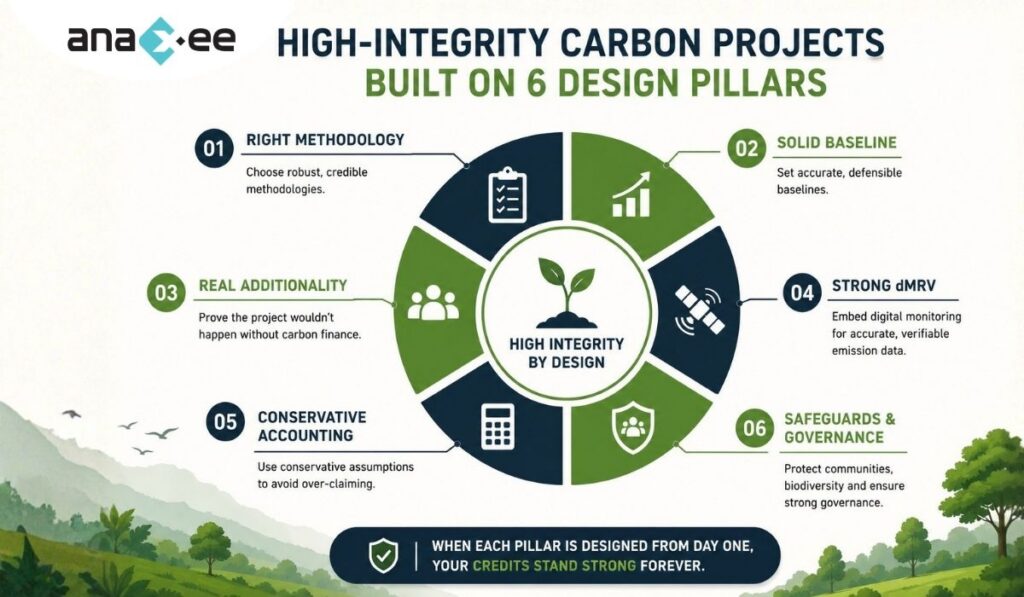
What Actually Defines a High-Integrity Carbon Project
To understand why integrity must be designed early, it helps to look at what truly defines a high-quality carbon project.
It is not just certification.
It is the strength of multiple interdependent components working together:
1. Methodology Selection
The choice of methodology determines how emission reductions are calculated, monitored, and verified. A weak or poorly suited methodology creates structural gaps that cannot be corrected later.
2. Baseline Setting
Baselines are not theoretical constructs—they are the reference point for all future claims. If baselines are inflated or poorly justified, the credibility of the entire project collapses.
3. Additionality
Proving that a project would not have happened without carbon finance is central to integrity. This is not something you can convincingly retrofit after project execution.
4. Monitoring, Reporting, and Verification (dMRV)
Traditional MRV often relies on periodic reporting. In contrast, digital MRV (dMRV) embeds monitoring into daily operations—capturing real-time, verifiable data from the field.
5. Safeguards and Governance
Community impact, leakage risks, and permanence considerations must be designed into the project—not addressed as compliance checkboxes later.
6. Conservative Accounting
Overestimation of impact is one of the biggest credibility risks. Conservative accounting frameworks must be integrated into the methodology and execution model from the beginning.
Each of these elements is interconnected.
And each one loses effectiveness if introduced late.
Why Technology Cannot Be Retrofitted
One of the most common misconceptions in today’s carbon market is that technology can “fix” integrity gaps.
It cannot.
Technology amplifies what already exists. If your project design is weak, technology will only make those weaknesses more visible.
For example:
- If field data is collected manually and retrospectively, digitizing it does not make it reliable
- If survival rates are not monitored continuously, dashboards will only display delayed failures
- If accountability is unclear, data systems will not create ownership
To be effective, technology must be embedded at the design stage:
- Data capture protocols defined before implementation
- Geo-tagging integrated into field operations
- Real-time monitoring systems aligned with project milestones
- Quality control loops built into workflows
This is what separates reporting systems from operational systems.
Designing for Integrity: What It Looks Like in Practice
In a recent project, a different approach was taken.
Instead of treating monitoring and reporting as downstream activities, the entire system was designed upfront.
From the first week:
- Field activities were geo-tagged
- Data collection was standardized and digitized
- Quality checks were embedded into workflows
- A dMRV system was operational before the first on-ground intervention
Nothing was added later.
Everything was designed into the system.
This changed the nature of the project itself.
Data was no longer something that was “reported”—it was continuously generated, verified, and reviewed.
Monitoring was not periodic—it was ongoing.
And accountability was not assumed—it was built into the process.
The Shift Towards High-Integrity Carbon Credits
The voluntary carbon market is evolving rapidly.
Buyers are no longer satisfied with basic certification.
They are asking deeper questions:
- Can the data be traced back to the source?
- Are emission reductions conservatively estimated?
- Are safeguards genuinely implemented?
- Can the project withstand reputational scrutiny?
This shift is being reinforced by global frameworks such as the Integrity Council for the Voluntary Carbon Market (ICVCM), which has introduced the Core Carbon Principles (CCP).
The CCP label acts as an additional layer of assurance—evaluating whether carbon credits meet enhanced integrity benchmarks across:
- additionality
- quantification
- governance
- safeguards
Projects that receive this label are not just compliant.
They are considered high-integrity by design.
Validation Comes from the Market
Ultimately, integrity is not proven in documentation.
It is proven in how a project holds up under scrutiny.
There are two strong signals of this:
1. Buyer Confidence
When credit buyers trust the underlying data, methodology, and execution, transactions become easier—and reputational risks decrease.
2. Independent Recognition
Frameworks like CCP do not evaluate narratives—they evaluate systems.
Receiving such recognition is not a marketing milestone.
It is a validation of how the project was designed and executed.
The Real Future of Carbon Markets
There is a misconception that the future of carbon markets will be driven by scale.
It will not.
Scale without integrity creates systemic risk.
The real differentiator will be credibility:
- Can projects demonstrate real, measurable impact?
- Can they provide verifiable, transparent data?
- Can they withstand independent evaluation without rework?
This is where the market is heading.
And this is where most projects will either stand strong—or fail.
Final Thought
Integrity is often discussed as a principle.
But in carbon projects, it is a system.
It is built into:
- how projects are designed
- how data is captured
- how decisions are made
- how risks are managed
And once the project begins, it is too late to rebuild that system.
Because integrity is not a checkpoint you pass at the end.
It is the foundation you build at the beginning.
About Anaxee:
Anaxee drives large-scale, country-wide Climate and Carbon Credit projects across India. We specialize in Nature-Based Solutions (NbS) and community-driven initiatives, providing the technology and on-ground network needed to execute, monitor, and ensure transparency in projects like agroforestry, regenerative agriculture, improved cookstoves, solar devices, water filters and more. Our systems are designed to maintain integrity and verifiable impact in carbon methodologies.
Beyond climate, Anaxee is India’s Reach Engine- building the nation’s largest last-mile outreach network of 100,000 Digital Runners (shared, tech-enabled field force). We help corporates, agri-focused companies, and social organizations scale to rural and semi-urban India by executing projects in 26 states, 540+ districts, and 11,000+ pin codes, ensuring both scale and 100% transparency in last-mile operations. Connect with Anaxee atsales@anaxee.com