
India’s climate story is no longer limited to solar parks, EVs, and industrial decarbonization. A large part of the country’s climate future will depend on something much closer to the ground — literally.
Trees on farms. Restored landscapes. Soil health. Water retention. Biodiversity. Community participation.
This is where nature-based carbon projects are becoming important.
Across India, governments, corporates, investors, and climate developers are increasingly looking at nature not just as an environmental asset, but as critical climate infrastructure. The shift is practical. Nature-based solutions can remove carbon from the atmosphere while also solving real problems on the ground — declining farm productivity, water stress, rising temperatures, and biodiversity loss.
The concept is gaining global momentum as cities, governments, and institutions recognize that ecological systems are essential for climate resilience and human wellbeing.
But in India, the conversation is slightly different.
Here, climate action cannot be separated from livelihoods.
A carbon project that ignores communities will struggle to survive in the long term. That is why India’s strongest nature-based carbon projects are increasingly becoming community-linked projects instead of isolated plantation exercises.
What Are Nature-Based Carbon Projects?
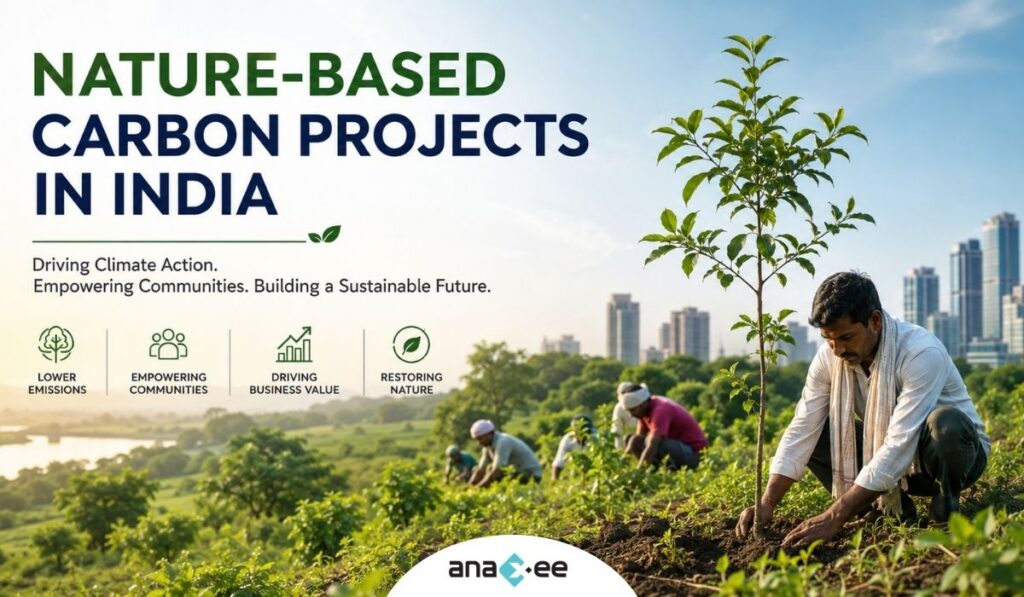
Nature-based carbon projects are climate initiatives that use natural ecosystems to capture or avoid greenhouse gas emissions.
These projects usually include activities such as:
- Agroforestry
- Afforestation and reforestation
- Mangrove restoration
- Grassland restoration
- Soil carbon improvement
- Watershed restoration
- Regenerative agriculture
- Community forest management
The core idea is simple: restore ecological systems so they can naturally absorb carbon dioxide while generating additional environmental and social benefits.
Globally, nature-based solutions are now being seen as an important part of climate adaptation and mitigation strategies because they provide multiple co-benefits across ecological, economic, and social dimensions.
In India, these projects are especially relevant because rural economies and ecological systems are deeply interconnected.
A well-designed agroforestry project, for example, does more than generate carbon credits. It can also:
- Improve farmer income diversification
- Increase soil fertility
- Reduce heat stress
- Improve groundwater recharge
- Reduce climate vulnerability
- Strengthen local biodiversity
That combination matters.
Because climate projects in India cannot succeed if they only optimize for carbon numbers on paper.
Why India Is Becoming a Major Market for Nature-Based Climate Projects
India has several conditions that make it highly suitable for nature-based carbon projects.
1. Large Agricultural Landscape
More than half of India’s population is connected to agriculture directly or indirectly. This creates enormous potential for agroforestry and regenerative farming models.
Millions of farms already have partial tree cover or traditional mixed-farming systems. In many regions, climate projects are not introducing entirely new practices — they are strengthening systems that already existed historically.
2. Climate Vulnerability Is Increasing
Heatwaves, droughts, erratic rainfall, and water scarcity are becoming common across Indian states.
The document highlights how urban and ecological systems are increasingly vulnerable to climate-related disturbances such as extreme heat, flooding, and environmental stress.
India is already experiencing this reality.
From Bundelkhand’s water stress to heatwaves in central India and flood-prone regions in Assam, climate adaptation is no longer theoretical.
Nature-based interventions help reduce vulnerability while improving ecosystem resilience.
3. Corporates Need Credible Climate Action
Indian and global companies are under pressure to demonstrate measurable climate action.
Many organizations have already announced:
- Net-zero targets
- ESG commitments
- Carbon neutrality goals
- Supply chain sustainability programs
But high-quality carbon removal opportunities are limited globally.
Nature-based projects in India offer an opportunity to combine climate outcomes with rural development impact.
The Problem With “Plantation-Only” Thinking
One of the biggest misconceptions in the market is that carbon projects are just tree plantation drives.
They are not.
Or at least, serious projects are not.
Planting trees is the easy part.
Maintaining survival rates for years, ensuring community participation, measuring carbon accurately, monitoring land-use change, preventing leakage, and building transparent MRV systems — that is the difficult part.
A poorly designed plantation project can fail very quickly.
This is why the global climate ecosystem is increasingly emphasizing long-term ecosystem resilience, governance, biodiversity, and social inclusion in nature-based solutions.
In India, this becomes even more important because projects often operate across:
- Smallholder farms
- Fragmented landholdings
- Diverse climatic zones
- Complex rural socio-economic conditions
Without strong field execution, many projects remain PowerPoint concepts.
Why Community Participation Decides Project Success
The strongest climate projects in India are usually community-driven.
Not because it sounds good in sustainability reports.
Because execution depends on people.
Consider an agroforestry carbon project spread across thousands of farmers. The success of the project depends on:
- Whether farmers continue maintaining trees
- Whether survival rates remain high
- Whether field data is reliable
- Whether monitoring is consistent
- Whether trust exists locally
This requires continuous engagement.
Climate implementation in India is fundamentally a last-mile challenge.
That is where technology-enabled field networks, local coordination systems, training frameworks, and transparent monitoring systems become important.
Projects that underestimate ground execution often struggle later during verification or long-term maintenance phases.
Agroforestry Is Emerging as a Strong Indian Model
Among different nature-based approaches, agroforestry is receiving significant attention in India.
The reason is practical.
Pure conservation projects often face land availability challenges. Agroforestry, however, integrates trees into productive farming systems.
That creates dual benefits:
- Carbon sequestration
- Agricultural productivity support
Farmers are more likely to participate when projects support livelihoods alongside climate goals.
In states like Madhya Pradesh, Maharashtra, Uttar Pradesh, and Gujarat, agroforestry models are increasingly being explored for:
- Timber species
- Fruit-based systems
- Bamboo plantations
- Boundary plantations
- Mixed native species
When implemented properly, these systems can create long-term ecological and economic value.
The Role of Technology in Modern Carbon Projects
Nature-based projects are no longer managed using spreadsheets and occasional site visits.
Modern projects increasingly depend on:
- Satellite monitoring
- GIS mapping
- Digital MRV systems
- Farmer-level traceability
- Geo-tagged plantation data
- Mobile-based field audits
- Real-time dashboards
This is especially important in India because projects often operate across geographically dispersed rural areas.
Transparency is becoming central to carbon market credibility.
Buyers now expect:
- Verified field data
- Survival tracking
- Community participation evidence
- Additionality documentation
- Monitoring transparency
Without strong digital systems, scaling becomes difficult.
Why Businesses Are Paying Attention
Companies are realizing that nature-based projects offer more than carbon credits.
They also create visible impact narratives.
A renewable energy investment may reduce emissions. But a community-linked agroforestry project can:
- Support farmers
- Improve biodiversity
- Restore degraded land
- Create rural employment
- Improve water systems
- Generate carbon removals
That makes nature-based climate projects strategically attractive for:
- ESG reporting
- CSR integration
- Supply chain sustainability
- Climate disclosures
- Stakeholder engagement
In India especially, projects that combine environmental and social outcomes are likely to receive stronger long-term support.
The Future of Nature-Based Carbon Projects in India
India’s climate transition will not happen through industrial decarbonization alone.
Nature will play a major role.
But the future will belong to projects that move beyond symbolic plantation campaigns and focus on:
- Long-term ecosystem restoration
- Farmer participation
- Scientific monitoring
- Transparent verification
- Strong implementation systems
- Measurable impact
The global discussion around nature-based solutions is already evolving toward resilience, governance, inclusivity, and multi-benefit ecological systems.
India has the opportunity to build climate projects that are not only scalable, but also deeply connected to communities and landscapes.
That will require execution capacity at scale.
Not just climate ambition.
At Anaxee, we believe climate projects succeed only when last-mile execution is strong.
From farmer engagement and field operations to digital monitoring and transparent implementation support, scalable climate action in India needs systems that work on the ground — not just on paper.
If your organization is exploring nature-based carbon projects, agroforestry initiatives, or community-linked climate implementation models, connect with Anaxee to understand how technology-enabled field execution can support long-term project success.