
Why Agroforestry Carbon Projects Are Gaining Momentum in India
For many years, climate conversations in India revolved around energy.
Solar parks. Wind energy. Electric mobility. Industrial emissions.
Those areas still matter. But another climate solution is quietly becoming important across rural India — agroforestry.
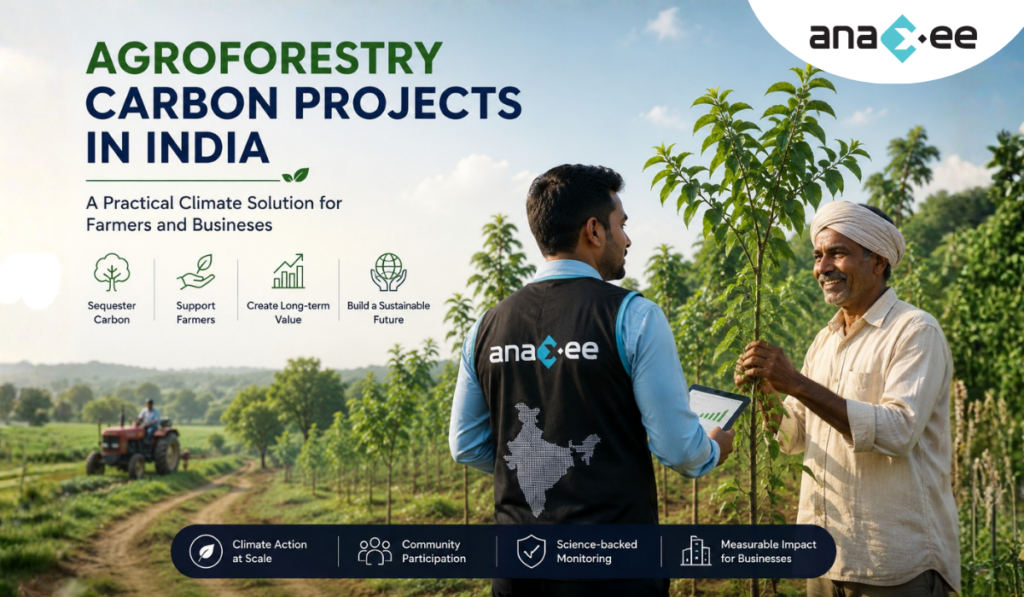
In simple terms, agroforestry means integrating trees into farming systems. Instead of separating agriculture and forestry, both are combined on the same land in a planned way.
Now this traditional-looking practice is becoming part of the modern carbon economy.
Across India, agroforestry carbon projects are attracting attention from:
- Climate investors
- Carbon project developers
- Sustainability-focused corporates
- ESG teams
- Policymakers
- Rural development organizations
The reason is straightforward.
Agroforestry can address multiple problems at the same time:
- Carbon sequestration
- Farmer resilience
- Soil degradation
- Water stress
- Biodiversity decline
- Rural income diversification
That combination is difficult to ignore.
What Is an Agroforestry Carbon Project?
An agroforestry carbon project is a climate initiative where trees are integrated into agricultural landscapes to remove carbon dioxide from the atmosphere while improving ecosystem health and supporting livelihoods.
These projects usually involve:
- Boundary plantations
- Timber-based systems
- Fruit tree integration
- Silvopasture systems
- Bamboo plantations
- Mixed native species plantations
- Regenerative farming practices
The carbon stored in tree biomass and soil can be measured, monitored, and verified under carbon methodologies.
Over time, the project may generate carbon credits that organizations can purchase to support climate goals.
But unlike isolated plantation drives, agroforestry projects work within existing farming systems.
That changes everything.
Why Agroforestry Fits India Better Than Many Other Climate Models
India’s agricultural landscape is dominated by smallholder farmers.
Large-scale land aggregation is often difficult. Land ownership patterns are fragmented. Rural livelihoods are deeply connected to farming cycles.
In this context, agroforestry works because it adapts to existing realities instead of replacing them.
Farmers do not have to stop cultivation completely.
Trees become an additional layer of productivity.
This is one reason agroforestry is increasingly being recognized as a practical nature-based solution capable of delivering ecological, economic, and social co-benefits together.
In many Indian villages, farmers have historically maintained trees on farms for:
- Shade
- Fodder
- Fruit
- Timber
- Soil protection
Modern agroforestry projects are often strengthening and formalizing these practices through scientific planning and carbon finance mechanisms.
Climate Change Is Already Affecting Indian Agriculture
Farmers across India are experiencing climate pressure directly.
Delayed monsoons. Heatwaves. Groundwater decline. Soil degradation. Crop unpredictability.
These are no longer isolated events.
The document highlights how rising temperatures, environmental stress, and climate-related disturbances are increasingly affecting ecosystems and human systems globally.
In India, agriculture sits directly inside that risk zone.
Agroforestry helps reduce some of this vulnerability.
Trees can:
- Reduce heat stress on crops
- Improve moisture retention
- Reduce soil erosion
- Improve microclimates
- Increase biodiversity
- Enhance groundwater recharge
This does not eliminate climate risk entirely.
But it can improve resilience significantly over time.
Farmers Need Economic Incentives, Not Just Climate Messaging
One major mistake in climate project design is assuming that rural participation will happen automatically because climate action sounds important.
That is rarely enough.
Farmers evaluate projects practically.
Questions they ask include:
- Will this reduce my agricultural income?
- How long before trees become productive?
- What happens during drought years?
- Who will buy the produce?
- What if survival rates decline?
- Will I receive long-term support?
Good agroforestry projects recognize this reality.
The strongest projects are designed around livelihood compatibility, not just carbon accounting.
That means selecting species carefully based on:
- Regional climate
- Soil conditions
- Water availability
- Farmer preferences
- Market demand
- Crop compatibility
In India, climate implementation succeeds when ecological goals align with economic realities.
Agroforestry Is Not Just About Planting More Trees
This is where many people misunderstand the sector.
A successful agroforestry carbon project requires much more than sapling distribution.
It involves:
- Land mapping
- Species planning
- Farmer onboarding
- Survival monitoring
- Geo-tagging
- Carbon baseline assessments
- Long-term maintenance systems
- Digital MRV processes
- Community engagement
Nature-based solutions are increasingly being understood as integrated systems involving ecological, technological, and social coordination.
That systems approach becomes essential in India because projects often operate across thousands of dispersed farms.
Without strong operational execution, projects can struggle with:
- Poor survival rates
- Data inconsistencies
- Verification failures
- Farmer drop-offs
- Monitoring gaps
Carbon projects are operationally intensive.
That reality is often underestimated.
Why Corporates Are Interested in Agroforestry Projects
Many companies today face pressure to show measurable climate action.
Especially organizations with:
- Net-zero commitments
- ESG targets
- Sustainability disclosures
- Supply chain emission goals
But businesses are also becoming cautious.
There is growing scrutiny around:
- Greenwashing
- Low-quality credits
- Weak verification systems
- Temporary carbon removal claims
This is pushing companies toward projects that generate visible ecological and social impact.
Agroforestry projects are attractive because they combine:
- Carbon sequestration
- Farmer engagement
- Biodiversity support
- Rural development
- Land restoration
For many organizations, this creates a more credible climate narrative than isolated offset purchases.
Technology Is Changing Agroforestry Project Management
Traditional plantation programs often struggled because monitoring was inconsistent.
That is changing rapidly.
Modern agroforestry projects increasingly depend on:
- GIS-based land mapping
- Satellite verification
- Mobile field applications
- Geo-tagged plantation records
- Digital farmer databases
- Remote sensing
- Survival tracking dashboards
Transparency is becoming critical for carbon market trust.
Buyers increasingly expect:
- Verifiable field evidence
- Traceable plantation data
- Consistent monitoring
- Long-term reporting
India’s large and dispersed rural geography makes technology-enabled implementation especially important.
Why Last-Mile Execution Determines Project Quality
Many climate projects look strong during presentations.
The real test begins after implementation starts.
Can the project maintain engagement across villages for years?
Can survival rates remain stable?
Can data collection remain consistent across thousands of farms?
Can communities continue participating beyond the first plantation cycle?
These are operational questions.
And they often determine whether a project succeeds or fails.
India’s climate ecosystem needs stronger execution infrastructure for:
- Rural coordination
- Training systems
- Monitoring workflows
- Digital verification
- Farmer communication
- Ground-level audits
Without strong field systems, scalability becomes difficult.
The Future of Agroforestry Carbon Projects in India
India is entering a phase where climate action and rural development will increasingly overlap.
Agroforestry sits directly at that intersection.
It supports:
- Climate mitigation
- Climate adaptation
- Rural livelihoods
- Ecological restoration
- Sustainable agriculture
But the sector will likely evolve beyond simple plantation models.
Future projects will increasingly focus on:
- Long-term ecosystem restoration
- Biodiversity-linked models
- Community ownership
- Transparent MRV systems
- Scientific carbon accounting
- Climate resilience outcomes
The broader global conversation around nature-based solutions is already moving toward integrated, resilient, and inclusive ecological systems.
India has the opportunity to become one of the most important agroforestry carbon markets globally.
Not because of carbon demand alone.
But because the country already has the rural ecosystems, farming networks, and community structures needed to scale these models meaningfully.
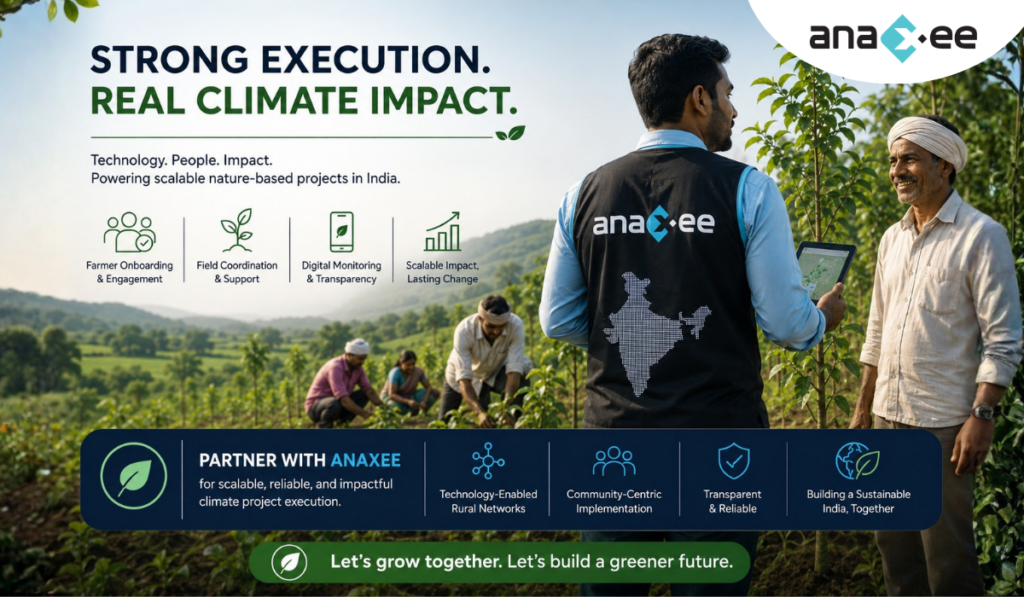
At Anaxee, we understand that climate projects in India are fundamentally execution-driven.
From farmer onboarding and field coordination to digital monitoring and large-scale rural implementation, successful agroforestry projects require strong last-mile systems.
If your organization is exploring agroforestry carbon projects, community-based climate programs, or nature-based implementation models in India, Anaxee can help support scalable on-ground execution through technology-enabled rural networks.