
If you ask most companies how their retail expansion is going, you’ll hear numbers.
- “We added 5,000 retailers”
- “We opened 3 new states”
- “Our primary sales grew 40%”
But here’s the uncomfortable truth:
Most of this growth is misleading.
Because in India’s retail ecosystem — especially in non-FMCG and aftermarket categories —
what looks like expansion on paper often doesn’t translate into real market presence.
And this is where most brands get it wrong.
The Illusion of Growth: Primary Sales vs Reality
In almost every sales review, there are three numbers:
- Primary sales (company → distributor)
- Secondary sales (distributor → retailer)
- Tertiary sales (retailer → end customer)
Most companies celebrate primary sales.
But primary sales only tell you one thing:
how much stock you pushed into the system — not how much actually sold.
As highlighted in your podcast discussion:
Primary sales can be the most dangerous number in the room
Why?
Because stock can sit:
- In distributor warehouses
- On retailer shelves (without movement)
- Or worse, be pushed through discounting later
So while dashboards show growth, the market reality stays weak.
The Real Battlefield Is Not Distribution — It’s Execution
Many brands think expansion = appointing distributors.
But in India, especially in categories like:
- Tyres
- Batteries
- Lubricants
- Electricals
- Agri-inputs
Distribution alone does not create demand.
Retail is not a supply chain problem.
It’s an execution problem.
Because:
- Retailers don’t push every brand they stock
- Mechanics influence buying decisions
- Credit cycles control product movement
- Shelf space is political, not logical
So even if your product reaches 10,000 outlets,
it doesn’t mean it is being sold.
Distributor Is Not Your Market — Retailer Is
This is one of the biggest mindset gaps.
Many companies treat distributors as their primary customer.
But ask a simple question:
👉 Who actually decides whether your product sells?
- The distributor? → No
- The retailer? → Partially
- The mechanic / influencer? → Often yes
So the real chain is:
Brand → Distributor → Retailer → Influencer → Customer
If you lose control at any point,
you lose the market.
And this happens more often than companies admit.
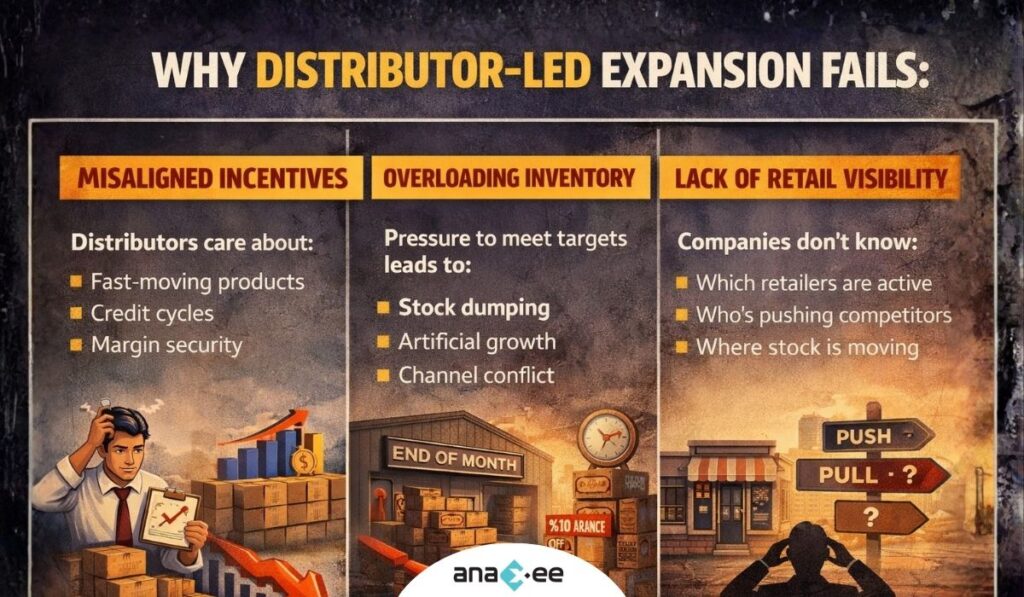
Why Distributor-Led Expansion Fails
Companies spend months selecting the “right distributor.”
But most distributor relationships fail because:
1. Misaligned Incentives
Distributors care about:
- Fast-moving products
- Credit cycles
- Margin security
Not your long-term brand building.
2. Overloading Inventory
End-of-month pressure leads to:
- Stock dumping
- Artificial growth
- Channel conflict
Which later results in:
- Dead stock
- Discount wars
- Brand dilution
3. Lack of Retail Visibility
Most companies don’t know:
- Which retailers are active
- Which ones are pushing competitors
- Where stock is actually moving
So decisions are made on assumptions, not reality.
The Most Underrated Insight: Retail Intelligence Lives in People
One of the most powerful observations from your document:
The real intelligence is in people’s heads — distributors and field reps
This includes:
- Which retailer is creditworthy
- Which shop owner influences demand
- Which mechanic prefers which brand
And here’s the problem:
👉 This knowledge is never structured or scalable
So when:
- A salesperson leaves
- A distributor changes
- A region expands
You lose everything.
Why Technology Alone Doesn’t Fix This
Today, companies are investing in:
- CRM tools
- SFA apps
- DMS systems
- GPS tracking
But let’s be honest:
Most of this improves reporting — not reality.
Because:
- Data is often manually entered
- Field teams optimize for targets, not truth
- Ground behavior doesn’t match dashboards
So instead of solving the problem,
technology often makes the gap more sophisticated.
The Moment You Lose Control of Your Brand
A critical question raised in your document:
When does a brand lose control of its product?
The answer is uncomfortable:
You lose control at multiple points:
- When it enters distributor inventory
- When a retailer hides it behind competitors
- When a mechanic recommends something else
At that point:
- Pricing becomes inconsistent
- Visibility disappears
- Positioning breaks
And your brand becomes just another option.
Push vs Pull: The Transition Most Brands Never Achieve
Most aftermarket brands start as push brands:
- Driven by schemes
- Dependent on distributor push
- Focused on availability
But the goal is to become a pull brand:
- Retailers ask for it
- Mechanics recommend it
- Customers trust it
The problem?
👉 Many brands stay stuck in push forever.
Because they never invest in:
- Retail relationships
- Last-mile visibility
- Consistent execution
The Core Problem: Last-Mile Execution Is Broken
If we simplify everything:
👉 The biggest gap is not strategy — it’s execution.
Companies know what to do:
- Expand distribution
- Activate retailers
- Build demand
But they fail at:
- Doing it consistently
- Doing it at scale
- Doing it transparently
What Companies Consistently Get Wrong
Based on real ground patterns:
Underinvested:
- Retail activation
- Retail intelligence
- Last-mile monitoring
Overinvested:
- Trade schemes
- Distributor margins
- Top-level marketing
This creates an imbalance where:
👉 Money is spent, but outcomes don’t scale.
So What Actually Works?
To win in Indian retail, especially in non-FMCG:
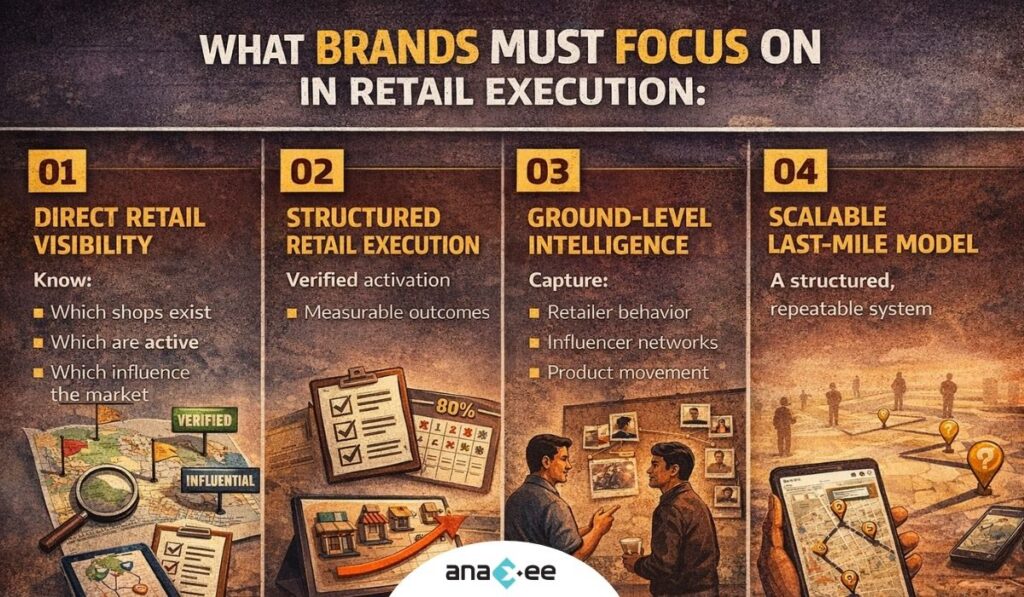
You need to focus on:
1. Direct Retail Visibility
Know:
- Which shops exist
- Which are active
- Which influence the market
2. Structured Retail Execution
Not random visits — but:
- Planned coverage
- Verified activation
- Measurable outcomes
3. Ground-Level Intelligence
Capture:
- Retailer behavior
- Influencer networks
- Product movement
4. Scalable Last-Mile Model
Not dependent on:
- Individual sales reps
- Distributor assumptions
But on:
- A structured, repeatable system
What This Means for Your Business
If you’re a brand in:
- Automotive aftermarket
- Electricals
- Industrial products
- Agri-inputs
Then this is the reality:
👉 Your growth is not limited by product quality
👉 It is limited by retail execution
And unless you fix that:
- Expansion will stay superficial
- Sales will remain inconsistent
- Brand building will stall