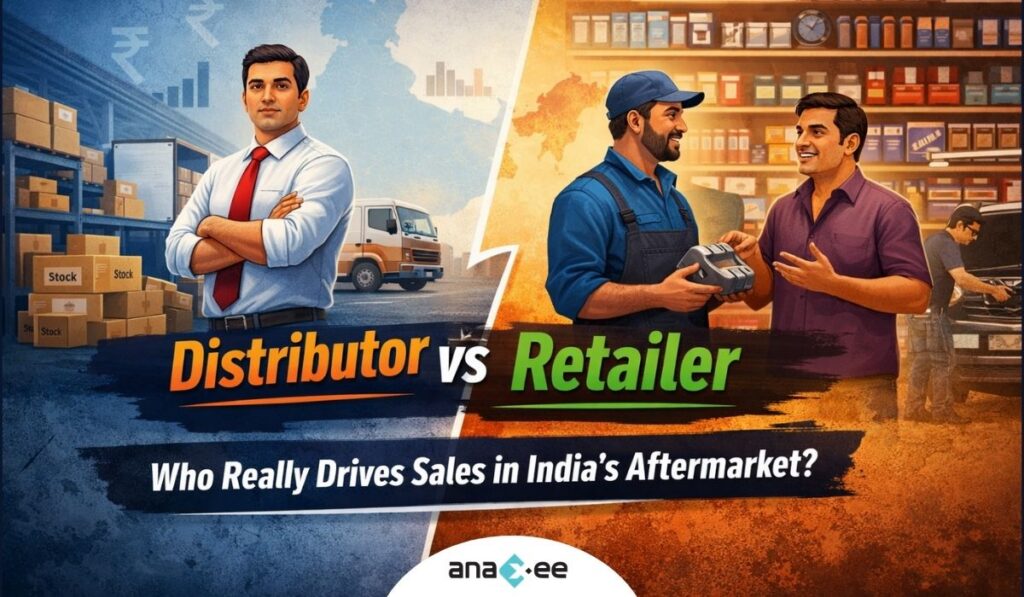

If you walk into any sales review meeting, there’s one silent assumption everyone operates on:
👉 “If the distributor is strong, the market will grow.”
Sounds logical.
But in India’s aftermarket ecosystem —
this assumption is deeply flawed.
Because the distributor doesn’t control your sales.
The retailer does.
And in many cases —
even the retailer doesn’t have the final say.
Let’s Break the Myth First
Companies typically structure their thinking like this:
Brand → Distributor → Retailer → Customer
So naturally, they focus on:
- Appointing strong distributors
- Giving them schemes
- Tracking primary and secondary sales
And assume growth will follow.
But what actually happens on the ground is different:
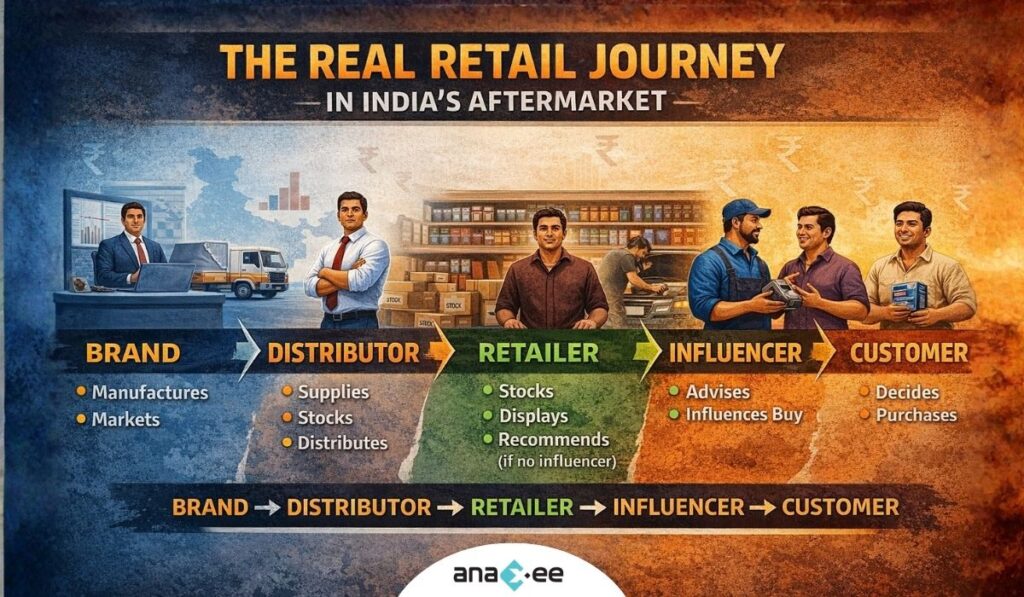
Brand → Distributor → Retailer → Influencer → Customer
That one extra layer — influencer (mechanic, electrician, technician) —
completely changes how sales move.
The Distributor’s Role: Important, But Limited
Let’s be clear — distributors matter.
They handle:
- Inventory
- Credit
- Logistics
- Market reach
But here’s what they don’t control:
- Which product gets recommended
- Which brand gets shelf visibility
- Which SKU actually sells
Their job is to enable supply, not create demand.
So Why Do Companies Over-Rely on Distributors?
Because distributors are:
- Easy to measure
- Easy to manage
- Easy to scale (on paper)
You can:
- Appoint 50 distributors
- Expand to 5 states
- Show growth in dashboards
But none of this guarantees:
👉 Retail movement
👉 Brand recall
👉 Market share
This is why many companies scale distribution —
but not sales.
The Retailer Reality: Where the Market Actually Moves
Now let’s shift focus to the retailer.
In aftermarket categories, retailers:
- Decide what to stock actively
- Decide what to recommend (if no influencer involved)
- Decide how visible your product is
And most importantly:
👉 They prioritize what works for them — not for you
That includes:
- Better margins
- Faster movement
- Lower risk
- Strong relationships
So even if your product is available:
- It may sit in the back
- It may not be pushed
- It may be replaced by a competitor
The Hidden Layer: Influencers Control Conversion
Here’s where most strategies break.
In categories like:
- Tyres
- Batteries
- Lubricants
- Electricals
The final decision is often made by:
👉 Mechanics
👉 Electricians
👉 Technicians
And their behavior is driven by:
- Trust
- Habit
- Incentives
- Brand familiarity
So even if:
- Distributor stocks your product
- Retailer displays it
If the influencer prefers another brand —
you lose the sale.
A Hard Truth: Availability ≠ Sales
This is where most companies misread the market.
They think:
👉 “If we are available in 10,000 outlets, we will grow.”
Reality:
👉 You may be available in 10,000 outlets
👉 But active in only 2,000
And selling in maybe 500.
The rest is just:
- Passive stock
- Dead inventory
- False confidence
PUSH vs PULL: Where This Confusion Begins
This distributor vs retailer debate is actually tied to a deeper concept:
PUSH Model:
- Driven by distributors
- Powered by schemes
- Focused on availability
PULL Model:
- Driven by demand
- Built through retailers & influencers
- Focused on preference
Most aftermarket brands start with PUSH.
But here’s the problem:
👉 Many never transition to PULL.
Because they stay dependent on:
- Distributor incentives
- Trade schemes
- Short-term sales pushes
When Does a Brand Actually Become a PULL Brand?
Not when you increase ads.
Not when you increase distributors.
You become a PULL brand when:
- Retailers start asking for your product
- Influencers start recommending it
- Customers recognize your name
And that only happens when:
👉 You win at the last mile consistently
Why Distributor-First Strategy Breaks at Scale
At small scale, distributor-led growth works.
At large scale, it fails.
Why?
1. Loss of Control
You don’t control:
- Pricing
- Visibility
- Positioning
2. Data Blindness
You don’t know:
- Which retailers are active
- Where your product is moving
- Where you’re losing
3. Execution Gaps
Even with strong distributors:
- Retail visits are inconsistent
- Activation is unverified
- Schemes don’t reach the ground
The Core Shift: From Channel Thinking to Market Thinking
Most companies think in terms of:
👉 Channels (Distributor, Retailer)
But winning companies think in terms of:
👉 Market behavior
Which includes:
- Retailer preferences
- Influencer networks
- Local demand patterns
This shift changes everything.
So Who Really Drives Your Sales?
Let’s answer the question directly:
| Layer | Role in Sales |
|---|---|
| Distributor | Enables supply |
| Retailer | Enables visibility |
| Influencer | Drives decision |
| Customer | Completes purchase |
👉 Your sales are driven by the combination of retailer + influencer — not distributor alone
What This Means for Your GTM Strategy
If you are still:
- Investing heavily in distributor expansion
- Measuring success through primary sales
- Ignoring retailer-level data
Then you’re not building a market.
You’re just building a pipeline.
What Needs to Change
To actually drive sales, you need:
1. Direct Retail Engagement
Not through distributor assumptions —
but through verified ground presence
2. Influencer Mapping
Know:
- Who influences purchase
- Where they operate
- What they prefer
3. Retail Activation
Ensure:
- Product visibility
- Retailer engagement
- Scheme execution
4. Ground Truth Data
Not dashboards — but:
- Real outlet-level insights
- Verified execution data
Where Most Companies Struggle
At this point, most companies realize the gap.
But they hit a wall:
👉 “How do we do this at scale?”
Because:
- Hiring large field teams is expensive
- Managing them is complex
- Data becomes unreliable
So they fall back to:
👉 Distributor-led execution again
And the cycle repeats.