
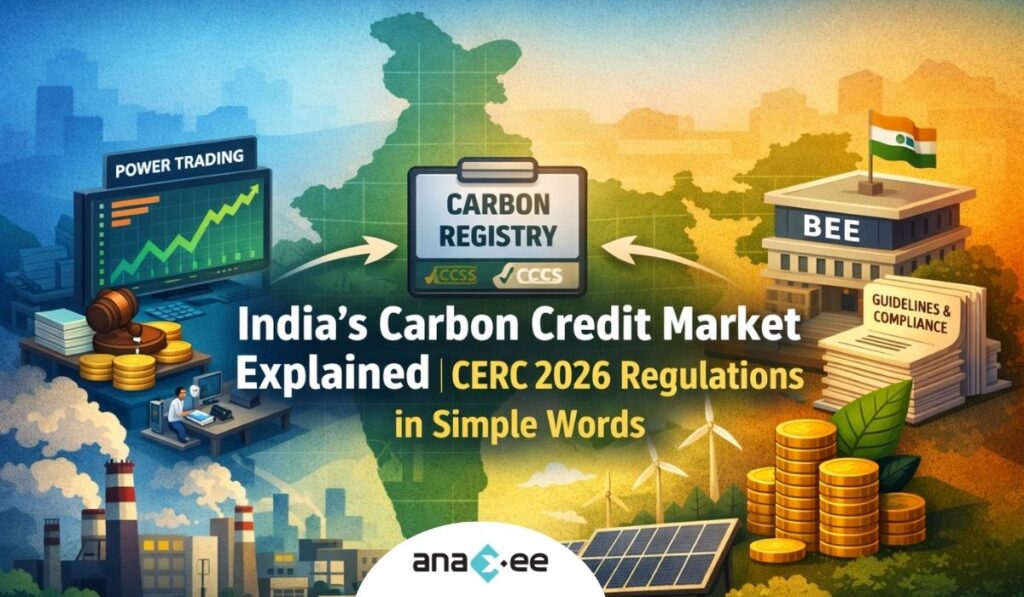

India has officially taken a big step toward building its own carbon market.
With the release of the CERC (Terms and Conditions for Purchase and Sale of Carbon Credit Certificates) Regulations, 2026, the government is no longer just talking about climate goals — it is creating a real system where carbon becomes tradable.
But if you try reading the regulation directly, it feels like legal language with too many definitions and cross-references.
So let’s break it down in simple terms.
What Is India Trying to Build?
At its core, India is building a carbon trading system.
This means:
- Companies that reduce emissions → earn carbon credits
- Companies that emit more → must buy those credits
Instead of forcing every company to reduce emissions equally, the government is allowing a market-based approach.
👉 In simple words:
Pollution now has a price.
What Is a Carbon Credit?
A carbon credit represents:
👉 1 ton of carbon dioxide (CO₂) reduced, removed, or avoided
If a company reduces emissions by 1000 tons → it earns 1000 credits
If another company exceeds limits → it must buy credits
This creates financial value for climate action
Why This Regulation Matters Now
India already launched the Carbon Credit Trading Scheme (CCTS) in 2023.
But that was just the framework.
This 2026 regulation answers the real questions:
- Where will trading happen?
- Who can participate?
- How will pricing work?
- Who will monitor the system?
👉 In short:
This regulation makes the carbon market operational
Who Are the Key Players in This System?
Understanding the system starts with understanding the participants.
1. Obligated Entities
These are companies that are required to meet emission targets.
Typically includes:
- Cement companies
- Steel plants
- Power producers
- Large industrial units
If they fail to meet targets → they must buy carbon credits
2. Non-Obligated Entities
These are voluntary participants.
Examples:
- Companies running sustainability projects
- Carbon project developers
- Renewable energy players
They can generate and sell credits
3. Bureau of Energy Efficiency (BEE)
BEE acts as the administrator of the system.
Its role includes:
- Creating procedures
- Monitoring transactions
- Ensuring compliance
- Sharing market data
4. Registry (Grid Controller of India)
Think of this as a bank for carbon credits
- Stores credits digitally
- Tracks ownership
- Updates accounts after each trade
5. Power Exchanges
This is where trading actually happens.
Instead of creating a new platform, India will use existing power exchanges.
👉 That’s a strategic decision:
It reduces friction and speeds up adoption.
How Carbon Credit Trading Works (Simple Flow)
Let’s simplify the entire process:
Step 1
A company reduces emissions → earns carbon credits
Step 2
Credits are issued and stored in the registry
Step 3
Company lists credits on a power exchange
Step 4
Another company buys those credits
Step 5
Registry updates ownership
Two Types of Carbon Markets in India
One of the most important parts of the regulation is this:
👉 India is creating two separate markets
1. Compliance Market
- Mandatory participation
- Only for obligated entities
- Used to meet emission targets
This is where real demand will come from
2. Offset Market
- Voluntary participation
- Open to non-obligated entities
- Used for ESG goals and sustainability claims
This is closer to today’s voluntary carbon market
Where Will Trading Happen?
This regulation clearly states:
👉 Carbon credits will be traded mainly on power exchanges
And not through random bilateral deals (unless allowed later).
This ensures:
- Transparency
- Standard pricing
- Better regulation
How Is Price Decided?
Pricing is market-driven, but not completely free.
There are two important controls:
1. Floor Price
Minimum price → prevents market crash
2. Forbearance Price
Maximum price → prevents extreme spikes
Why This Matters
In earlier carbon markets globally:
- Prices crashed → no incentive to reduce emissions
- Or prices spiked → industries resisted
India is trying to balance both extremes
Key Rule: You Can’t Cheat the System
The regulation has strict checks:
- You cannot sell more credits than you own
- Registry verifies all trades
If violated:
- Your bids are cancelled
- Repeated violations → 6-month ban from trading
👉 This is critical for market credibility
Trading Frequency
- Trading will happen monthly (or as decided)
This is important because:
- It avoids excessive speculation
- Keeps the market controlled in early stages
What Is Banking and Surrender?
Two important concepts:
Banking
You can save credits for future use
Surrender
You submit credits to meet compliance
Government Oversight: Not a Free Market
This is not a completely open market.
The regulator can intervene if:
- Prices become unstable
- Sudden spikes or crashes happen
- Trading becomes abnormal
👉 This is a controlled market, not a free-for-all
What This Means for Businesses
Let’s get practical.
If You Are a Large Industrial Company
- You will likely become an obligated entity
- You need to:
- Track emissions
- Plan reduction strategies
- Buy credits if needed
If You Are a Carbon Project Developer
This is where opportunity opens up.
- You can generate credits
- Sell into a regulated domestic market
- Build long-term revenue streams
If You Are a Corporate ESG Team
- Offset market gives you a domestic alternative
- You don’t have to depend only on global carbon markets
The Reality: Will This Market Work?
This is where most blogs stop—but this is the important part.
A carbon market only works if:
1. Targets are strict
If targets are weak → no demand for credits
2. Pricing is meaningful
If prices are too low → no incentive
3. Enforcement is strong
If compliance is weak → system collapses
India’s Challenge
India is trying to balance:
- Economic growth
- Industrial pressure
- Climate commitments
That’s not easy.
Final Thoughts
The CERC 2026 regulation is not just another policy document.
It is the execution layer of India’s carbon market.
For the first time:
- Carbon becomes tradable in a regulated system
- Companies are financially accountable for emissions
- A domestic climate economy starts taking shape
One Simple Way to Understand This
👉 Earlier: Pollution was a cost nobody paid
👉 Now: Pollution becomes a cost someone must buy
If implemented properly, this system can:
- Create new climate businesses
- Drive real emission reductions
- Build India’s position in global carbon markets
If not, it risks becoming another underperforming compliance mechanism.