
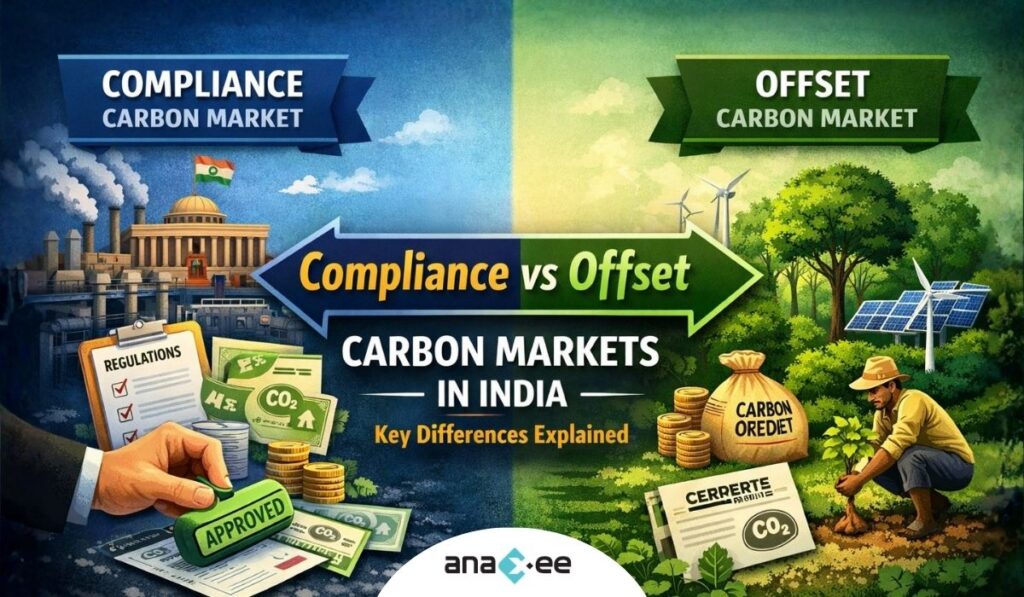

Two Markets, One System — But Completely Different Logic
India’s carbon market is not a single uniform system.
It has two separate segments:
- Compliance Market
- Offset Market
At first glance, both involve carbon credits.
But the motivation, demand, and behavior in these markets are very different.
Understanding this difference is critical.
What Is the Compliance Market?
The compliance market is mandatory.
Companies classified as “obligated entities” must:
- Meet emission targets
- Or buy carbon credits
Who Participates?
Typically:
- Cement companies
- Steel plants
- Power generators
- Energy-intensive industries
What Drives Demand?
Not ESG.
Not branding.
👉 Regulation
If a company fails to meet targets:
- It must buy credits
- Or face penalties
Key Characteristics
- Predictable demand
- Policy-driven
- Lower flexibility
- Higher stability (if enforced properly)
What Is the Offset Market?
The offset market is voluntary.
Companies choose to buy credits.
Why Do They Buy?
- ESG commitments
- Net-zero goals
- Sustainability reporting
- Brand positioning
Who Participates?
- Corporates
- Multinationals
- ESG-focused investors
Key Characteristics
- Demand is uncertain
- Driven by perception and strategy
- More flexible
- More volatile
The Core Difference (Simplified)
👉 Compliance market = “You have to buy”
👉 Offset market = “You choose to buy”
This one difference changes everything.
Why Compliance Market Will Drive Early Growth
In the early stages:
- Compliance market will dominate
Because:
- Demand is guaranteed
- Participation is enforced
Why Offset Market Matters Long-Term
Over time:
- Offset market can grow larger
But only if:
- ESG pressure increases
- Carbon disclosure becomes serious
- Buyers demand high-quality credits
Risk: Weak Compliance = Weak Market
This is the biggest risk.
If:
- Targets are too lenient
- Enforcement is weak
Then:
👉 No one needs to buy credits
And the entire market weakens.
Risk: Weak Offset Demand
On the voluntary side:
- Companies may delay action
- ESG budgets may shrink
- Cheap global credits may dominate
Where Real Opportunity Lies
Let’s be practical.
Short-Term Opportunity
👉 Compliance market
Because:
- Demand is forced
- Market will activate faster
Long-Term Opportunity
👉 Offset market
Because:
- Scale potential is larger
- More participants can enter
Strategic Insight for Businesses
If you are:
A Project Developer
Focus on:
- Compliance-ready credits
- Strong verification
- Scalability
A Corporate Buyer
Understand:
- Difference between obligation and branding
- Risk of low-quality credits
A Market Participant
Don’t mix both markets blindly.
👉 They behave differently
Final Thought
India has not created one carbon market.
It has created:
👉 Two markets with different psychology
Understanding this is the difference between:
- Strategic positioning
- And random participation
About Anaxee:
Anaxee drives large-scale, country-wide Climate and Carbon Credit projects across India. We specialize in Nature-Based Solutions (NbS) and community-driven initiatives, providing the technology and on-ground network needed to execute, monitor, and ensure transparency in projects like agroforestry, regenerative agriculture, improved cookstoves, solar devices, water filters and more. Our systems are designed to maintain integrity and verifiable impact in carbon methodologies.
Beyond climate, Anaxee is India’s Reach Engine- building the nation’s largest last-mile outreach network of 100,000 Digital Runners (shared, tech-enabled field force). We help corporates, agri-focused companies, and social organizations scale to rural and semi-urban India by executing projects in 26 states, 540+ districts, and 11,000+ pin codes, ensuring both scale and 100% transparency in last-mile operations. Connect with Anaxee at sales@anaxee.com