
Let’s start with a blunt truth:
👉 Most aftermarket brands in India are not growing.
They are pushing.
And there’s a big difference.
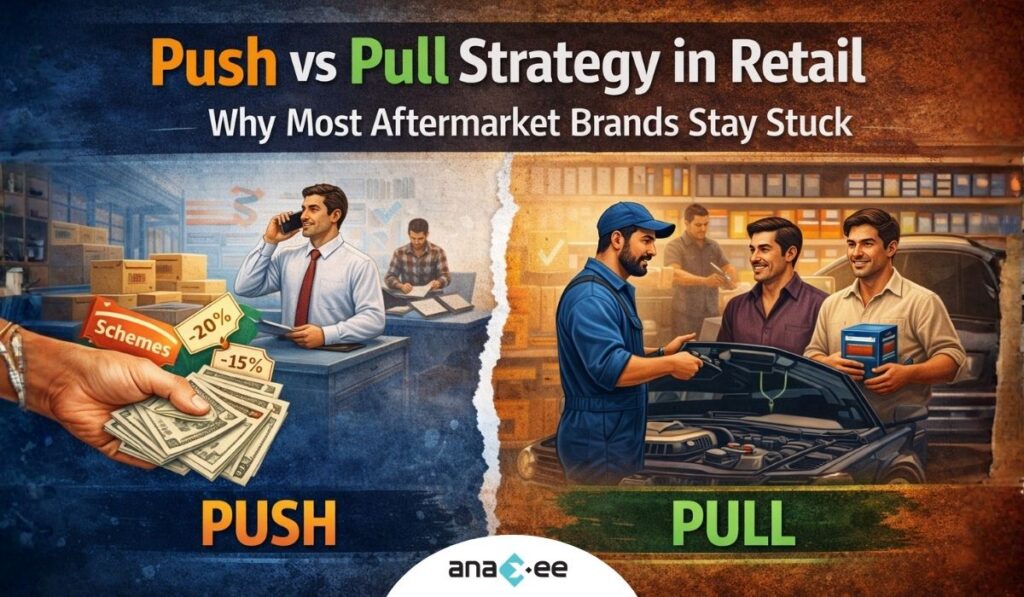
Because pushing creates movement of stock.
Pulling creates movement of demand.
And confusing the two is where most companies get stuck for years.
What a Push Strategy Actually Looks Like
If your growth depends on:
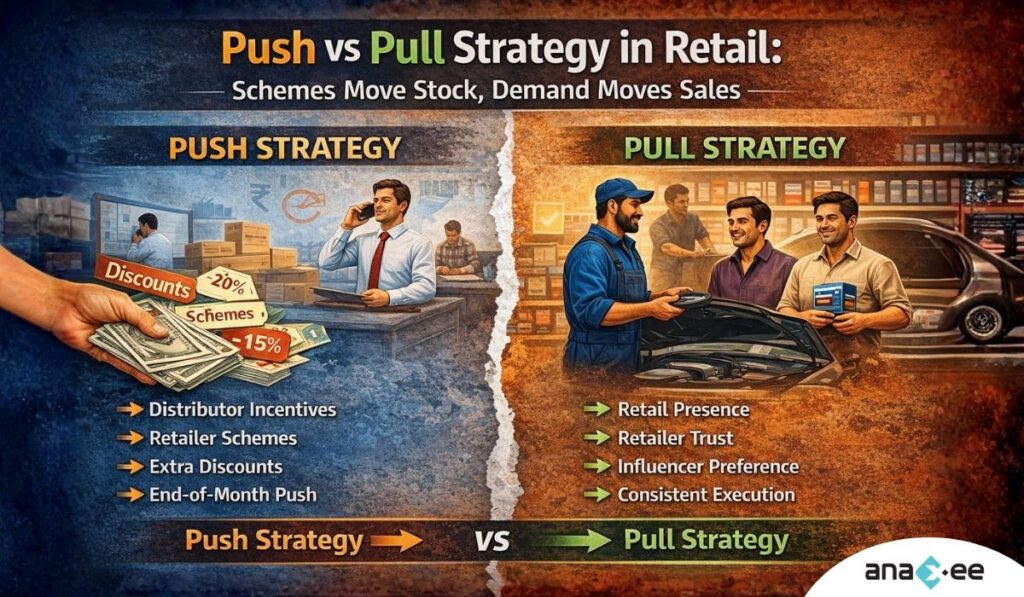
- Distributor incentives
- Retailer schemes
- Extra margins
- End-of-month pushing
Then you are running a push strategy.
And it usually looks like this:
- Sales spike at month-end
- Distributors overloaded with stock
- Retailers buying for schemes, not demand
- Discounts driving decisions
On paper, it looks like growth.
On ground, it’s unstable.
Why Push Feels Like It Works
Push strategies survive because they give immediate results:
- Quick sales numbers
- Easy distributor alignment
- Short-term target achievement
It gives control.
You can “force” the market.
But here’s the catch:
👉 You are not building demand.
👉 You are borrowing it.
And borrowed demand always comes back to hurt you.
The Hidden Cost of Push
Push doesn’t fail immediately.
It fails slowly — and then suddenly.
1. Margin Erosion
Every quarter, you need:
- Bigger schemes
- Higher discounts
- More incentives
Your brand becomes dependent on price.
2. Retailer Loyalty Becomes Transactional
Retailers don’t believe in your brand.
They believe in:
👉 “Which company is giving more today?”
So:
- Today it’s you
- Tomorrow it’s your competitor
3. Inventory Distortion
Stock moves, but not evenly.
You get:
- Overstock in some areas
- Stock-outs in others
- No clarity on real demand
4. Brand Dilution
When a brand is always sold on schemes:
👉 It is never chosen on merit.
And once that happens,
it’s very hard to reverse.
The Illusion of Control
Push gives companies a dangerous illusion:
👉 “We are driving the market.”
Reality:
👉 The market is responding to incentives — not preference.
The moment you remove schemes:
- Sales drop
- Retailers shift
- Distributors slow down
That’s not growth.
That’s dependency.
What a Pull Strategy Actually Means
Now let’s flip it.
A pull strategy is when:
- Retailers want to stock your product
- Influencers recommend your brand
- Customers ask for it
And this happens without forcing the channel.
How Pull Actually Gets Created
This is where most companies oversimplify.
They think pull = advertising.
It’s not.
In aftermarket categories, pull is built through:
1. Retail Presence
Not just availability — but:
- Visibility
- Placement
- Consistency
2. Retailer Trust
Retailers push brands that:
- Move consistently
- Don’t create risk
- Have reliable supply
3. Influencer Preference
Mechanics/electricians recommend what they:
- Trust
- Know
- Have seen work
4. Consistent Execution
Pull is not a campaign.
It’s:
👉 Repeated, reliable presence at the last mile.
Why Most Brands Never Reach Pull
Because pull is harder.
It requires:
- Time
- Discipline
- Ground execution
And most companies:
- Want faster results
- Prefer scalable shortcuts
- Depend on schemes
So they stay in push.
The Transition Problem: Push → Pull
Every brand says:
👉 “We want to become a pull brand.”
But very few actually transition.
Why?
Because during the shift:
- Sales may slow down
- Schemes reduce
- Channel resistance increases
And companies panic.
So they go back to push.
The Real Shift Is Not Strategy — It’s Execution
This is the part most companies miss.
Push vs Pull is not just a marketing decision.
It’s an execution capability problem.
Because to build pull, you need:
1. Retail-Level Visibility
You must know:
- Where you are present
- Where you are active
- Where you are missing
2. Consistent Retail Activation
Not random visits — but:
- Planned coverage
- Verified execution
- Repeat engagement
3. Influencer Reach
You need to:
- Identify influencers
- Engage them
- Build preference over time
4. Ground Truth Data
Not assumptions — but:
- Real outlet-level insights
- Execution tracking
- Market feedback
Why Schemes Can’t Build Pull
Schemes can:
- Accelerate sales
- Support distribution
- Help initial entry
But they cannot:
👉 Build preference
👉 Build trust
👉 Build habit
And without these:
👉 Pull never happens.
A Hard Question Every Brand Should Ask
If you remove all schemes tomorrow:
👉 Will your product still sell?
If the answer is no —
you don’t have a market.
You have a mechanism.
What Winning Brands Do Differently
Brands that successfully move to pull:
- Invest in last-mile execution
- Focus on retailer relationships
- Build influencer networks
- Track real market behavior
They don’t eliminate push.
But they don’t depend on it.
The Real Insight
Push drives availability.
Pull drives preference.
And in the long run:
👉 Preference always wins.
What This Means for Your Business
If you are:
- Increasing schemes every quarter
- Struggling with inconsistent sales
- Seeing low retailer loyalty
Then you are not facing a sales problem.
👉 You are facing a demand creation problem.