
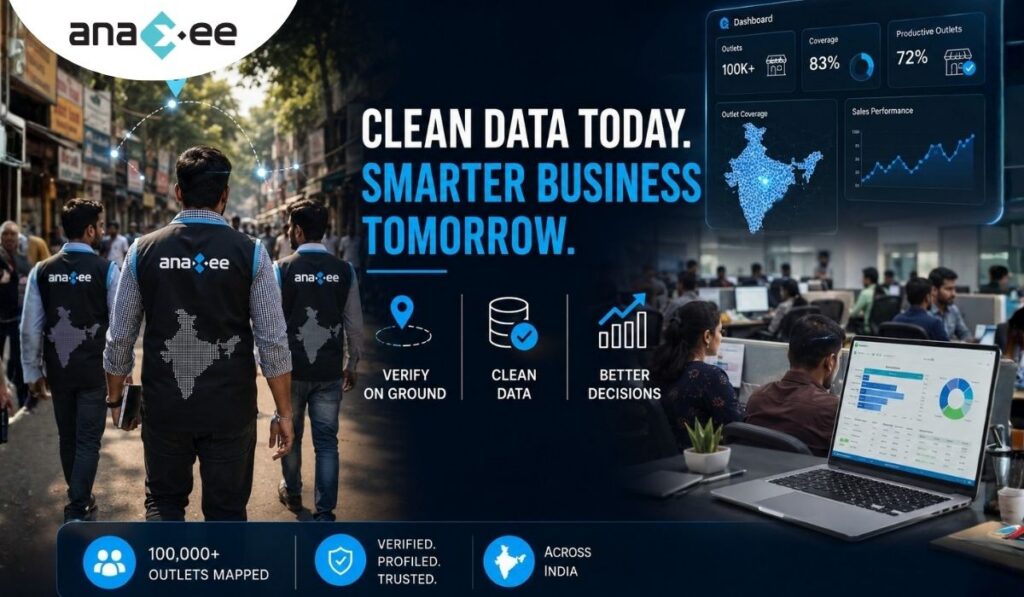

Every brand today wants to talk about AI.
AI-powered sales forecasting.
AI route planning.
AI-driven retailer targeting.
AI-led distributor intelligence.
AI dashboards predicting market expansion opportunities.
But very few brands are asking the most important question first:
Is the ground data even correct?
Because no matter how advanced the AI tool is, it still depends on the quality of the data underneath it.
And in Indian retail markets, that data is often badly broken.
Retailer lists that haven’t been updated for years.
Duplicate outlets inside CRMs.
Distributors working with outdated shop databases.
Sales teams visiting closed shops.
Route plans based on incorrect geotagging.
Coverage reports built on partially verified data.
The result?
Companies invest heavily in technology while the foundation itself remains weak.
It’s the business equivalent of building a warehouse on a cracked floor.
AI Cannot Fix Bad Ground Reality
There’s a dangerous assumption spreading across industries today:
“Once we implement AI tools, efficiency problems will automatically reduce.”
That rarely happens.
AI doesn’t magically create accurate information.
It simply processes the information you already have.
Which means:
- Bad retailer data creates bad market insights
- Wrong outlet mapping creates poor route optimization
- Duplicate records distort sales intelligence
- Inactive shops damage productivity tracking
- Incorrect geo-location impacts expansion planning
The AI system may look sophisticated on the surface.
But underneath, it is still running on broken field reality.
That’s why many GTM transformation projects quietly fail after large investments.
Not because the software was weak.
Because the data feeding it was unreliable.
The Hidden Cost of Dirty Retail Data
Most companies underestimate how expensive poor data actually becomes over time.
The damage compounds silently.
A sales rep visits 15 wrong shops every week.
A distributor follows outdated retailer records.
A territory manager analyses incorrect market coverage.
A leadership dashboard reports inflated outlet reach.
Over months and years, these errors become operational habits.
And once AI systems are layered on top, the scale of wrong decisions increases even faster.
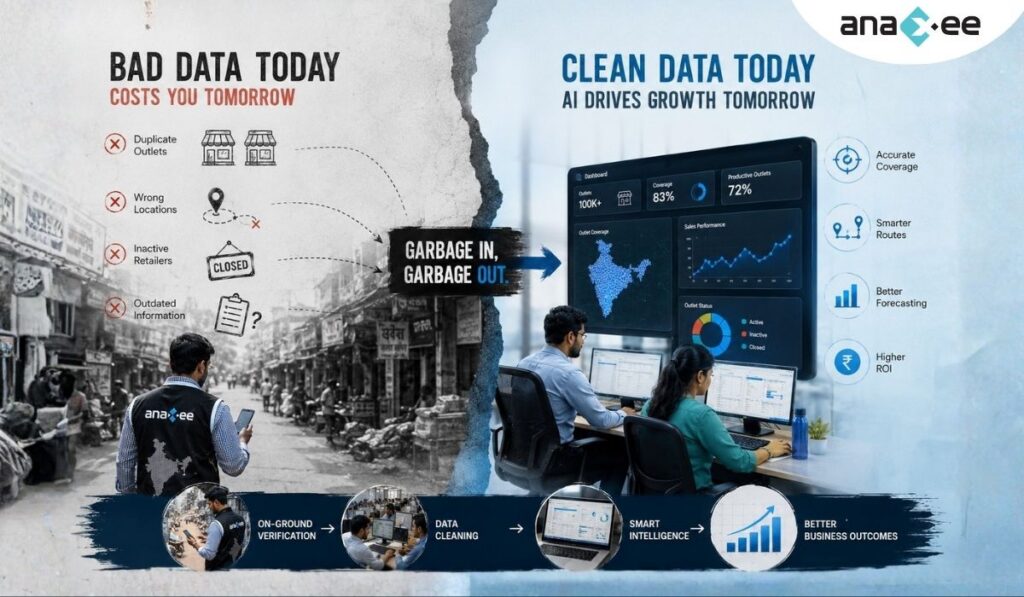
The bigger the organization becomes, the more expensive poor data becomes.
This is exactly why data quality is no longer just an IT issue.
It has become a GTM growth issue.
Why Retail Data Decays Faster Than Most Companies Realize
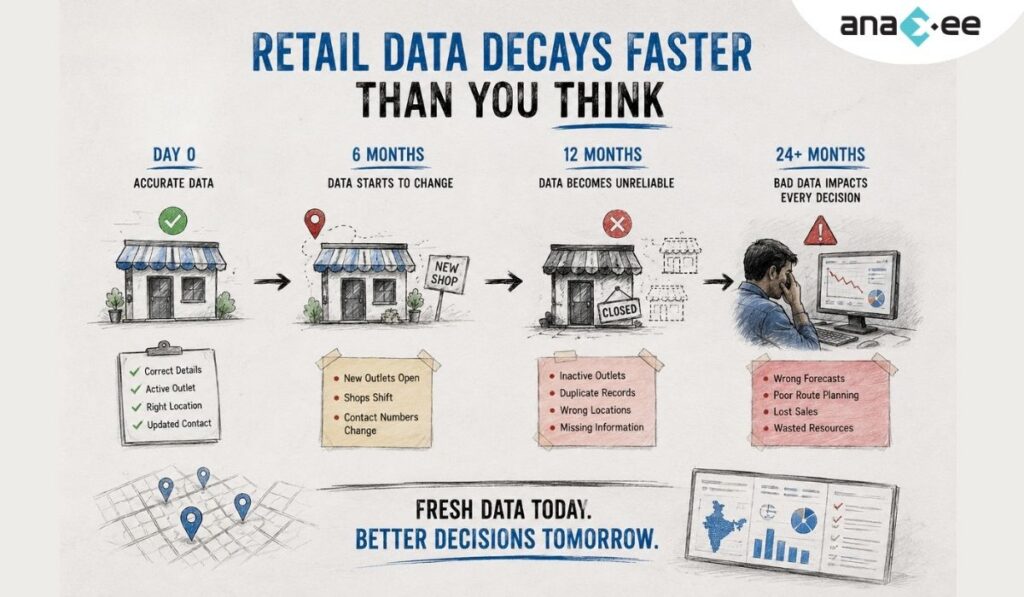
Retail markets are extremely dynamic.
Shops shut down.
New shops open.
Ownership changes.
Mobile numbers change.
Product categories shift.
Geotags become inaccurate.
Coverage patterns evolve.
In semi-urban and rural India, this movement happens constantly.
A retailer database that looked accurate 18 months ago may already be partially outdated today.
Yet many brands continue building sales plans, expansion strategies, and AI initiatives on that same stale database.
That creates a dangerous disconnect between dashboard reality and ground reality.
This Is Where Ground Verification Matters
Data quality cannot be solved only from a laptop.
At some point, someone still needs to physically validate the market.
That means:
- Verifying whether the shop actually exists
- Confirming retailer ownership
- Validating product availability
- Checking location accuracy
- Updating contact details
- Identifying duplicate records
- Mapping inactive outlets
- Confirming distributor linkage
This is operationally difficult at scale.
Especially across India’s fragmented retail ecosystem.
That’s why many organizations postpone it for years.
Until productivity starts falling.
Why Anaxee Is Built for This Problem
At Anaxee Digital Runners, field execution is not theoretical for us.
We’ve onboarded, mapped, profiled, surveyed, verified, and taken orders across more than 100,000 retail outlets through our large last-mile network.
That experience matters.
Because retail data quality is not just a software exercise.
It’s a field execution challenge.
You need systems.
You need process discipline.
You need verification logic.
You need on-ground validation capability.
Most importantly, you need people who understand how Indian retail actually behaves.
That’s where our approach becomes valuable.
Data Quality as a Service
This is why we believe every GTM transformation project should begin with a data quality check.
Before launching AI initiatives.
Before redesigning sales routes.
Before expanding distribution.
Before implementing automation layers.
Brands should first ask:
“How healthy is our existing retailer and distributor data?”
That’s the role of Data Quality as a Service.
Using Anaxee’s field-driven validation methods, brands can audit their existing databases and identify:
- Duplicate outlets
- Inactive retailers
- Incorrect geo-tags
- Wrong contact details
- Coverage gaps
- Outlet classification errors
- Distributor mismatch issues
- Data freshness problems
This creates a far stronger foundation for future GTM decisions.
Clean Data Creates Better AI Outcomes
The companies that will benefit most from AI over the next five years may not necessarily be the ones buying the most expensive tools.
They’ll likely be the companies with:
- Cleaner retailer databases
- Better field visibility
- Accurate market mapping
- Reliable distributor intelligence
- Consistent verification systems
Because AI amplifies operational quality.
If the inputs improve, the outputs improve.
Simple.
A Small Audit Can Prevent Large Future Costs
One of the biggest advantages of data-quality audits is prevention.
Fixing errors early is dramatically cheaper than correcting strategic mistakes later.
A simple verification exercise today can prevent:
- Misaligned sales territories
- Wasted retailer visits
- Incorrect expansion decisions
- Distributor inefficiencies
- Faulty AI predictions
- Poor route optimization
- Inflated market assumptions
The ROI often becomes visible much faster than expected.
The Real Competitive Advantage
Over the next three years, many brands will purchase similar AI tools.
Technology itself will become increasingly accessible.
But clean, verified, continuously updated retail data?
That will become the real competitive advantage.
Because most organizations still underestimate how difficult accurate field data actually is.
The brands that solve this early will move faster, expand smarter, and make better decisions.
Not because their dashboards look prettier.
Because their ground reality is more trustworthy.
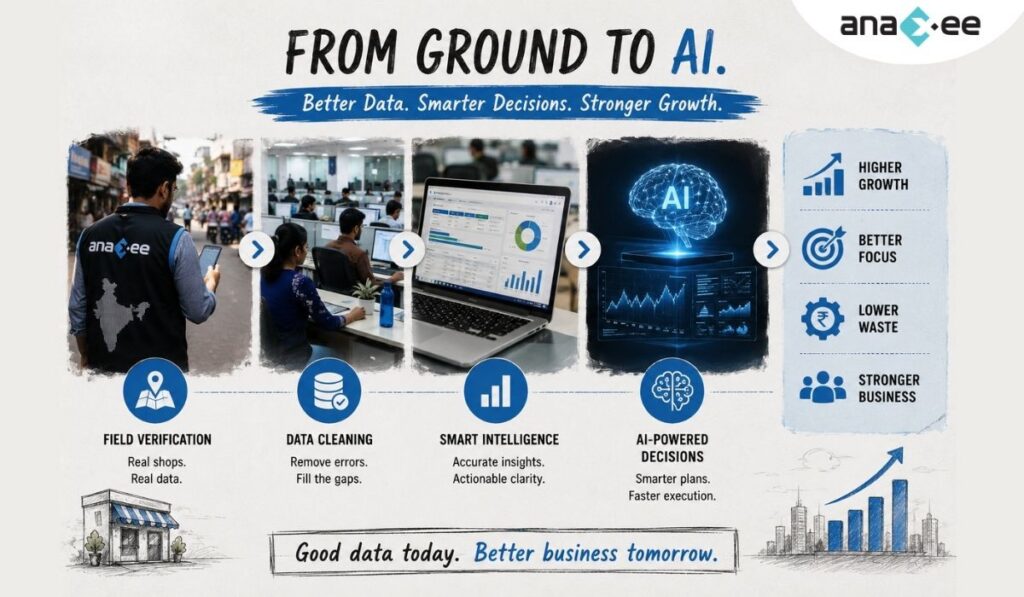
Final Thought
Before asking whether AI can improve your business, ask whether your data deserves AI in the first place.
Because even the smartest AI system cannot outperform broken field inputs.
Clean your retail data today.
Your future AI systems will depend on it.