
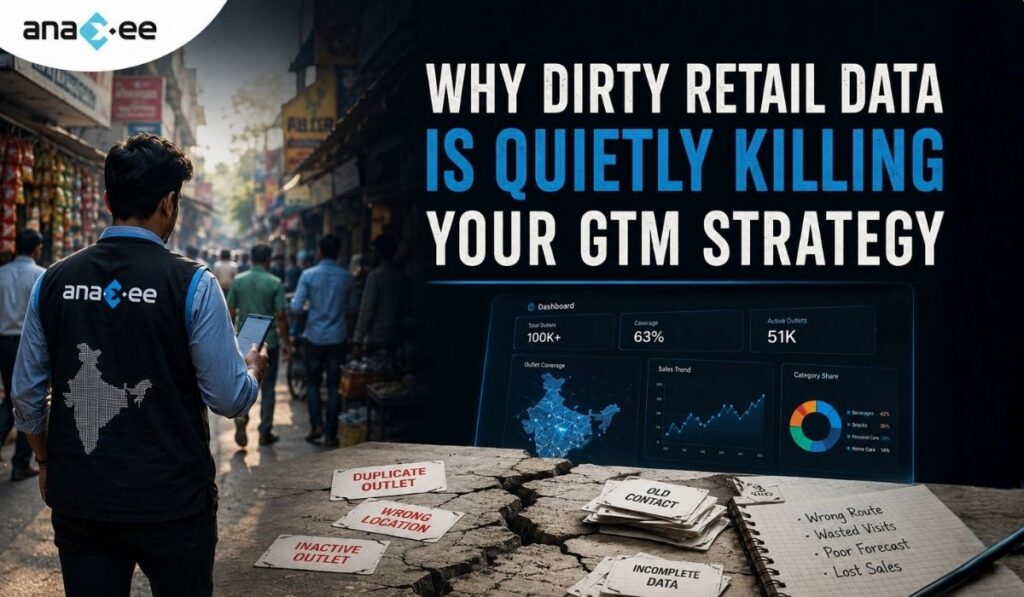

Most GTM problems do not start in the boardroom.
They start much earlier.
Inside outdated retailer lists.
Inside duplicate outlet records.
Inside wrong geo-tags.
Inside inactive distributor mappings.
Inside field data nobody has verified in years.
And the scary part?
Many companies don’t even realize how much damage this creates until growth starts slowing down.
The Invisible Problem Inside Modern GTM Systems
Today’s sales organizations rely heavily on digital systems.
CRMs.
Sales apps.
Route optimization tools.
Retail dashboards.
Distributor management platforms.
AI-based forecasting systems.
All of them depend on one thing:
Data quality.
But in reality, many retail databases contain serious ground-level inaccuracies.
The software may look advanced.
The dashboard may look impressive.
But the underlying market information is often outdated, fragmented, or partially incorrect.
That creates an invisible operational problem.
Everything appears efficient on the surface while execution quality quietly weakens underneath.
Dirty Data Creates Expensive Decisions
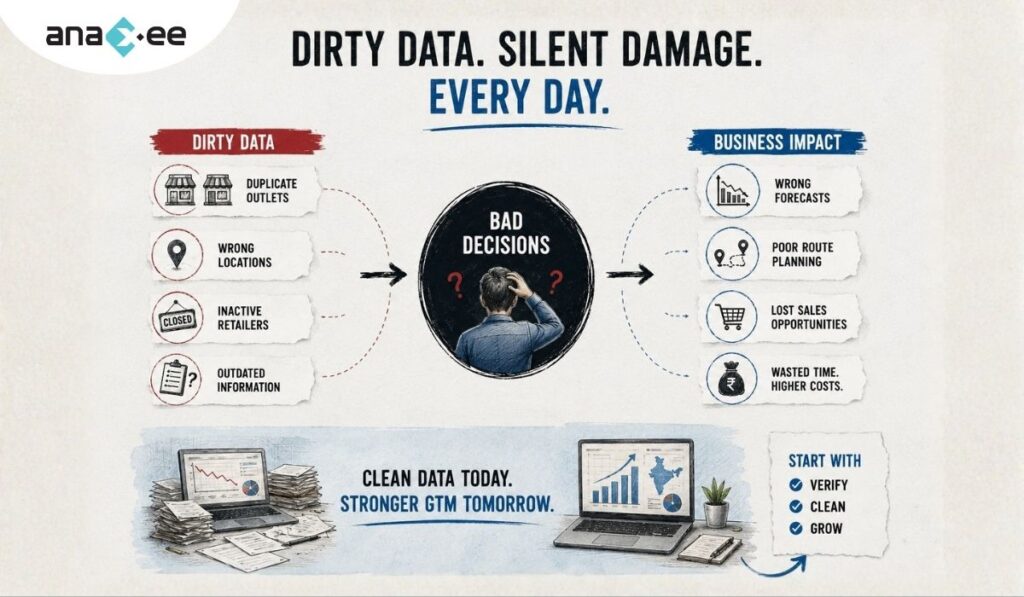
Bad retail data doesn’t only create reporting issues.
It affects actual business decisions.
For example:
A company may believe it has coverage in 15,000 outlets.
After verification, maybe only 10,500 are truly active.
A sales team may optimize routes using incorrect retailer locations.
Distributors may service duplicate outlets unknowingly.
Leadership teams may allocate budgets using distorted market visibility.
Over time, these small errors compound into major GTM inefficiencies.
And once AI systems start using this data, the scale of wrong recommendations increases further.
AI Is Only as Smart as the Data Feeding It
This is the biggest misconception in the current AI wave.
Many organizations think AI itself automatically creates intelligence.
It doesn’t.
AI identifies patterns from existing information.
If the input data is weak, incomplete, duplicated, or outdated, the system simply produces poor recommendations faster.
That’s why “Garbage In, Garbage Out” still matters more than ever.
The quality of your AI outcomes depends heavily on the quality of your retail data foundation.
Retail Markets Change Faster Than Dashboards
One major challenge in India is that retail markets evolve continuously.
Especially in semi-urban and rural markets.
Retailers shift locations.
New shops emerge.
Old outlets shut down.
Ownership changes frequently.
Product focus changes seasonally.
But databases often remain static for years.
Eventually, companies begin operating using an outdated version of the market.
That disconnect becomes dangerous during expansion planning.
The Real Cost of Unverified Retail Data
Most brands track visible expenses carefully.
But hidden inefficiencies caused by bad data are harder to notice.
For example:
- Sales reps visiting invalid outlets
- Duplicate retailer servicing
- Wrong distributor allocations
- Incorrect outlet segmentation
- Poor territory balancing
- Missed market opportunities
- Low field productivity
- Inflated coverage reporting
These issues reduce GTM efficiency slowly over time.
And because the problems accumulate gradually, companies often normalize them.
Why Field Verification Is Becoming Critical Again
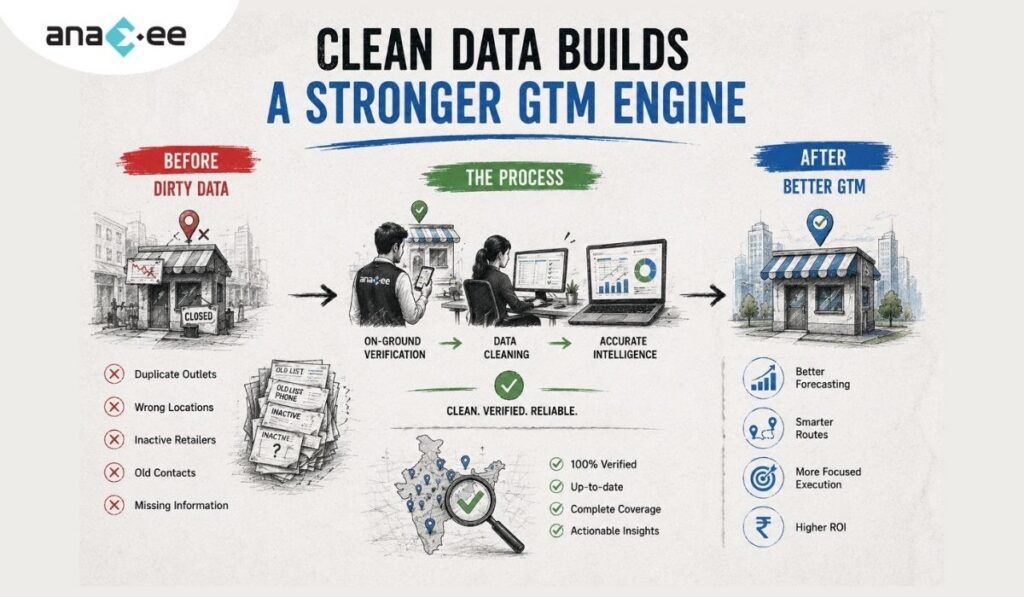
For years, companies assumed digital systems alone would solve market visibility problems.
But now the industry is realizing something important:
Retail intelligence still requires ground truth.
Someone still needs to physically verify reality.
That includes:
- Outlet existence checks
- Retailer profiling
- Contact validation
- Geo-tag verification
- Distributor linkage confirmation
- Market classification updates
Without field validation, databases eventually drift away from actual market conditions.
Why Anaxee’s Model Fits This Challenge
At Anaxee Digital Runners, our strength comes from combining technology with last-mile field execution.
We’ve worked across large-scale retail and outreach operations involving mapping, profiling, surveying, verification, and order-taking activities across thousands of locations.
That operational exposure gives us a different perspective on data quality.
We understand that retail data problems are not purely technical.
They are execution problems.
And execution problems require on-ground systems.
Introducing Data Quality as a Service
This is where Data Quality as a Service becomes strategically valuable.
Instead of replacing existing systems, brands can first evaluate how reliable their current retail and distributor data actually is.
A structured data-quality audit can identify:
- Duplicate retailer entries
- Inactive outlets
- Wrong geo-locations
- Incorrect retailer classification
- Missing contact information
- Distributor mismatches
- Data freshness gaps
Once these issues are corrected, every downstream system improves.
That includes:
- AI tools
- Route planning
- CRM effectiveness
- Sales productivity
- Market expansion planning
- Territory management
The Best AI Strategy May Start Offline
Ironically, some of the most valuable AI preparation work happens outside AI itself.
It starts with fixing field reality.
Because the companies that will scale successfully with AI are not necessarily the ones with the fanciest software stack.
They’ll be the ones operating on the cleanest, most trusted market data.
That advantage compounds over time.
Why This Matters Right Now
Retail competition is becoming more data-driven every year.
Brands are trying to expand faster while reducing inefficiencies simultaneously.
That pressure is increasing investment into automation and AI-led decision-making.
But automation built on inaccurate data only accelerates mistakes.
Which is why data quality is becoming a strategic growth layer, not just a backend cleanup task.
Final Thought
Before investing heavily in AI-led GTM transformation, companies should first ask a simpler question:
“How accurate is our current ground data?”
Because better technology cannot forever compensate for weak-field reality.
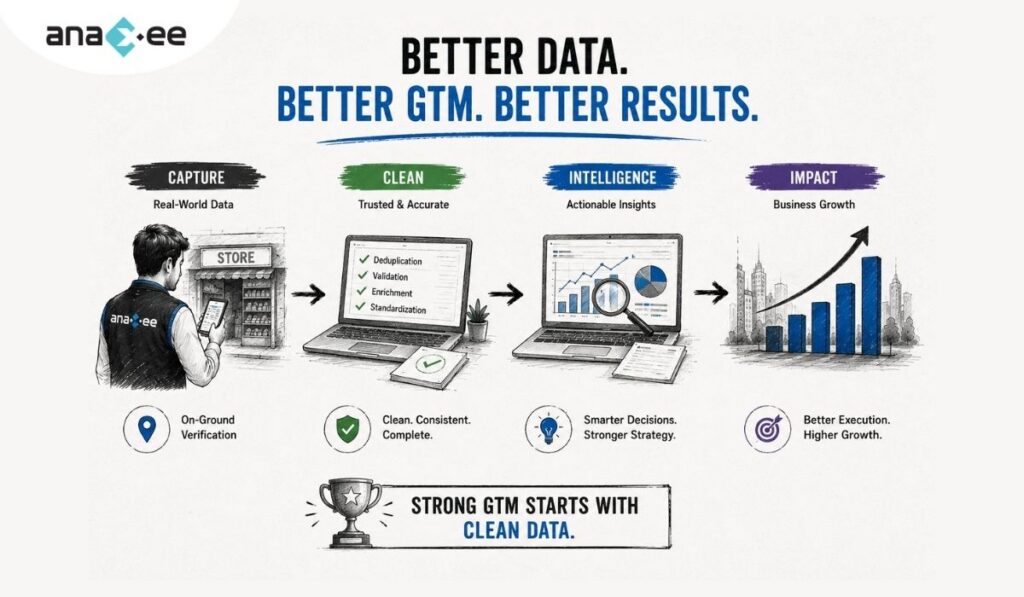
The brands that clean and verify their data today will likely make smarter, faster, and more profitable decisions tomorrow.
And in the coming AI-driven retail era, that advantage may become enormous.