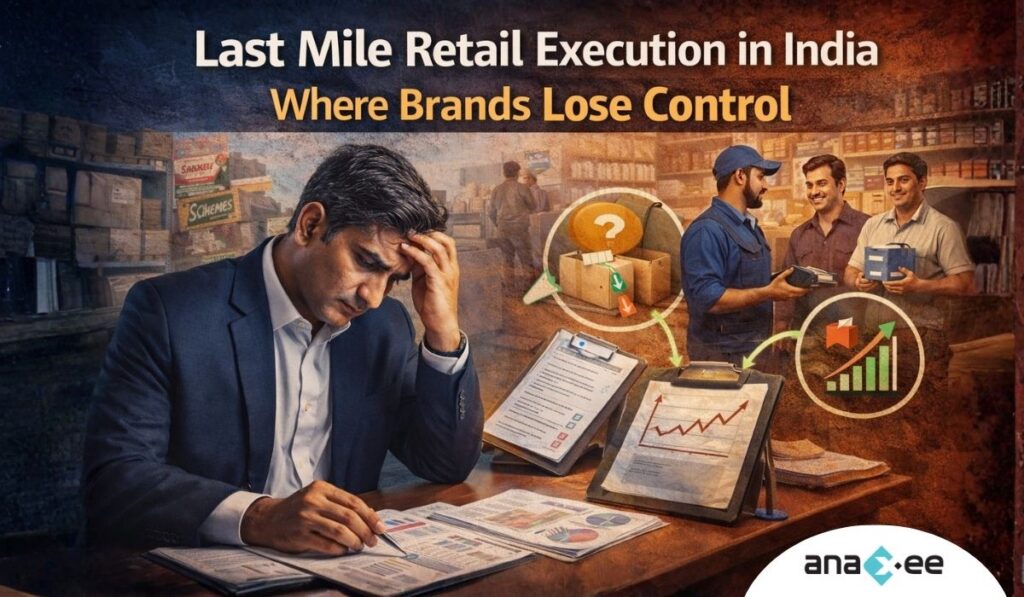

Most companies believe they lose control at the distributor level.
They don’t.
👉 They lose control at the last mile — quietly, gradually, and almost invisibly.
And by the time it shows up in numbers,
it’s already too late.
Let’s Start With an Honest Question
Do you know, right now:
- Which retailers are actively selling your product?
- Where your product is visible vs hidden?
- Which outlets are pushing your competitor?
If your answer is:
👉 “We have an idea”
or
👉 “Our distributor handles that”
Then you don’t have control.
You have assumptions.
Where Control Actually Breaks
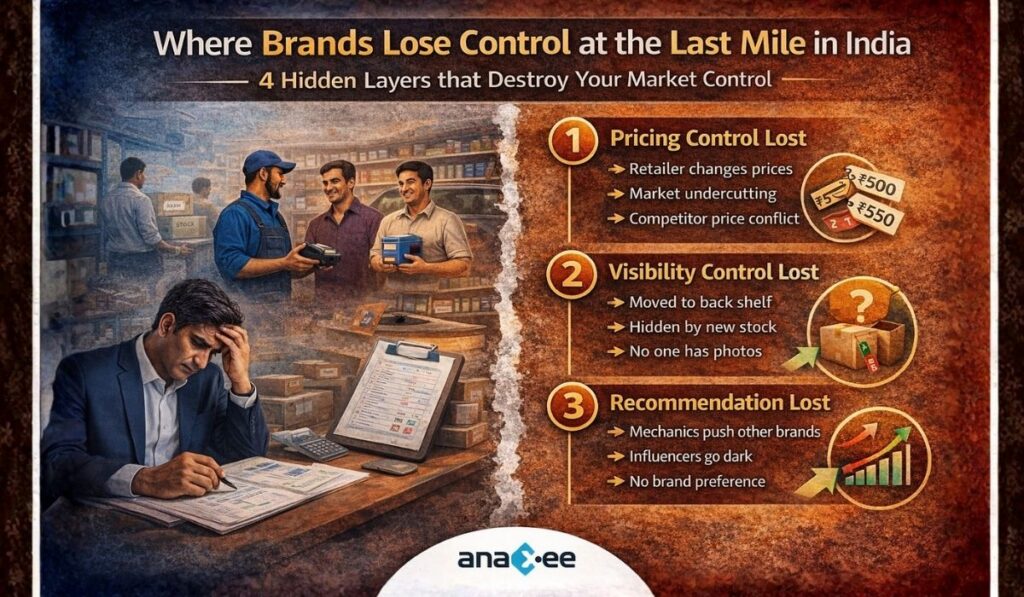
Brands don’t lose control in one place.
They lose it in layers.
1. Pricing Control Breaks First
Once your product leaves the distributor:
- Retailers adjust margins
- Discounts vary market to market
- Price undercutting starts
So:
👉 Same product, different price, same city
What happens next?
- Brand trust drops
- Channel conflict increases
- Premium positioning collapses
2. Visibility Control Disappears
You may be “present” in a store.
But:
- Are you visible?
- Are you recommended?
- Are you placed well?
In most cases:
👉 Your product is stocked, but not sold.
Because:
- Competitors occupy front space
- Retailers push higher margin brands
- No one is monitoring execution
3. Recommendation Control Is Lost Completely
This is the most critical — and most ignored.
In aftermarket categories:
👉 The final decision is influenced by:
- Mechanics
- Electricians
- Technicians
And they don’t care about your:
- Schemes
- Brand campaigns
- Distributor relationships
They care about:
- Trust
- Habit
- Experience
If you are not winning here:
👉 You are not winning the market.
4. Data Control Becomes Fiction
Most companies rely on:
- Distributor reports
- Sales team inputs
- CRM dashboards
But the reality is:
- Data is delayed
- Data is incomplete
- Data is biased
So leadership sees:
👉 “Growth”
While ground reality is:
👉 “Leakage”
The Invisible Problem: You Don’t See the Loss
This is what makes last-mile failure dangerous.
It doesn’t show up immediately.
It shows up as:
- Slow-moving inventory
- Increasing scheme dependency
- Inconsistent market performance
And companies respond by:
👉 Adding more schemes
👉 Adding more distributors
Which makes the problem worse.
Why This Problem Doesn’t Get Solved
Because fixing last-mile execution is hard.
It requires:
- Deep retail coverage
- Consistent field presence
- Reliable data capture
- Continuous monitoring
Most companies try to solve it by:
Option 1: Expanding Sales Teams
- Expensive
- Hard to manage
- Low visibility
Option 2: Relying on Distributors
- Limited control
- Biased execution
- No standardization
Option 3: Using Software Alone
- Good dashboards
- Poor ground truth
So the gap remains.
What Actually Fixes Last-Mile Execution
Let’s be clear:
👉 This is not a strategy problem.
👉 This is an execution infrastructure problem.
To fix it, you need:
1. Direct Retail Reach (At Scale)
You need visibility into:
- Every outlet
- Every interaction
- Every activation
Not selectively — but systematically.
2. Standardized Execution
Every retailer visit should be:
- Structured
- Measurable
- Verifiable
Not dependent on individual field reps.
3. Real-Time Ground Truth
You need:
- Photo-verified execution
- Outlet-level data
- Continuous updates
Not monthly reports.
4. Consistency Across Markets
Execution should not vary by:
- City
- Distributor
- Salesperson
It should be:
👉 Uniform, repeatable, scalable.
This Is Where Most Models Break
Traditional models fail because they are:
- People-dependent
- Distributor-dependent
- Reporting-heavy, execution-light
And that’s exactly where companies lose control.
Where Anaxee Changes the Game
This is the gap Anaxee is built to solve.
Not as a marketing agency.
Not as a tech platform alone.
👉 But as a last-mile execution engine.
1. Deep Retail Reach
Through a network of trained digital runners,
Anaxee enables brands to:
- Reach thousands of retailers
- Across cities, towns, and rural markets
- Without building large field teams
2. Structured Execution on Ground
Every activity is:
- Pre-defined
- Standardized
- Trackable
So execution is not random —
it is designed and repeatable.
3. Verified, Real-Time Data
Unlike traditional reporting:
- Every visit is tracked
- Every activation is verified
- Every insight is captured
So brands don’t rely on assumptions.
They operate on:
👉 ground truth
4. Scale Without Chaos
Most companies struggle with scale because:
- More people = more complexity
Anaxee flips that.
It enables:
👉 Scale with structure
👉 Reach with control
👉 Execution with visibility
What This Means for Your Business
If you are facing:
- Inconsistent sales across markets
- High dependency on schemes
- Low retailer engagement
- Poor visibility at the ground
Then the issue is not your product.
👉 It is your last-mile execution model
A Hard Reality Check
Ask yourself:
👉 If you visit 100 retailers today,
how many are truly selling your product?
If you don’t know the answer —
that’s the problem.
The Shift You Need to Make
From:
- Distributor-led execution
- Assumption-driven decisions
- Scheme-based growth
To:
- Retail-driven execution
- Data-backed decisions
- Demand-led growth