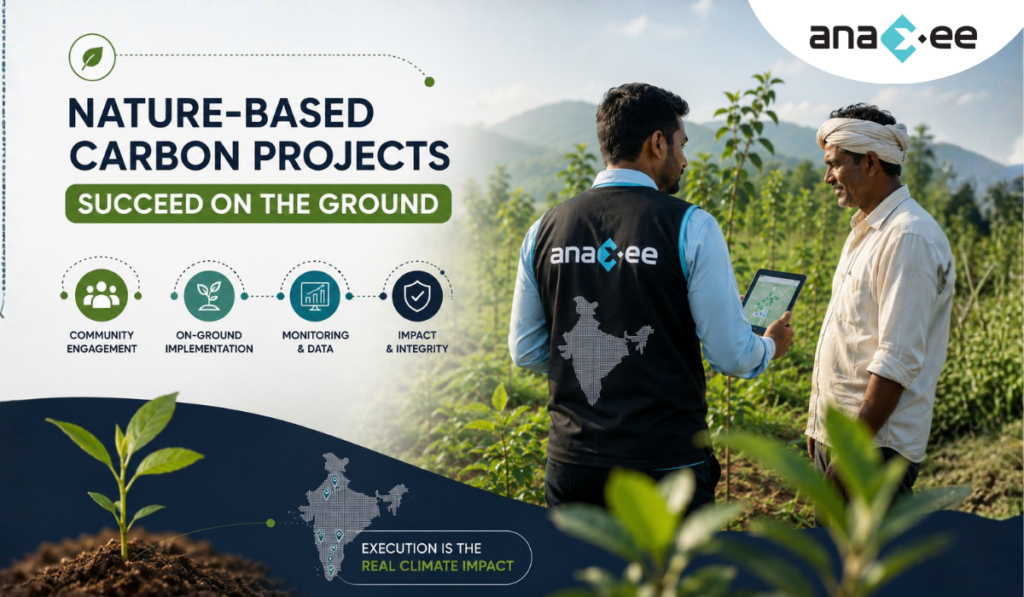

Nature-Based Carbon Projects Fail Without Strong Last-Mile Execution
The climate industry often talks about ambition.
Net-zero targets. Carbon neutrality goals. Billions committed to sustainability. Large-scale plantation announcements.
But on the ground, climate projects are usually won or lost through execution.
Especially in India.
A nature-based carbon project may look excellent in a proposal deck. The methodology may be approved. Satellite maps may look promising. Funding may already be committed.
Yet many projects still struggle after implementation begins.
Why?
Because climate projects are not just environmental initiatives. They are operational systems involving people, land, technology, data, logistics, governance, and long-term coordination.
And in India, that complexity becomes much larger.
Climate Projects in India Are Deeply Field-Dependent
Unlike industrial decarbonization projects that may operate inside factories or controlled infrastructure systems, nature-based projects depend heavily on distributed rural execution.
A single agroforestry or landscape restoration project may involve:
- Thousands of farmers
- Multiple districts
- Diverse climatic zones
- Fragmented landholdings
- Different languages and local practices
- Long monitoring cycles
That changes the nature of project management completely.
The broader global discussion around nature-based solutions increasingly recognizes that these projects require integrated ecological, technological, and governance systems working together.
In India, the “human coordination layer” becomes especially important.
Because implementation happens village by village.
Plantation Is the Easiest Part
This is one of the biggest misconceptions in the carbon market.
People often assume that once trees are planted, the project is successful.
But plantation is usually the beginning — not the outcome.
The real challenge starts afterward.
Questions that determine long-term project success include:
- Will the saplings survive?
- Are farmers continuing participation?
- Is the field data reliable?
- Are geo-tags accurate?
- Is monitoring happening consistently?
- Are there leakages or land-use changes?
- Is the project maintaining audit readiness?
Carbon credits are generated through verified outcomes, not plantation announcements.
That distinction matters.
Why Survival Rates Become a Major Operational Challenge
India’s climatic diversity creates very different survival conditions across regions.
A plantation model that works in one district may fail completely in another.
Factors affecting survival include:
- Water availability
- Soil conditions
- Grazing pressure
- Heat stress
- Species selection
- Community ownership
- Maintenance support
The document emphasizes that ecosystems themselves must remain resilient to environmental stressors in order to continue providing long-term benefits.
That applies directly to agroforestry and restoration projects.
If ecological systems fail, carbon outcomes fail too.
Which means project quality depends heavily on continuous ground engagement.
Carbon Projects Are Actually Data Projects
This part is often underestimated.
Modern carbon projects depend heavily on data integrity.
Projects today require:
- Baseline assessments
- GIS mapping
- Geo-tagged plantations
- Farmer records
- Field photographs
- Survival tracking
- Monitoring reports
- Verification documentation
- Remote sensing integration
Without reliable field data, project credibility weakens quickly.
Carbon markets are becoming more demanding.
Buyers increasingly expect:
- Transparency
- Traceability
- Verification-ready systems
- Continuous monitoring
- Evidence-backed reporting
This is pushing climate projects toward stronger digital MRV systems.
Why Farmer Engagement Cannot Be Treated as a One-Time Activity
Many projects conduct initial onboarding well.
But long-term engagement is harder.
Farmers need continuous communication because climate projects operate over years, not weeks.
Ground realities change:
- Rainfall patterns shift
- Market conditions fluctuate
- Migration affects participation
- Crop economics evolve
- Local priorities change
Without consistent engagement, participation can decline gradually.
The strongest projects therefore build local coordination systems rather than relying only on centralized management.
In India, community trust often determines operational continuity.
The “Scale Problem” in Indian Climate Projects
India offers enormous potential for nature-based climate projects because of its agricultural scale and rural networks.
But scale also creates operational complexity.
Imagine managing:
- 50,000 farmers
- Across 5 states
- Over 8–10 years
- With periodic audits
- Under evolving carbon standards
This is not a conventional sustainability program.
It becomes a large-scale distributed operations challenge.
Nature-based solutions globally are increasingly viewed as multi-disciplinary systems requiring coordination across ecology, governance, planning, and implementation.
India’s climate ecosystem needs operational models designed specifically for that complexity.
Technology Alone Cannot Solve Execution Problems
Climate-tech is growing rapidly.
Satellite imagery, AI monitoring, remote sensing, and digital dashboards are improving transparency and scalability.
But technology alone is not enough.
Because field realities still require:
- Local verification
- Farmer interaction
- Physical audits
- Community coordination
- Training
- Ground troubleshooting
A dashboard cannot replace local trust.
Similarly, a mobile app cannot independently maintain plantation survival.
The strongest climate implementation models combine:
- Technology systems
- Human field networks
- Local operational capacity
- Continuous monitoring workflows
That combination matters far more than presentation-layer technology.
Why Community Ownership Changes Project Outcomes
Projects tend to perform better when communities see long-term value.
That value may come through:
- Additional income
- Improved soil productivity
- Fruit production
- Timber value
- Water benefits
- Shade and microclimate improvements
If communities perceive the project only as an external climate initiative, long-term engagement weakens.
But when projects integrate livelihood benefits, participation becomes more stable.
This is one reason agroforestry models are receiving strong attention in India.
They align ecological restoration with economic utility.
Carbon Market Credibility Will Depend on Ground Truth
The voluntary carbon market is evolving rapidly.
At the same time, scrutiny is increasing.
Questions around:
- Additionality
- Permanence
- Leakage
- Verification quality
- Community impact
- Biodiversity outcomes
are becoming central.
This means future carbon projects will need stronger evidence and operational transparency.
Projects that cannot demonstrate credible implementation may struggle to attract long-term buyers.
Field execution is becoming part of carbon market trust itself.
India Needs Climate Infrastructure, Not Just Climate Intentions
India already has:
- Large agricultural landscapes
- Rural participation potential
- Growing corporate climate demand
- Expanding sustainability focus
But scaling high-quality nature-based projects requires implementation infrastructure.
That includes:
- Local field teams
- Monitoring systems
- Digital workflows
- Verification readiness
- Rural coordination networks
- Training mechanisms
- Operational accountability
Without these systems, many climate projects remain difficult to scale sustainably.
The Future of Nature-Based Projects Will Be Execution-Led
The next phase of India’s climate ecosystem will likely reward projects that combine:
- Scientific rigor
- Community participation
- Transparent MRV
- Long-term monitoring
- Strong field execution
Because carbon markets are maturing.
And mature markets eventually prioritize credibility over announcements.
Nature-based solutions are increasingly being recognized globally as critical tools for climate resilience, biodiversity, and human wellbeing.
But translating those goals into measurable outcomes requires operational depth on the ground.
That is the real climate challenge.
And also the real opportunity.
At Anaxee, we believe nature-based climate projects succeed only when execution systems are built for scale.
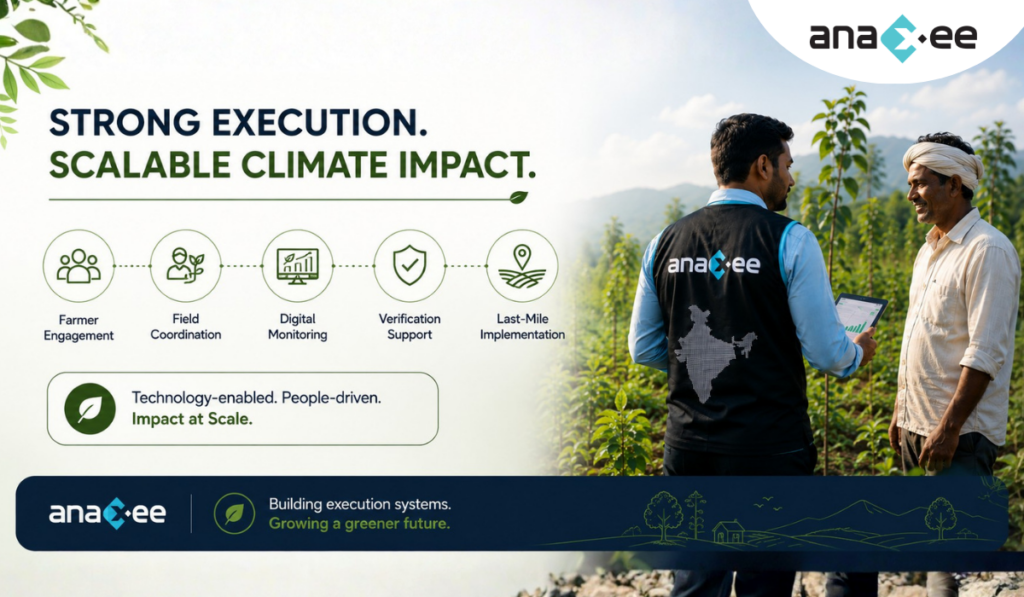
From farmer engagement and field coordination to digital monitoring, verification support, and last-mile implementation, climate projects in India require strong operational infrastructure on the ground.
If your organization is exploring agroforestry carbon projects, restoration initiatives, or community-based climate programs, Anaxee can help support scalable implementation through technology-enabled rural execution networks.