
Verra’s AI Investment Is Good News for Carbon Markets—But It Won’t Solve Their Biggest Problem
When Verra announced its new AI partnership, the carbon market paid attention.
Headlines quickly focused on one message:
Artificial Intelligence is coming to carbon registries.
For many readers, it sounded like verification was finally about to become dramatically faster.
That interpretation isn’t entirely wrong.
But it misses something far more important.
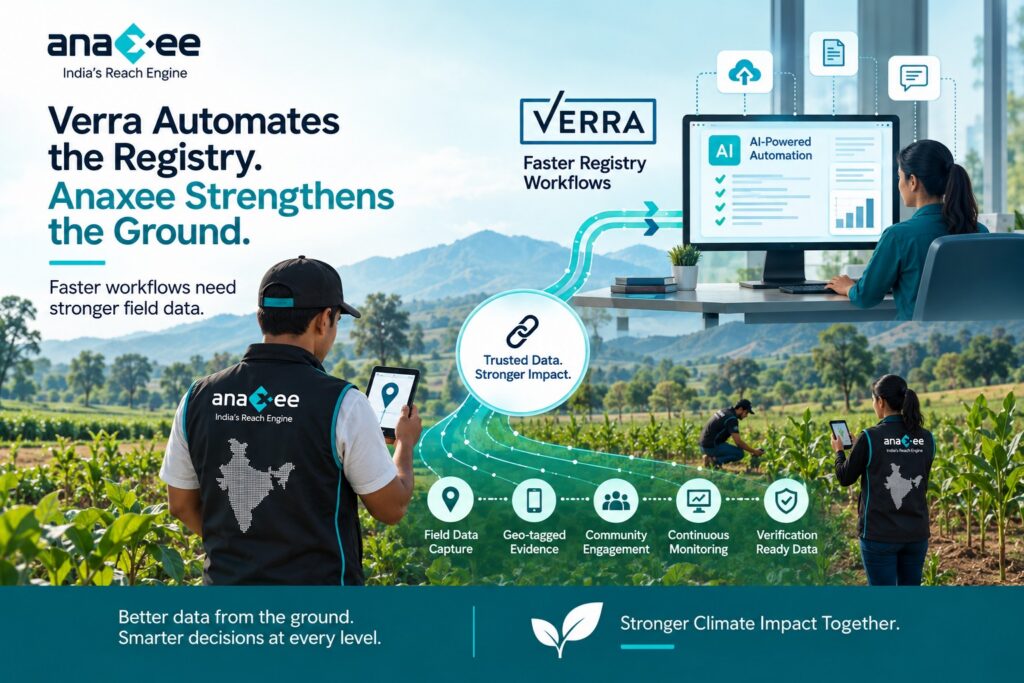
The announcement wasn’t really about improving carbon data.
It was about improving administrative workflows.
And that difference tells us something important about where today’s carbon market is actually getting stuck.
What Verra Actually Announced
Verra recently entered into a multi-year partnership with ServiceNow, DocuSign, The Process Play, and LeverX to modernize its internal operations.
The initiative includes AI-powered workflow automation, document management, contract processing, and customer service improvements.
The objective is straightforward:
- Better developer experience
- Faster administrative processes
- Improved document handling
- More efficient registry operations
This is an important investment.
Anyone who has worked on carbon projects knows that registry processes can be lengthy and administratively demanding.
Reducing those bottlenecks benefits everyone—from project developers to credit buyers.
But the announcement also highlights something equally important.
It addresses only one half of the carbon project lifecycle.
Carbon Projects Have Two Very Different Bottlenecks
When people think about carbon credits, they often imagine registries, methodologies, auditors, and certification.
But every carbon credit starts much earlier.
Long before documents reach a registry, someone has to collect evidence from the ground.
For a nature-based carbon project, that could mean:
- Visiting thousands of farms
- Mapping plantation boundaries
- Recording tree survival
- Monitoring restoration sites
- Verifying household cookstove usage
- Capturing geo-tagged photographs
- Interviewing beneficiaries
- Conducting periodic monitoring
Only after that information is collected can it move into verification and registry workflows.
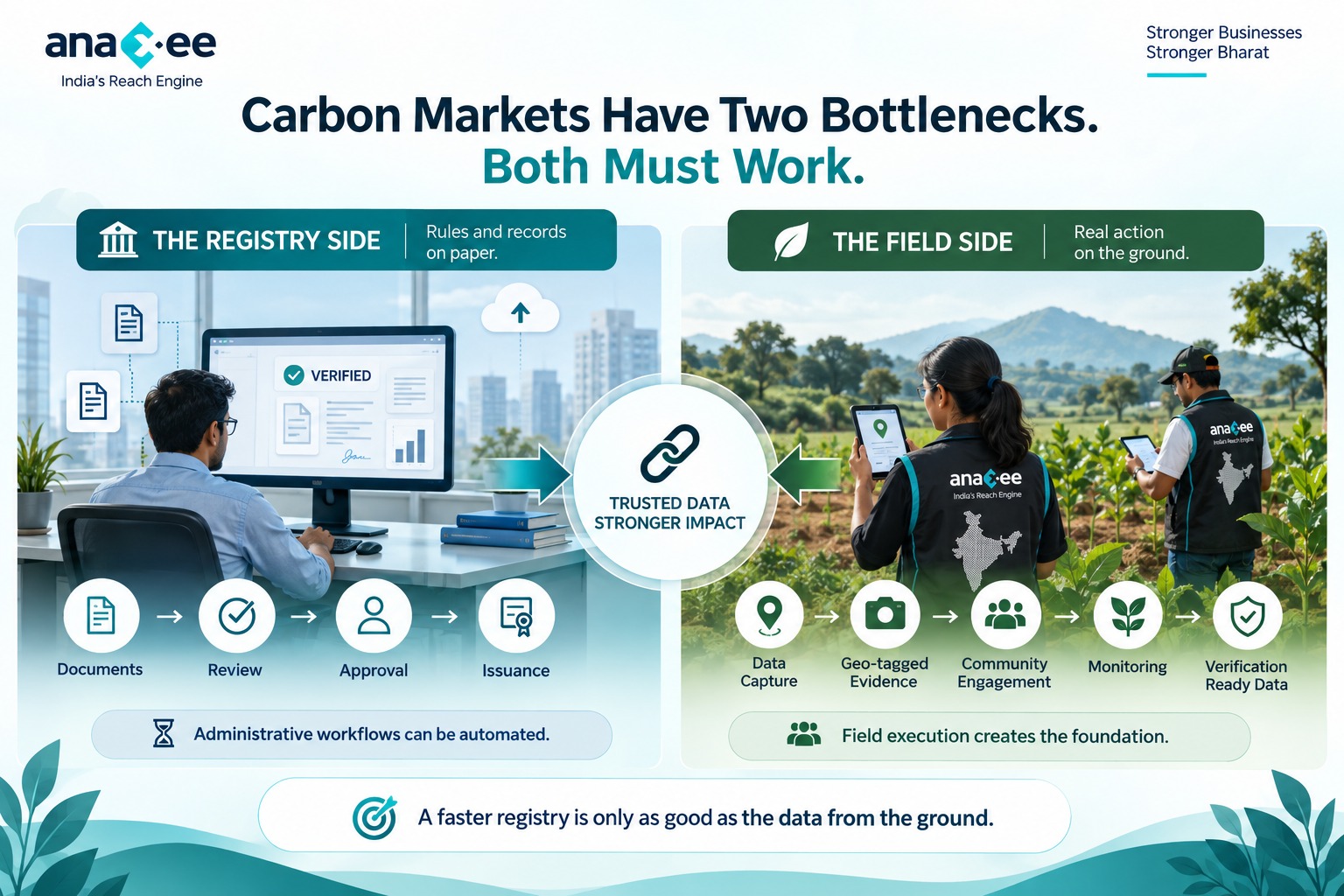
In other words, the carbon market has two distinct systems:
The administrative system
where documents move.
The field system
where evidence is created.
Verra’s announcement improves the first.
The second remains one of the industry’s biggest operational challenges.
AI Cannot Improve Data That Doesn’t Exist
Artificial intelligence is becoming increasingly capable of reviewing documents, extracting information, routing approvals, and automating repetitive work.
Those are valuable improvements.
But AI depends on inputs.
If field data is:
- incomplete,
- delayed,
- inconsistent,
- poorly documented,
- or difficult to verify,
no amount of workflow automation can solve the underlying problem.
Instead, AI simply processes unreliable information more quickly.
That’s why data quality continues to matter.
Not just for verification.
For trust.
The Foundation of Every Carbon Credit Is Still Human
Nature-based carbon projects rarely operate inside controlled environments.
Instead, they span:
- villages,
- forests,
- farms,
- wetlands,
- restoration landscapes,
- community-managed ecosystems.
These projects involve thousands of people making thousands of observations over many years.
Technology can help organize that information.
But someone still has to collect it.
That means:
- visiting sites,
- engaging communities,
- validating activities,
- recording evidence,
- and repeating the process throughout the project’s lifetime.
This isn’t simply administration.
It’s implementation.
Faster Registries Need Faster Field Systems
As registries become more efficient, another challenge becomes more visible.
Can projects generate verification-ready field evidence quickly enough?
Consider a large agroforestry project involving 20,000 farmers.
Every monitoring cycle requires information like:
- tree survival
- species verification
- GPS locations
- photographs
- farmer participation
- land records
- timestamped observations
If collecting this information still takes months, registry automation only solves part of the overall timeline.
The limiting factor shifts from paperwork to field execution.
Digital MRV Begins Long Before the Registry
Digital MRV (Measurement, Reporting and Verification) is often discussed as software.
In reality, it starts much earlier.
Before dashboards.
Before reports.
Before AI.
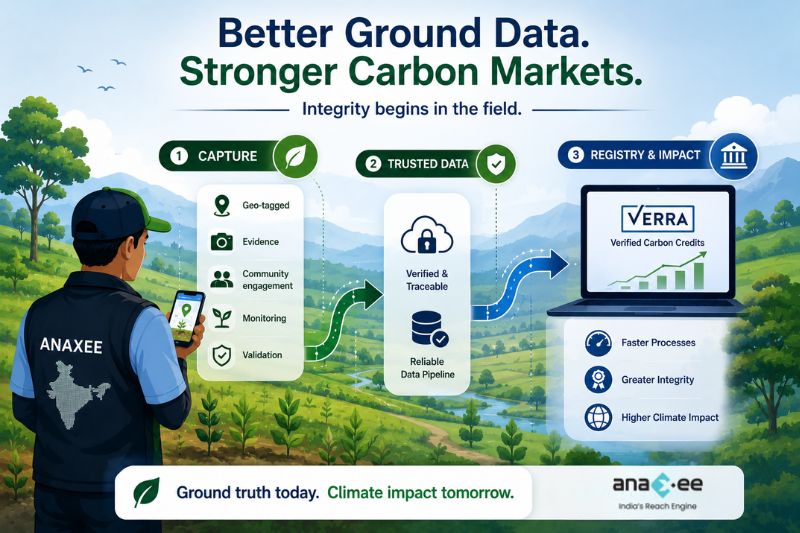
Digital MRV begins when reliable evidence is captured correctly at the source.
That includes:
- geo-tagged observations,
- timestamped field records,
- standardized mobile workflows,
- beneficiary verification,
- repeatable monitoring,
- transparent audit trails.
Only then can automation create meaningful efficiency.
Without trustworthy inputs, digital systems simply move uncertainty through the pipeline faster.
Why This Matters for India
India is expected to become one of the world’s largest markets for nature-based carbon projects.
Agroforestry, landscape restoration, mangrove conservation, clean cooking, regenerative agriculture, and watershed restoration are all expanding rapidly.
But Indian projects also operate at enormous scale.
One project may involve:
- thousands of villages,
- tens of thousands of farmers,
- multiple climatic zones,
- years of continuous monitoring.
That makes last-mile execution just as important as methodology design.
As the carbon market grows, the organizations that can consistently produce transparent, high-quality field evidence will become increasingly valuable.
The Future of Carbon Markets Will Be Built on Better Ground Truth
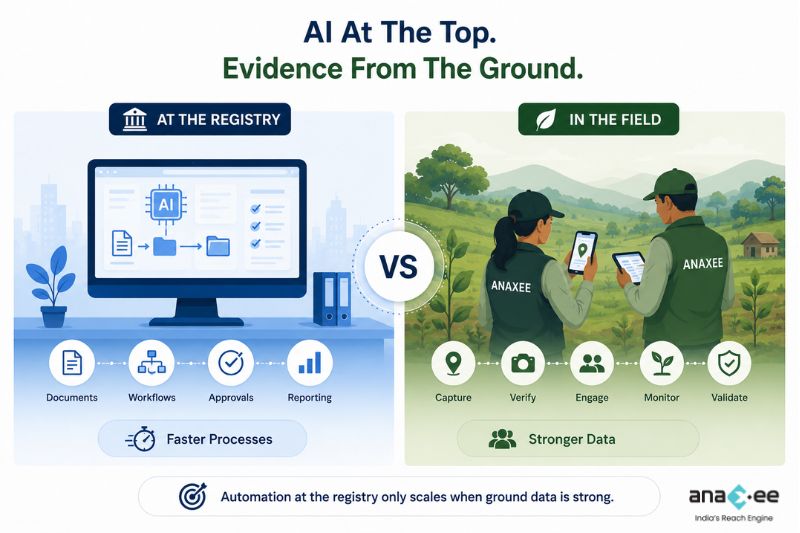
Verra’s AI investment deserves attention.
It reflects an industry that’s becoming more efficient, more digital, and more responsive.
But it also highlights an important reality.
The future of carbon markets won’t be determined only by faster registries.
It will also depend on faster, more reliable, and more transparent field execution.
Because every carbon credit begins with evidence collected somewhere on the ground.
AI can accelerate what happens after that.
It cannot replace it.
How Anaxee Supports This Layer
At Anaxee, we focus on the part of the carbon ecosystem that rarely makes headlines.
Through our technology-enabled Digital Runner network across India, we support climate projects with:
- Ground-level monitoring
- Household verification
- Geo-tagged data collection
- Field audits
- Beneficiary engagement
- Digital evidence capture
- Last-mile implementation support
As carbon markets become more automated, reliable field data becomes even more valuable.
Because integrity isn’t created inside a registry.
It begins where the project begins—on the ground.
Sources
- Carbon Herald (25 June 2026): Verra announces multi-year AI and workflow modernization partnership with ServiceNow, DocuSign, The Process Play, and LeverX.
- Verra official announcement (referenced for partnership details).