
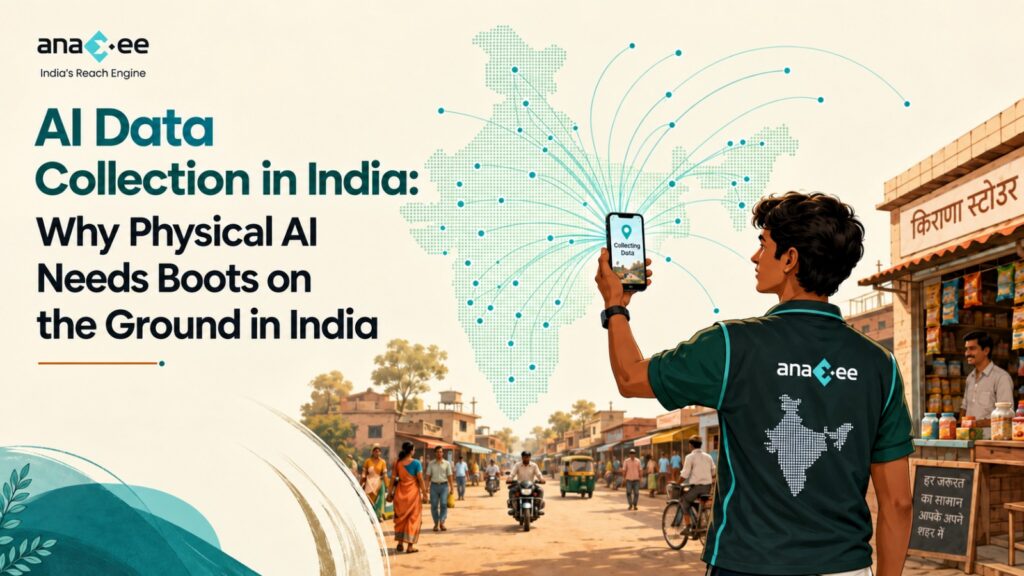

AI Data Collection in India: Why Physical AI Needs Boots on the Ground in Bharat
The last decade of AI was built on data that already existed. Text scraped from the web, images pulled from the internet, video lifted from public platforms. That well is running dry — and the next decade of AI can’t be built the same way.
The models everyone is racing to build now — robots that fold laundry, warehouse systems that pick and pack, driver-assistance that reads an Indian street — don’t learn from the internet. They learn from the physical world. And the physical world has to be recorded by actual people, in actual homes, shops, farms and streets, one clip and one sample at a time.
That’s the shift. And it’s why the center of gravity for AI data collection is moving toward places with scale, diversity and reach on the ground. India is at the front of that queue.
What is physical AI, and why does it need real-world data?
Physical AI is the branch of artificial intelligence that operates in the real world rather than on a screen — robots, autonomous machines, and any system that has to perceive and act in physical space. A chatbot can learn from text. A robot arm cannot. It has to learn from data that captures how objects move, how hands grip, how light falls in a real kitchen at 6 pm.
That data doesn’t exist online. It has to be created. Someone has to record a person chopping vegetables, sorting screws, stacking boxes, or walking a crowded market — from the right angle, with consent, at the quality a model can actually train on.
The money is following this. Indian physical-AI startups pulled in around $155 million in 2026 alone, with a wave of companies building human-motion datasets and India-based robotics data factories. The demand is real, it’s funded, and it’s here.
The problem with web-scraped data
Web data got AI this far, but it has three limits that matter now:
It’s already used. The public internet has largely been scraped. The easy gains are gone.
It’s biased toward some parts of the world and not others. Most of it reflects English-speaking, urban, Western life. A model trained on it doesn’t know what an Indian kirana store looks like, how a farmer holds a tool, or what forty regional languages sound like in a noisy room.
It isn’t physical. No amount of web text teaches a robot the weight of a steel tumbler or the way a bedsheet folds. That information only exists in recordings of the real thing.
Every serious AI team hits the same wall: to go further, they need fresh, real-world, diverse data — and they need someone who can actually go out and collect it.
Why India is where real-world AI data gets collected
Three things make India uniquely suited to this moment.
Diversity at a scale nowhere else offers. Skin tones, languages, dialects, faces, environments, ways of doing everyday tasks — India contains more genuine variety than most continents. For AI teams that need datasets representing the actual range of humanity, that’s not a nice-to-have. Models that only work on some people are a liability, and diverse data is the fix.
Depth beyond the metros. The India that matters for real-world data isn’t only Mumbai and Bengaluru. It’s Tier 2, Tier 3 and Tier 4 towns and villages — the 90% of the country most data collection never reaches. That’s exactly the range that makes a dataset robust.
A cost and workforce advantage. A young, mobile-savvy, smartphone-equipped population across the whole country means data can be collected at a scale and cost structure that’s hard to match elsewhere.
The catch is the last mile. Diversity and depth only help if you can actually reach them — and reaching 11,000 pincodes is a very different problem from posting a task online and hoping the right people show up.
Real-world data needs real-world reach
This is where most AI data collection quietly breaks down.
Anyone can build an app and ask the internet to record clips. What you get back is whoever happened to sign up — clustered in a few cities, skewed toward the same demographics, thin everywhere it matters. The hard part isn’t the recording. It’s the reach: getting the right people, in the right places, doing the right tasks, with proper consent and consistent quality, across a country as large and varied as India.
That’s an on-ground problem. It needs feet on the street, not just software.
How Anaxee collects real-world AI data across Bharat
Anaxee was built for exactly this kind of reach. Since 2016, we’ve run one of India’s largest distributed field networks — and we’ve turned it into infrastructure that AI companies can plug into.
The footprint:
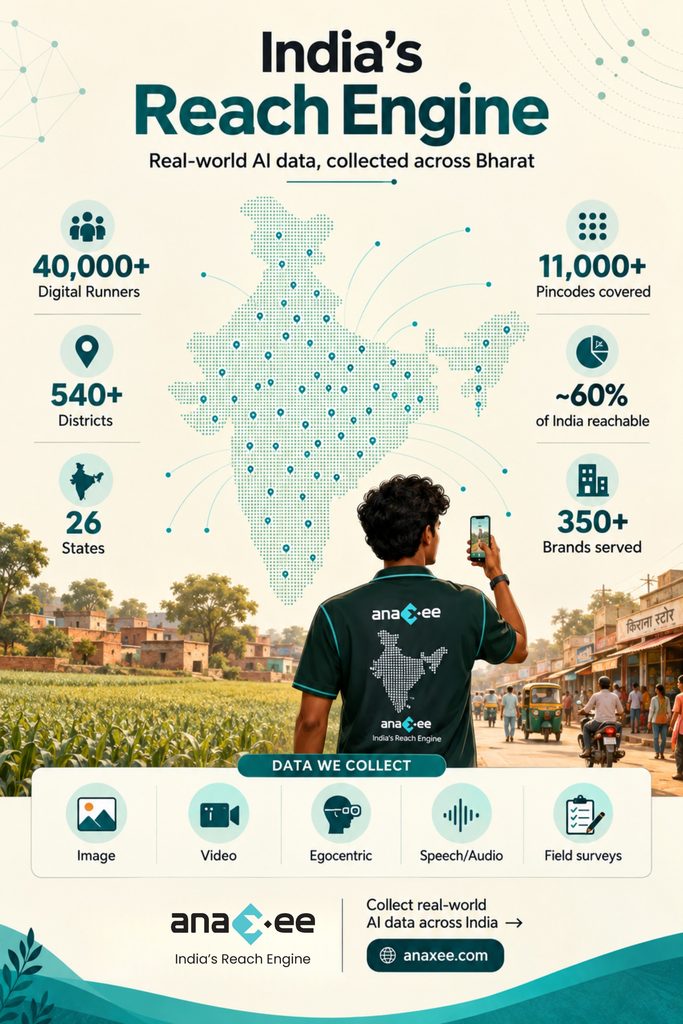
- 40,000+ Digital Runners — local youth living in the districts, sub-districts and villages they work in
- 540+ districts across 26 states
- 11,000+ pincodes — roughly 60% of India, including the Tier 2/3/4 areas most collection never touches
- A 150+ person in-house team managing quality, training and delivery
- A track record with 350+ brands, including Colgate, Mahindra, ITC and Pepsi
Because our Runners live where they work, we don’t parachute in. We collect data from inside real communities — with local language, local trust, and genuine demographic range. And because consent and quality are managed by a trained in-house team rather than left to an anonymous crowd, the data holds up.
For AI teams, that turns “we need diverse, real-world Indian data” from a logistics nightmare into a single conversation.
What Anaxee can collect for AI teams
The network is data-type agnostic. If it can be captured in the field, it can be collected at scale and with consent:
- Image data — faces, objects, scenes, documents, across demographics and regions
- Video data — short clips, task recordings, activity capture
- Egocentric (first-person) data — the head-mounted, point-of-view recordings that robotics teams need (here’s what egocentric data is and why it matters)
- Speech and audio data — across dozens of Indian languages and dialects, in real acoustic conditions
- Structured field data — surveys, market mapping, and large-scale on-ground collection
All of it consent-first, all of it sourced from real people across real India.
Consent isn’t a checkbox — it’s the whole point
When you collect face, voice or personal data, how you collect it matters as much as what you collect. Under India’s Digital Personal Data Protection Act, informed consent is the foundation, not the fine print. Data gathered without it isn’t just an ethical problem — it’s an unusable asset the day a client audits it.
Anaxee’s model is built on trained field agents who explain, obtain and record consent properly, in the participant’s own language. Diverse data, collected the right way, is the only kind worth building an AI on.
The bottom line
The AI race has moved from the web to the world. The teams that win the next phase are the ones that can get real, diverse, consented data out of the places models have never seen — and India is the single richest source of that data on earth.
Reaching it takes more than an app. It takes a network already standing in 11,000 pincodes.
That network is Anaxee. Book a call and tell us what you need to collect.
Frequently asked questions
What is AI data collection? AI data collection is the process of gathering real-world data — images, video, audio, speech or sensor data — that’s used to train and improve artificial intelligence and machine learning models. For physical AI and robotics, this data has to be captured from the real world rather than scraped from the internet.
Why is India important for AI training data? India offers a rare combination of demographic diversity, linguistic range, and reach into non-urban areas, all at scale. This makes it one of the best sources in the world for the diverse, real-world data that modern AI models need to work reliably across different people and environments.
What kind of data can Anaxee collect? Anaxee collects image, video, egocentric (first-person), speech, audio and structured field data across India, sourced with informed consent from real people in over 11,000 pincodes.
How does Anaxee ensure data is collected ethically? Data is gathered by trained Digital Runners who obtain informed consent in the participant’s own language, in line with India’s Digital Personal Data Protection Act. Quality and consent are managed by an in-house team rather than an anonymous crowd.