
The Hidden Cost of Inaccurate Doctor Databases in Pharmaceutical Sales
A pharmaceutical company may have thousands of doctors listed in its database. But how many of those doctors can its Medical Representatives (MRs) actually reach?
Thank you for reading this post, don't forget to subscribe!Having a large doctor database does not necessarily mean having a reliable one.
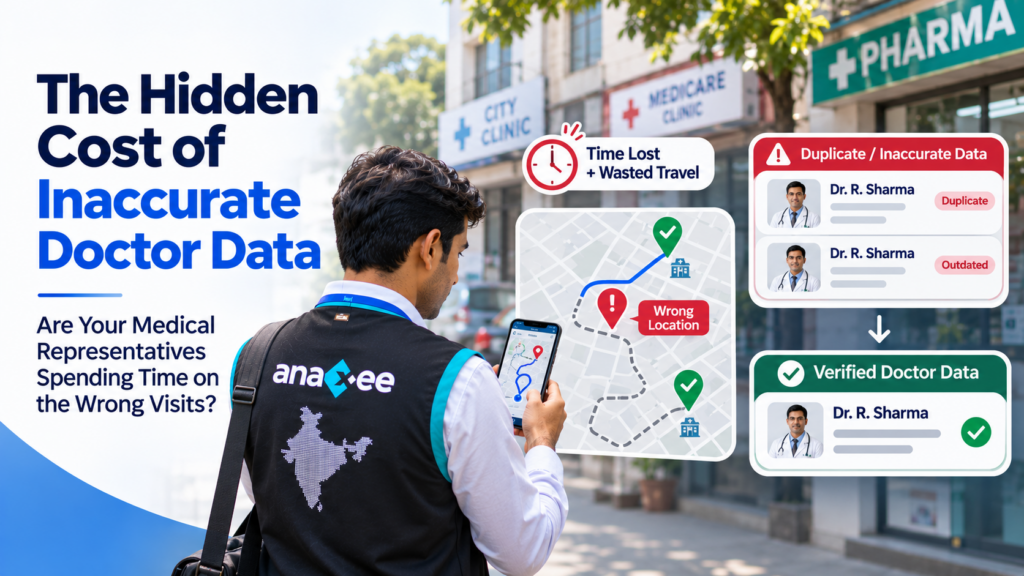
An incorrect clinic address, an outdated phone number or an unverified doctor record can create problems for pharmaceutical sales teams. MRs may spend valuable time travelling to locations where they cannot find the intended doctor. Sales managers may plan territories using incomplete information, while companies continue spending money on visits that do not deliver the expected results.
These problems often go unnoticed because companies measure sales activities through the number of calls, visits and doctors covered. However, the accuracy of the underlying database is equally important.
For pharmaceutical companies, doctor database accuracy is not just an administrative requirement. It is an important part of sales productivity, territory management and business planning.
Let’s understand how inaccurate doctor data affects pharmaceutical operations and what companies can do to address it.
1. What Makes a Doctor Database Inaccurate?
A doctor database typically contains information such as doctor names, specialisations, clinic addresses, contact numbers and geographical locations.
However, this information can become incomplete or outdated over time.
Some common doctor database problems include:
- Incomplete addresses: Records contain only a locality, road name or area instead of a complete clinic address.
- Incorrect contact information: Phone numbers may be outdated, incorrect or unavailable.
- Duplicate records: The same doctor may appear multiple times under slightly different names or addresses.
- Outdated clinic information: Doctors may change their practice locations, clinics or consultation arrangements.
- Unverified records: Some entries may not have been physically checked to confirm the doctor’s presence at the listed location.
- Missing geographical information: Records may lack accurate GPS coordinates or identifiable landmarks.
Consider a practical example.
A pharmaceutical company’s database contains a doctor’s name and an address that mentions only a particular locality. When an MR reaches that area, there may be several streets, buildings and clinics. Without an exact location, identifying the correct clinic becomes difficult.
The problem is not necessarily that the doctor does not exist. The problem is that the information available to the sales team is insufficient to locate the doctor.
This is where database accuracy becomes important.
2. How Inaccurate Doctor Data Affects Medical Representative Productivity
Medical Representatives are an important part of pharmaceutical sales operations. Their work involves meeting doctors, communicating product information and maintaining professional relationships.
Their productivity depends partly on how effectively they can reach the doctors assigned to them.
When doctor information is inaccurate, several operational problems can arise.
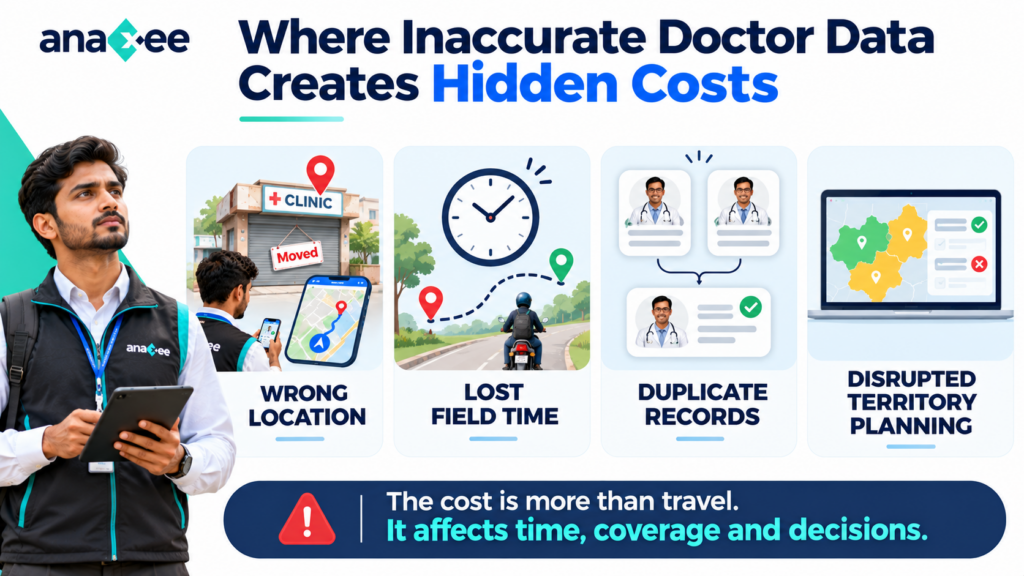
Unproductive doctor visits
An MR may travel to a clinic only to discover that the doctor is unavailable, the address is incorrect or the clinic cannot be identified.
This consumes time that could have been spent on productive visits.
Increased travel expenditure
Every field visit involves operational expenses, including transportation and travel-related costs.
Repeated attempts to locate doctors at incorrect addresses can increase these expenses.
Reduced daily visit productivity
MRs generally operate within defined territories and working hours.
Time spent searching for an incorrect location reduces the time available for other planned visits.
Inefficient territory planning
Sales managers use doctor databases to allocate territories, assign responsibilities and plan field activities.
When the underlying information is unreliable, territory planning can become less effective.
Poor utilisation of promotional resources
Pharmaceutical companies may allocate product samples, promotional materials and other resources for doctor interactions.
If a visit cannot be completed, the intended promotional activity may not take place.
The combined impact can affect the efficiency of the entire field-sales operation.
3. The Financial Impact of Inaccurate Doctor Databases
One of the biggest challenges with inaccurate data is that its financial impact is not always immediately visible.
Companies may track salaries, travel expenditure and promotional costs separately without connecting these expenses to the quality of their doctor databases.
Let’s consider a hypothetical pharmaceutical sales operation to understand the potential financial exposure.
An illustrative business scenario
Suppose a pharmaceutical company maintains a database of 2,400 doctors.
For this example, assume that 20% of the records are inaccurate or require further verification.
| Parameter | Illustrative value |
|---|---|
| Total doctor records | 2,400 |
| Assumed inaccurate records | 20% |
| Potentially problematic records | 480 |
| Average MR visits per month | 240 per MR |
| Monthly MR operating cost | ₹60,000 |
| Estimated cost per visit | ₹250 |
| Additional promotional expenditure per visit | ₹250 |
Based on these assumptions, 480 records may require attention.
If each problematic record results in one unsuccessful visit every month, the potential number of unsuccessful visits could reach 480 per month.
Over one year:
480 × 12 = 5,760 potentially unsuccessful visits.
Now consider the estimated expenditure associated with these visits.
A. MR operational expenditure
Assuming an average MR operating cost of ₹60,000 per month and 240 visits per month:
₹60,000 ÷ 240 = ₹250 per visit.
For 5,760 unsuccessful visits:
5,760 × ₹250 = ₹14.40 lakh.
B. Promotional expenditure
Assume an additional illustrative expenditure of ₹250 per visit towards gifts, samples or other promotional activities.
5,760 × ₹250 = ₹14.40 lakh.
C. Combined financial exposure
| Expense category | Illustrative annual amount |
|---|---|
| MR operational expenditure | ₹14.40 lakh |
| Promotional expenditure | ₹14.40 lakh |
| Combined expenditure exposure | ₹28.80 lakh |
This example illustrates how poor database quality can create a significant financial exposure for pharmaceutical companies.
Important: These calculations are hypothetical, not actual industry averages or audited losses. They assume that all 480 problematic records lead to one unsuccessful visit every month. Actual costs will depend on visit frequency, data quality, operational practices and expenditure patterns.
The larger takeaway is that companies should understand the cost of their unsuccessful field activities rather than looking only at the total number of visits completed.
4. Why Having a Large Doctor Database Is Not Enough
Many pharmaceutical businesses focus on expanding their doctor databases.
Having more records can help increase the potential reach of a sales team. However, database size alone does not indicate its usefulness.
A database should be evaluated on several parameters.
| Database parameter | What it tells a company |
|---|---|
| Database size | How many doctor records are available |
| Accuracy | Whether the information is correct |
| Completeness | Whether essential information is available |
| Freshness | Whether the information is up to date |
| Location accuracy | Whether the doctor or clinic can be located |
| Usability | Whether sales teams can practically use the information |
For example, a database containing 10,000 doctor records may appear valuable. But if a significant number of records have incomplete addresses or outdated contact information, the sales team may struggle to use it effectively.
On the other hand, a smaller but regularly validated database may provide more reliable information for field planning.
The objective should not simply be to build a bigger database. It should be to maintain a database that sales teams can actually use.
5. Why Basic Database Cleaning May Not Be Enough
When pharmaceutical companies identify data-quality issues, their first approach is often backend cleaning.
This is understandable because many database problems can be addressed through desk-based activities.
For example, a dedicated resource can:
- Search for clinic information online.
- Review incomplete addresses.
- Check available contact information.
- Identify duplicate records.
- Update information using publicly available sources.
- Flag records that require additional verification.
These activities can improve database quality without requiring a field visit for every record.
However, online research has limitations.
A Google search may identify a locality or a nearby clinic, but it may not always confirm whether a specific doctor is practising at the listed address.
Similarly, a broad address may not provide enough information to identify the exact clinic.
This creates an important distinction:
Backend data cleaning improves the information available in a database. Field verification helps establish whether that information matches the actual situation on the ground.
Both approaches have a role in maintaining reliable doctor databases.
6. How Pharmaceutical Companies Can Improve Doctor Database Accuracy
A practical approach is to combine backend data cleaning with targeted field verification.
Here are some steps pharmaceutical companies can consider.
Step 1: Conduct a database quality assessment
Start by examining the existing doctor database.
Check:
- Missing information.
- Incomplete addresses.
- Duplicate records.
- Invalid or questionable contact numbers.
- Missing geographical details.
This helps identify the overall quality of the available data.
Step 2: Clean records through backend validation
Use desk-based resources to review available online information and correct records wherever reliable information is available.
This reduces the number of records that need further investigation.
Step 3: Identify records requiring physical verification
Not every record needs a field visit.
Prioritise records with:
- Vague addresses.
- Unconfirmed clinic locations.
- Conflicting information.
- Missing location details.
- Unresolved database discrepancies.
A risk-based approach helps allocate field resources more efficiently.
Step 4: Conduct field-level verification
Deploy field teams to locate the specified clinics and validate the relevant information.
The objective is to confirm the physical location and capture the required information from the field.
Step 5: Update the database
Combine the findings from backend cleaning and field verification.
Update the database with corrected information, GPS coordinates and verification status wherever applicable.
Step 6: Review data quality periodically
Doctor information can change over time.
Periodic validation helps companies identify outdated records and maintain a more reliable database for future sales activities.
7. The Additional Opportunity: Chemist-Level Market Intelligence
Doctor database accuracy is only one part of pharmaceutical market intelligence.
Chemists and retail pharmacies also play an important role in pharmaceutical distribution and product availability.
Visiting chemist shops can help companies understand their retail presence and distribution coverage.
Depending on the scope of the survey, field-level chemist data collection can provide information about:
- Retail outlet presence.
- Brand availability.
- Product availability.
- Competitor presence.
- Distribution coverage.
- Retail-level market intelligence.
For pharmaceutical companies, this creates an opportunity to understand both doctor outreach and the retail network.
A verified doctor database can support better field planning, while reliable chemist information can help companies understand their market presence at the retail level.
Together, these datasets can support more informed commercial decisions.
8. How Anaxee Supports Pharmaceutical Data Collection and Verification
Improving database accuracy requires more than a spreadsheet-cleaning exercise. Some information can be validated digitally, while other records require physical verification.
Anaxee Digital Runners Pvt. Ltd. supports businesses through field-level data collection, verification and market intelligence activities.
Through its distributed Digital Runner network and technology-enabled field operations, Anaxee can support pharmaceutical companies with activities such as:
- Doctor and clinic data collection.
- Chemist and retail outlet surveys.
- Existing database verification.
- Address and geographical information capture.
- GPS-enabled field data collection.
- Mobile number and contact information checks.
- Backend database cleaning support.
The approach can be structured around the client’s requirements.
For example, a pharmaceutical company can begin with a limited geographical pilot, assess the quality of its existing database and identify the records that require additional field verification.
The findings can then help the company understand its actual data-quality challenges and plan a larger exercise.
Rather than assuming that every record needs a physical visit, companies can combine backend validation and field activities based on the type of information available.
Conclusion: Your Doctor Database Is Only as Useful as Its Accuracy
Pharmaceutical companies invest considerable resources in building sales teams, managing territories and reaching doctors.
But these efforts depend on having reliable information.
An incomplete address or an outdated record may appear to be a small data-quality issue. When repeated across hundreds or thousands of records, however, it can create operational inefficiencies and unnecessary expenditure.
The solution is not necessarily to collect more data. It is to make existing data more accurate, complete and actionable.
Combining backend database cleaning with targeted field-level verification can help pharmaceutical companies build more reliable doctor and chemist databases.
Because better pharmaceutical field operations begin with better data.
If your organisation is looking to improve doctor database accuracy, verify clinic locations or understand chemist-level retail coverage, explore how Anaxee can support your field data collection and verification requirements.
Want to Improve Your Pharma Sales Productivity?
Let’s discuss how accurate doctor and chemist databases can help your team reduce unproductive visits, improve field coverage and make better business decisions.
Book a consultation with Anaxee today.
Schedule a Meeting with Our Team
 About Anaxee
- ★ National Startup Award 2021
- Trusted by 350+ brands
- India’s Reach Engine since 2016
Explore Anaxee: Go-To-Market · Field data collection · Platform & API · Drone & MRV · Climate
Planning field execution, a GTM rollout or data collection across India?
Tell Anaxee the outcome and the geography — our team will map it across 540 districts and 11,000+ pincodes.
Book a meeting WhatsApp Email sales