
Why Field Verification Is Better Than Desk-Based Data Cleaning for Accurate Business Data
Introduction: Can You Trust Data That Has Never Been Verified on the Ground?
Businesses make important decisions based on databases.
Thank you for reading this post, don't forget to subscribe!Pharmaceutical companies use doctor databases to plan medical representative visits. FMCG and consumer brands use retailer databases to plan distribution. Financial institutions use customer and business information for verification and outreach.
But how reliable is the information in these databases?
A business may have thousands of records containing names, addresses, phone numbers and other details. However, having information in a spreadsheet does not mean that the information is accurate.
A clinic may have relocated. A retailer may have permanently closed. A phone number may belong to someone else. An address may mention only a locality without specifying the actual establishment.
Many businesses initially try to resolve these problems through desk-based data cleaning.
This involves using spreadsheets, Google Search, Google Maps and other online sources to correct and enrich existing records.
While this approach is useful, it has limitations.
Sometimes, the only way to establish whether a record is correct is to verify it at the actual location.
This is where field verification becomes important.
In this article, we explain the difference between desk-based data cleaning and field verification, when businesses should use each method, and how a hybrid approach can improve data quality.
1. What Is Desk-Based Data Cleaning?
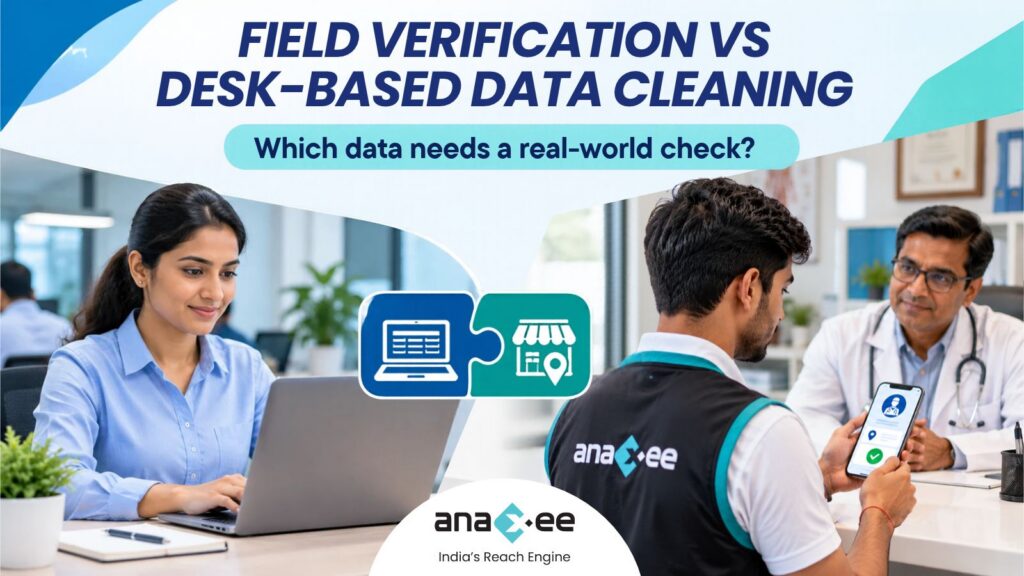
Desk-based data cleaning is the process of reviewing, correcting and updating information without physically visiting the locations associated with the records.
It is generally performed by backend teams using computers, spreadsheets, databases and online information sources.
For example, a pharmaceutical company may have a database of 2,400 doctors and chemists.
The database may contain:
- Doctor or chemist names
- Clinic or shop names
- Contact numbers
- Addresses
- Locality and city information
- Other business details
A backend team can review these records and identify obvious errors.
Common desk-based activities include:
A. Duplicate Identification
Identifying records that may belong to the same doctor, chemist or business.
B. Name Standardization
Correcting inconsistent spellings, abbreviations and formatting.
C. Address Enrichment
Using available online sources to add missing locality, road or establishment information.
D. Phone Number Checks
Checking number formats, available validity information and other permitted contact-data indicators.
E. Online Location Research
Searching Google Maps, business listings and other available sources to identify potential establishment locations.
F. Database Formatting
Organizing information into standardized fields to make it easier to search, filter and analyze.
Desk-based cleaning is useful because it can process large volumes of records without requiring field visits.
However, there is a difference between finding information online and confirming that the information is correct.
2. What Is Field Data Verification?
Field data verification is the process of validating information by physically visiting the location or interacting with the relevant establishment through a field representative.
Unlike desk-based cleaning, field verification provides an opportunity to check the actual situation on the ground.
For example, a pharmaceutical company provides a list of doctors in Indore.
The database contains a doctor’s name and an incomplete address.
A field representative visits the relevant locality, identifies the clinic and verifies the available information.
Depending on the project requirements, the representative may capture:
- Doctor’s name
- Clinic or hospital name
- Medical specialization
- Actual clinic address
- Contact number
- Clinic existence and operational status
- GPS coordinates
- Other relevant verification details
Similarly, in a retailer verification project, a field representative can physically visit a shop to check whether it exists, whether it is operational and whether the recorded business information is correct.
The key advantage is that the information is checked against real-world conditions rather than relying entirely on previously available digital records.
3. Desk-Based Data Cleaning vs Field Verification: Key Differences
Both approaches improve data quality, but they serve different purposes.
| Parameter | Desk-Based Cleaning | Field Verification |
|---|---|---|
| Data review | Yes | Yes |
| Duplicate identification | Yes | Can support |
| Name standardization | Yes | Can confirm |
| Online address research | Yes | Can support |
| Physical establishment verification | No | Yes |
| Actual GPS capture | Not reliably | Yes |
| Local information | Limited | Stronger |
| Closed or relocated establishments | Online evidence only | Can physically investigate |
| Contact verification | Digital checks | Direct confirmation where possible |
| Large-scale processing | Suitable | Requires field planning |
| Operational cost | Generally lower | Generally higher |
Neither approach should be considered universally better.
Desk-based cleaning is more suitable for resolving errors that can be identified digitally.
Field verification is more suitable when businesses need confirmation of physical existence, actual location or other information that cannot be reliably established online.
4. Five Data Quality Problems That Require Ground-Level Verification
There are several situations where online research alone may not provide sufficient confidence.
A. Incomplete Addresses
Consider the following example:
| Doctor Name | Available Address |
|---|---|
| Dr. Sunil Meena | Double Chowki |
The address provides a broad locality but does not identify the exact clinic.
A backend executive may find several possible locations online.
However, finding a clinic with a similar name or a doctor with the same name does not establish that it is the intended record.
A field representative can investigate the locality, identify the relevant establishment and capture the actual location.
B. Incorrect Business Location
A database may contain an address that is outdated or incorrectly mapped.
For example, a chemist shop may have shifted from one street to another.
An online listing may still show the old address.
Physical verification helps establish the current situation at the time of the visit.
C. Closed or Non-Operational Establishments
A business listing may remain available online even after the establishment has closed.
For businesses maintaining large retailer or service-provider databases, this creates a data-quality problem.
Field verification can help classify records based on whether the establishment is found and its observed operational status.
D. Duplicate Records With Different Addresses
Sometimes the same doctor or business appears multiple times with slightly different names or addresses.
For example:
- Sharma Medical Store
- Sharma Medicals
- Sharma Medical Agency
These may be separate businesses or different entries for the same establishment.
Desk-based deduplication can identify possible matches, but local investigation may be needed to resolve uncertain cases.
E. Missing Geographical Information
A business database may contain names and phone numbers without precise location coordinates.
This makes it difficult to plan routes, allocate territories and measure geographical coverage.
Field-based GPS capture can help attach location coordinates to the verified establishment.
5. Why GPS-Based Data Collection Improves Data Quality
One of the important advantages of field-based data collection is the ability to capture geographical information at the actual location.
GPS coordinates can help businesses move beyond traditional address-based databases.
For example, consider two records:
Record A
Shop Name: Sharma Medical Store
Address: Main Market, Indore
Record B
Shop Name: Sharma Medical Store
Address: Main Market, Indore
Both records appear similar.
However, without precise location information, it may be difficult to determine whether they refer to the same establishment or two different shops.
GPS coordinates can provide an additional data point for comparing records and identifying potential duplicates.
GPS-based data collection can support:
- Location identification
- Territory mapping
- Route planning
- Outlet mapping
- Geographical coverage analysis
- Location-based database validation
It is important to remember that GPS coordinates alone do not prove the identity of an establishment. They should be combined with name, address and other verification information.
6. How a Hybrid Data Verification Model Works
The most practical approach for many large databases is to combine desk-based cleaning with field verification.
Instead of sending field representatives to every record, businesses can first use backend teams to identify which records require physical investigation.
Here is a suggested workflow.
Step 1: Collect and Assess the Existing Database
The business shares its existing database in a structured format.
The data is reviewed to understand:
- Total number of records
- Missing information
- Incomplete addresses
- Duplicate entries
- Invalid or improperly formatted phone numbers
- Geographical distribution
This establishes the starting quality of the database.
Step 2: Perform Desk-Based Data Cleaning
Backend resources clean the information that can be resolved digitally.
This may include:
- Standardizing names
- Identifying duplicate records
- Checking phone number formats
- Researching publicly available addresses
- Enriching locality information
- Categorizing records by data completeness
Step 3: Classify Records Based on Verification Requirements
Not every record requires the same level of effort.
A useful classification system could look like this:
| Category | Record Condition | Recommended Action |
|---|---|---|
| A | Complete and consistent details | Desk review / sampling |
| B | Minor missing information | Online research |
| C | Incomplete address | Field investigation |
| D | Uncertain establishment identity | Physical verification |
| E | Possible duplicate | Backend review and field resolution |
| F | Establishment not located | Further investigation / unresolved status |
This classification helps prioritize field visits.
Step 4: Deploy Field Representatives
Field representatives visit locations that require physical verification.
They use the available information to identify the intended establishment and capture the required details.
A structured mobile application can be used to collect:
- Verified names
- Updated addresses
- GPS coordinates
- Photographs, where appropriate and permitted
- Contact details
- Verification status
- Remarks
Step 5: Validate the Collected Information
The collected data should go through quality checks.
For example:
- Are mandatory fields complete?
- Are coordinates within the expected geographical area?
- Are duplicate records flagged?
- Are photographs and other evidence appropriate for the task?
- Are unresolved records clearly identified?
- Does the record meet the agreed verification criteria?
Step 6: Deliver a Structured Database
The final database can include both verified and unresolved records.
A useful output should not simply provide updated information. It should also communicate what was actually verified and what remains uncertain.
This distinction is important for business decisions.
7. How to Measure the Quality of a Field Verification Project
A successful data verification project should be evaluated using measurable indicators.
Some important KPIs include:
1. Record Verification Rate
The percentage of assigned records on which the required verification activity has been completed.
Formula:
Records with completed verification ÷ Total assigned records × 100
2. Location Match Rate
The percentage of records for which the correct establishment location is successfully identified according to the agreed verification criteria.
3. Address Completeness Rate
The percentage of records containing all required address fields.
4. Duplicate Identification Rate
The percentage of records flagged as potential duplicates after applying the agreed matching rules.
5. Contact Validation Rate
The percentage of phone numbers that pass the specified technical or field-level validation checks.
6. Unresolved Record Rate
The percentage of assigned records that cannot be conclusively verified.
These indicators help businesses understand the actual outcome of the exercise.
Importantly, a record marked as unresolved should not automatically be treated as a failed field visit. Sometimes the original information is insufficient, the establishment is inaccessible or further investigation is required.
8. Which Industries Benefit From Field Verification?
Field verification is useful wherever business decisions depend on the accuracy of physical-world information.
Pharmaceutical Companies
- Doctor database verification
- Clinic and hospital mapping
- Chemist database verification
- Healthcare establishment mapping
FMCG and Consumer Brands
- Retailer database verification
- Distributor and dealer mapping
- Shop existence verification
- Retail market intelligence
Banking and Financial Services
- Business establishment verification
- Merchant location verification
- Field-level information collection
Agriculture and Rural Businesses
- Farmer surveys
- Village-level data collection
- Input retailer mapping
- Agricultural project verification
Climate and Sustainability Projects
- Plantation and agroforestry data collection
- Geotagging of project assets
- Field-level monitoring
- Community and beneficiary verification
The exact verification process and evidence requirements should be designed according to the industry and project objective.
9. How Anaxee Combines Field Verification With Digital Data Collection
Anaxee Digital Runners Pvt. Ltd. is an India-based field data collection and verification company headquartered in Indore, Madhya Pradesh.
Through its distributed Digital Runners network, Anaxee helps businesses collect and validate information across geographical locations.
Its approach combines field execution, digital data collection and backend support.
Depending on project requirements, Anaxee can support:
Ground-Level Data Collection
Deploying field representatives to visit designated locations and collect information using structured digital workflows.
Database Verification
Validating existing records against real-world information.
GPS-Based Data Collection
Capturing geographical coordinates to support location-based databases.
Retail and Merchant Mapping
Identifying and recording retailers, chemists, merchants and other establishments.
Doctor and Healthcare Database Verification
Supporting pharmaceutical companies with doctor and clinic verification requirements.
Backend Data Cleaning
Standardizing information, identifying duplicates and organizing records for further analysis.
Digital Reporting and Dashboards
Providing structured project data and reporting through digital systems, depending on the project scope.
The combination of field resources and technology helps businesses address the gap between what their databases say and what actually exists on the ground.
10. Should Your Business Choose Desk-Based Cleaning or Field Verification?
The answer depends on the quality of your existing database and the objective of your project.
Choose desk-based data cleaning when:
- Most records already contain complete information.
- Errors are primarily formatting-related.
- Online information is sufficient for the required checks.
- The primary requirement is deduplication or standardization.
Choose field verification when:
- Addresses are incomplete.
- Physical establishment existence must be confirmed.
- Actual GPS coordinates are required.
- Online information is outdated or conflicting.
- Local market intelligence is important.
Choose a hybrid approach when:
- Your database contains thousands of records.
- Some records are complete while others are unreliable.
- You need to optimize verification costs.
- You want to prioritize high-risk or incomplete records.
The objective should not be to physically visit every record. It should be to identify which records need field-level verification and apply the right verification method to each one.
Conclusion: Good Data Should Work Beyond the Spreadsheet
A business database is valuable only when it supports real-world business activities.
Online research and backend data cleaning are useful for correcting many common errors. But when information is incomplete, outdated or uncertain, physical verification becomes an important part of the process.
A hybrid model combining desk-based cleaning, field verification, GPS capture and digital reporting can help businesses build more reliable databases.
For companies operating across multiple districts and states, this approach can improve data quality while making verification activities more structured and measurable.
Anaxee helps businesses bridge the gap between digital databases and ground-level reality through field data collection, verification and location-based intelligence.
If your business needs reliable data from the ground, explore Anaxee’s services at www.anaxee.com.
Frequently Asked Questions
1. What is the difference between desk-based data cleaning and field verification?
Desk-based data cleaning uses digital sources and backend resources to correct and enrich existing information. Field verification involves physically visiting locations to validate information against actual ground conditions.
2. Is field verification more accurate than Google Maps?
Field verification can provide stronger evidence of physical establishment existence and actual location at the time of the visit. Google Maps remains useful for preliminary research and navigation. Both methods serve different purposes.
3. What is GPS-based field data collection?
It is the process of capturing geographical coordinates during field activities to associate a record with a physical location.
4. Can field verification identify duplicate business records?
Yes. Field verification can help investigate potential duplicates by checking establishment names, locations and other relevant details. However, backend matching and deduplication rules are also important.
5. Does every database record require physical verification?
No. Many records can be corrected through backend research. Field visits should be prioritized for incomplete, conflicting or high-risk records.
6. Which industries need field data verification?
Pharmaceuticals, FMCG, banking, agriculture, retail, climate projects and other industries that depend on accurate physical-world information can benefit from field verification.
7. How can businesses reduce the cost of field verification?
Businesses can first clean their databases, identify incomplete records, group nearby locations and prioritize records that require physical verification. This can help optimize field operations.
8. What information should a business provide before starting a field verification project?
The business should ideally provide the existing database, target locations, required verification fields, acceptance criteria, expected evidence and project timelines.
 About Anaxee
- ★ National Startup Award 2021
- Trusted by 350+ brands
- India’s Reach Engine since 2016
Explore Anaxee: Go-To-Market · Field data collection · Platform & API · Drone & MRV · Climate
Planning field execution, a GTM rollout or data collection across India?
Tell Anaxee the outcome and the geography — our team will map it across 540 districts and 11,000+ pincodes.
Book a meeting WhatsApp Email sales