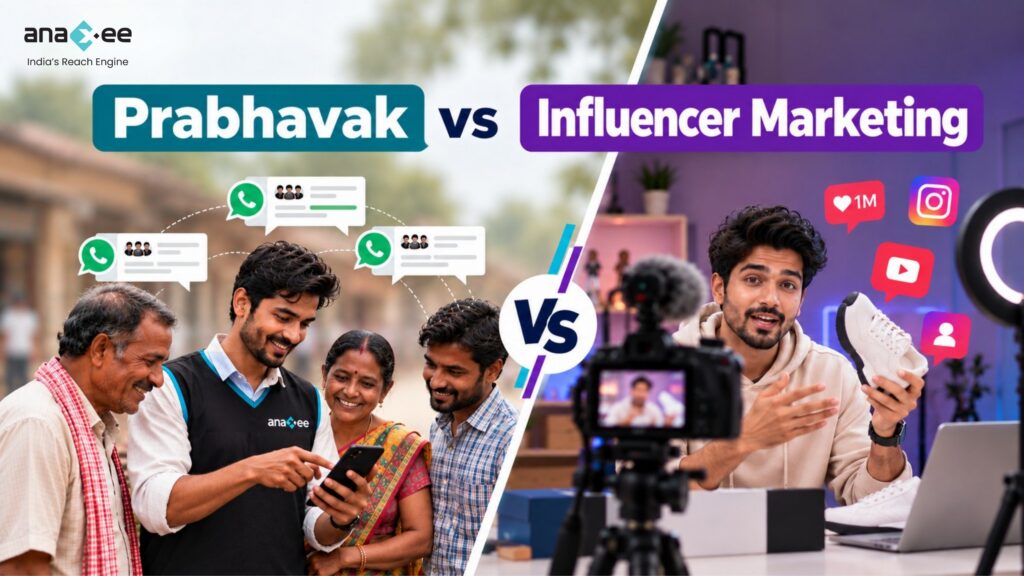

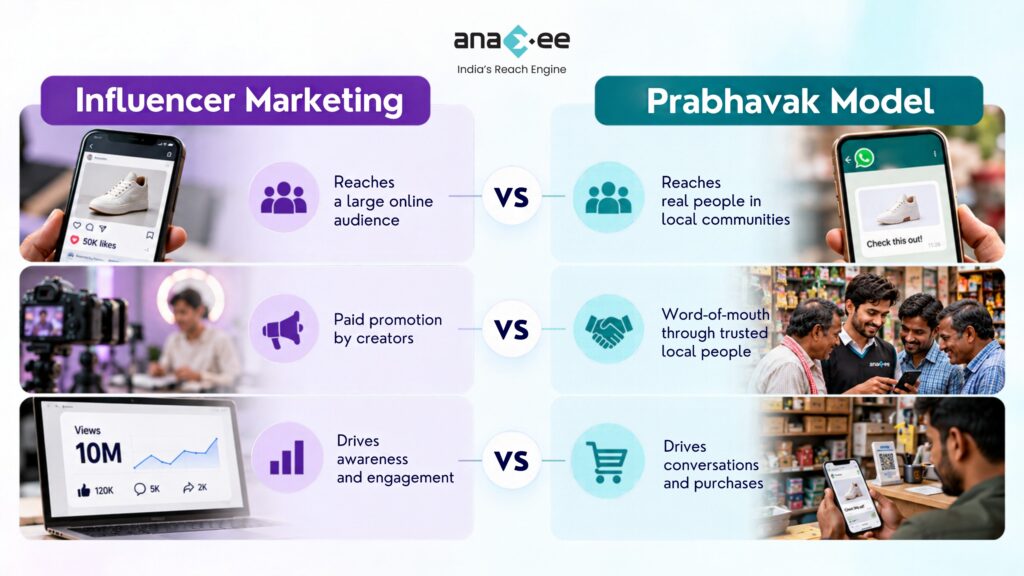
The short answer: influencer marketing runs on reach, the Prabhavak model runs on trust. An influencer puts your brand in front of a large online audience. A Prabhavak gets a trusted local person to recommend it, face to face, where the buying decision actually happens. One is built for awareness. The other is built for conversion.
So the real question isn’t which is “better.” It’s which job you’re trying to do — and, often, whether you should use both.
This guide breaks down the difference in plain terms: what each model is good at, how they compare on cost, trust, geography, and measurement, and how to decide which one fits your brand. If you’re new to the term Prabhavak, it helps to first read what a Prabhavak is — but the recap below covers the basics too.
Prabhavak vs influencer marketing: at a glance
Here’s the whole comparison in one view. The rest of the article unpacks each row.
| Influencer marketing | Prabhavak model | |
|---|---|---|
| Runs on | Reach | Trust |
| Who spreads the word | Online creators with large followings | Trusted local people in a specific area |
| Where it happens | Social feeds, online | On the ground — shops, homes, WhatsApp, local groups |
| Audience relationship | Follower to broadcaster | Neighbour to neighbour |
| Best for | Awareness, buzz, launches | Conversion, trust, first purchases |
| Strongest in | Metros and online audiences | Tier 2, 3, 4 towns and villages |
| You pay for | Reach and posts | Real conversations tied to results |
| Measurable? | Views, likes, reach — harder to tie to sales | Activity tracked and tied to conversions |
| After the campaign | The connection ends with the post | The local trust was there before, stays after |
Notice these aren’t ratings of good versus bad. They’re two different tools for two different jobs. Read the table again with your own goal in mind, and the right choice usually points itself out.
What is influencer marketing (and what it’s good at)
Let’s be fair to influencer marketing, because it earns its place.
Influencer marketing means partnering with people who have built an audience online — creators on Instagram, YouTube, or X — and paying them to feature your product. Their followers see it, and because they already like the creator, some of that goodwill rubs off on your brand.
What it does genuinely well:
- Scale of awareness. One post from a large creator can put you in front of hundreds of thousands of people in a day. Nothing on the ground moves that fast.
- Launch buzz. For a new phone, an app, a fashion drop — anything that thrives on being seen and talked about online — influencers create momentum quickly.
- Aspirational pull. A well-chosen creator lends your brand a certain image. That’s real value for categories built on aspiration.
- Content you can reuse. The photos and videos creators make often outlive the campaign as ad material.
Influencer marketing isn’t the problem child here. For the job of getting noticed, fast, online, it’s hard to beat.
Its limit is a specific one: reach is not the same as trust. A big following means a lot of people will see the message. It doesn’t mean many of them will act on it — especially for a considered purchase, or an audience that doesn’t live on social feeds. That’s the gap the Prabhavak model is built for.
What is the Prabhavak model?
Quick recap, in case you came straight to this comparison.
“Prabhavak” comes from the Hindi word prabhav — influence or impact — and literally means “one who influences.” A Prabhavak is a trusted local person who recommends a brand to the people around them, through real, everyday conversations.
Think of the schoolteacher, the shop owner, the society committee member — people with no online following, but with real standing where they live. When they recommend something, people in their circle listen, and often buy. The Prabhavak model organises that: it recruits these trusted locals, gives them a genuine reason to talk about a brand, and tracks each conversation back to a result.
The phrase people use for it is structured word of mouth — taking the oldest, most trusted form of marketing and giving it a system, so a brand can actually run it and measure it instead of leaving it to luck.
(For the full breakdown, see our guide on what a Prabhavak is.)
The core difference: reach vs trust
If you remember one thing from this article, make it this.
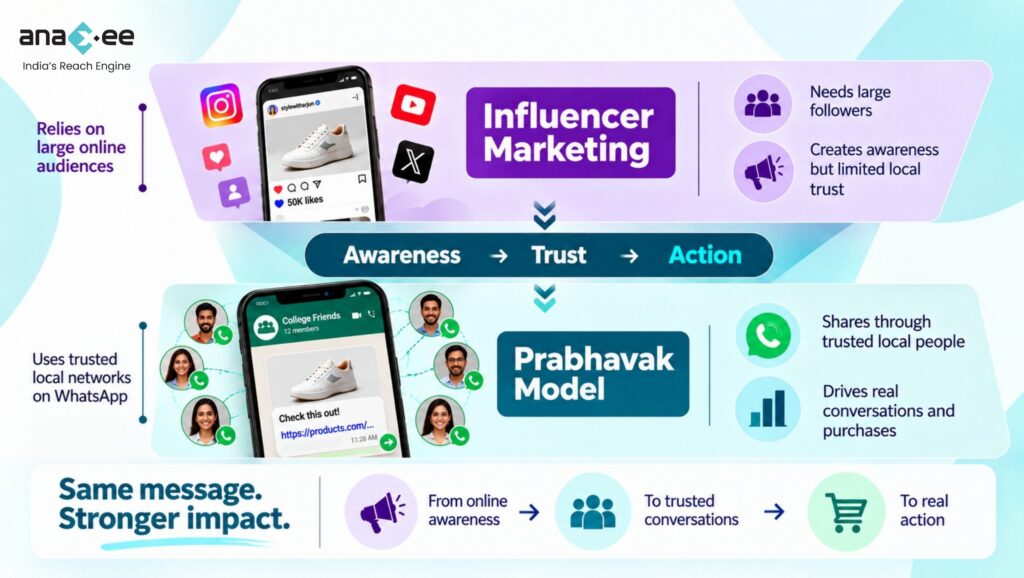
Influencer marketing buys reach. The Prabhavak model builds on trust. Everything else follows from that one split.
Here’s a way to feel the difference. Imagine you’re about to buy something you’re unsure about — a new brand of the product, a service you’ve never tried. Two things happen the same week.
First, a creator you follow online posts about it. It’s a nice post. You register it. You also know, somewhere in the back of your mind, that they were paid to make it. You scroll on.
Second, a friend, or the shopkeeper you’ve trusted for years, mentions the same product and says, “Yeah, I use it — it’s good.” No hashtag. No disclosure line. Just a person you believe.
Which one actually moves you toward buying?
For most people, most of the time, it’s the second. Not because the creator has less reach — they have vastly more — but because the friend has more trust. And trust, not reach, is what closes the gap between “I’ve heard of it” and “I bought it.”
That’s the whole comparison in one scene. Influencer marketing is very good at the first message. The Prabhavak model is built for the second.
Head to head on the things that matter
Beyond the core split, here’s how the two models compare on the dimensions brands actually weigh.
Audience and targeting. Influencer targeting is demographic and interest-based — you pick a creator whose followers match your buyer. It’s broad and probabilistic. Prabhavak targeting is geographic and relational — you place trusted people exactly where your buyers live, and they reach the specific people who already listen to them. One aims at a type of person; the other reaches actual named streets and communities.
Trust and credibility. An influencer’s credibility is borrowed and, everyone knows, rented for the campaign. A Prabhavak’s credibility is their own, built over years in the community, and it isn’t switched on and off by a brand deal. That’s why a smaller Prabhavak recommendation can out-convert a much larger influencer post.
Geography. This is a big, practical one for Indian brands. Influencer marketing is strongest in metros and among online audiences. But a huge share of India’s buying happens in Tier 2, 3, and 4 towns and villages — places where big creators have little pull and where a trusted local voice is everything. The Prabhavak model is built for exactly that terrain.
Longevity. When an influencer campaign ends, the connection to their audience ends with it. A Prabhavak’s relationship with their community existed before your brand arrived and continues after — so the trust you tapped isn’t rented for 24 hours, it’s part of the local fabric you can return to.
Measurability. Influencer results are usually reported in views, likes, and reach — real numbers, but hard to tie to an actual sale. The Prabhavak model logs each person’s activity and links it to conversions, so you can see which conversations led to which results. For a performance-minded marketer, that traceability is a meaningful edge.
Cost and ROI: what you’re actually paying for
The two models don’t just cost differently. They charge you for different things.
With influencer marketing, you’re paying for reach. The price scales with the size of the creator’s following. A big name costs a lot precisely because a lot of people will see the post. Whether those views turn into sales is a separate question — and often an unanswered one, because the link between a view and a purchase is hard to trace.
With the Prabhavak model, you’re paying for conversations that convert. You’re not buying a million impressions, most of which land on people who’ll never buy. You’re funding a set of real recommendations aimed at people close to a decision. Because activity is tracked to outcomes, you can see cost against actual results, not just eyeballs.
That difference matters most for the bottom of the funnel. For pure awareness, paying for reach can make sense — you want to be seen widely. But when the goal is conversions, paying for reach means paying for a lot of waste. Paying for trusted conversations puts your money closer to the sale.
A fair way to hold both: influencer spend is priced like advertising — cost per thousand seen. Prabhavak spend is priced like a sales channel — cost against people moved. Which one is “cheaper” depends entirely on whether you’re buying attention or buying action.
Which one should you choose?
Forget “better.” Ask what you’re trying to do. Here’s a simple way to decide.
Lean toward influencer marketing when:
- Your main goal is awareness — you need a lot of people to know you exist, fast.
- Your audience lives online and skews urban.
- You’re launching something visual or aspirational that thrives on being seen and shared.
- You want content and social proof you can reuse across channels.
Lean toward the Prabhavak model when:
- Your main goal is conversion — you need people to actually buy, subscribe, or sign up.
- A big part of your market is in Tier 2, 3, and 4 towns and villages.
- Your product needs trust to overcome hesitation — anything involving money, documents, health, or a first-time purchase.
- You want to see results tied to real activity, not just reach numbers.
A rough rule of thumb: if the hard part of your job is getting noticed, influencers help most. If the hard part is getting believed, Prabhavaks do.
Most brands, once they’re honest about where their sales actually come from, find they need more of the second than they’ve been buying.
Can you use both together?
Yes — and often that’s the smartest play. This isn’t really an either/or.
Think of your funnel. At the top, you need people to hear of you. Influencers are excellent there: broad, fast awareness. But awareness alone rarely closes a sale, especially outside the metros. At the bottom of the funnel, where someone is deciding whether to actually trust you with their money, a recommendation from a known local person does the convincing.
So the two stack neatly:
- Influencers create the awareness. People start recognising your name.
- Prabhavaks convert it. When your brand comes up in a local conversation, it’s no longer a stranger — the influencer buzz already warmed the ground, and the trusted local voice closes it.
This is the real meaning of “amplify, don’t replace.” The Prabhavak model isn’t there to kill your other marketing. It’s the layer that makes everything above it land harder. Your ad or influencer post plants the name; the Prabhavak turns that name into a decision, in the place and language where the decision happens.
Used together, each covers the other’s blind spot: influencers give you reach without deep trust, Prabhavaks give you trust without mass reach. Run both, and you get both.
Same brand, same budget: a side-by-side
To make it concrete, picture one brand — a personal-care company launching a new product in small-town India — with a fixed budget, spent two ways.
Run as an influencer campaign. The brand books a handful of mid-size creators. Their posts go out and rack up impressions — say, a few lakh views. Comments come in. Engagement looks healthy on the dashboard. But in the towns where the product actually needs to sell, most people either never saw the posts or saw them and scrolled past. On the shelf, the new product still sits unfamiliar, and unfamiliar products don’t get picked up. The campaign produced attention. Attention didn’t produce trial.
Run as a Prabhavak campaign. The same budget puts trusted locals to work across those towns — shopkeepers, community members, the people whose word already carries. Over a few weeks, they mention the product, use it, recommend it to people they actually talk to. The numbers are smaller and less flashy — hundreds of conversations, not lakhs of views. But those conversations happen right where the buying decision is made, from voices the buyer believes. More new products get tried. More get bought again. And every conversation is tracked, so the brand can see which towns and which profiles converted best.
Neither result is “wrong.” If the goal had been national buzz, the influencer run would look better. But the goal here was trial and sales in specific towns — and for that job, trusted local recommendation did what reach alone couldn’t.
Where Anaxee fits
Knowing you want trusted local recommendation is one thing. Finding genuinely trusted people across dozens of districts, onboarding them, and tracking every conversation is another — that’s an operation, not a campaign line.
This is what Anaxee does. Anaxee runs a large last-mile network across India — 40,000+ trained “Digital Runners” reaching 540+ districts — and has run on-ground campaigns for 350+ brands. Its Prabhavak offering turns that network into structured word of mouth: trusted local people carrying your brand into the exact markets where a recommendation still changes minds, with every activity tracked back to a result.
The framing Anaxee keeps honest is the one worth ending on. Prabhavak doesn’t replace your influencer or ad spend — it amplifies it. Your influencers and ads build awareness up top; Prabhavak converts that awareness on the ground, in the local language, from someone the buyer already trusts.
And you don’t have to commit to a national rollout to see if it works. The usual way in is a single district — run it, watch the numbers, then scale what works.
If you’re weighing where to put your next marketing rupee, that’s the conversation worth having.
Frequently asked questions
Is Prabhavak better than influencer marketing? Neither is better in general — they do different jobs. Influencer marketing is better for fast, wide awareness. The Prabhavak model is better for trust and conversion, especially in small towns. The right choice depends on your goal.
Is a Prabhavak just a micro-influencer? Not quite. Micro-influencers are still online creators, just with smaller followings. A Prabhavak’s influence is offline and local — built on real-life relationships in a community, not on a social media audience.
Which is cheaper, Prabhavak or influencer marketing? They’re priced differently. Influencer spend buys reach (cost per people reached); Prabhavak spend buys conversations tied to results (cost per people moved). For awareness, reach can be cost-effective. For conversions, paying for trusted conversations usually wastes less.
Can I use both influencer marketing and Prabhavaks? Yes, and it often works best. Use influencers to create awareness at the top of the funnel, and Prabhavaks to convert that awareness into action on the ground. They amplify each other.
Does the Prabhavak model work in metros too? It can, but its biggest edge is in Tier 2, 3, and 4 towns and villages, where local trust is strongest and big-creator influence is weakest. In metros, influencer marketing is often the more natural fit.
How is a Prabhavak campaign measured? Each Prabhavak’s activity is logged and tied back to a result — a click, sign-up, or sale — so you can see which conversations drove conversions, rather than only tracking views and likes.
Who provides Prabhavak marketing in India? Anaxee Digital Runners runs Prabhavak as a structured word-of-mouth service, built on its last-mile network across 540+ districts.