
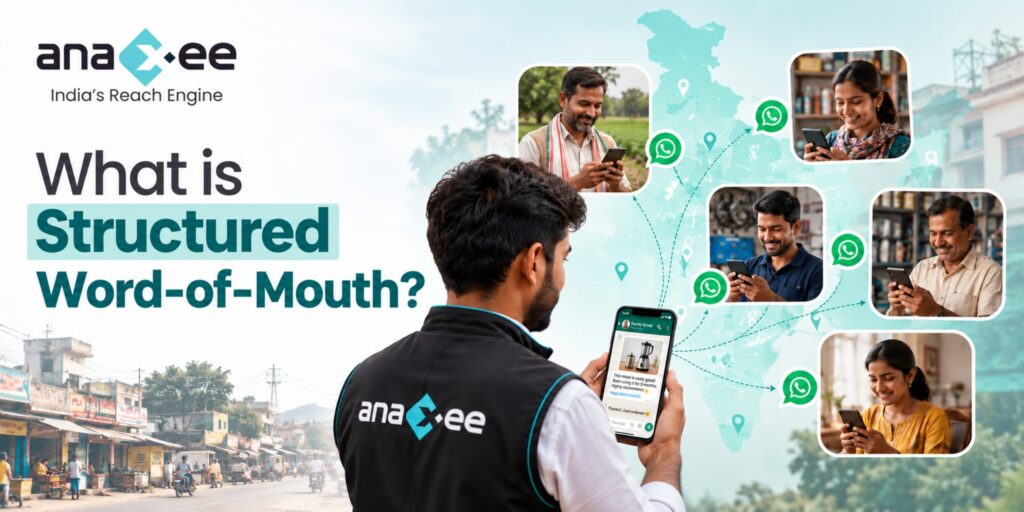

Structured word of mouth is ordinary word of mouth made deliberate — organised so a brand can actually run it, measure it, and repeat it, instead of waiting and hoping. Same trusted recommendations that have always sold products best; just with a system around them, so they stop being luck and start being a channel.
Every marketer already agrees word of mouth is the most trusted form of marketing. The catch has always been that you can’t plan it, budget for it, or prove it worked. Structured word of mouth is the answer to that catch.
This guide explains what it means, what “structured” actually adds, how it differs from organic word of mouth and from referral programs, and how brands put it to work — especially in India, where trust still decides most purchases.
Word of mouth: the best channel nobody can control
Ask any marketer which channel converts best, and word of mouth wins. A recommendation from someone you trust beats every ad ever made. People act on it because there’s no agenda behind it — just an honest “I use this, it’s good.”
And yet, look at any marketing budget. There’s a line for ads. A line for influencers. A line for SEO. There’s almost never a line for word of mouth. Why? Because of how it usually behaves:
- It’s invisible. You can’t see it happening. A hundred conversations about your brand might be going on this week, and you’d never know.
- It’s unpredictable. You can’t decide it’ll happen on Tuesday, in these five towns, for this new product. It shows up when it shows up.
- It’s uncountable. Even when it works, you can’t easily prove which sale came from which conversation.
- It’s un-plannable. You can’t brief it, schedule it, or scale it the way you can a campaign.
So the best channel gets treated like weather. Everyone hopes for a good spell, nobody plans around it.
Most brands accept this. They assume word of mouth is something you earn — a reward that arrives, if you’re lucky, after years of doing everything right. Structured word of mouth challenges that assumption. What if the only real problem with word of mouth was the lack of structure — and structure is something you can add?
What “structured” actually adds
Structure is just four things laid on top of natural word of mouth. Each one fixes one of the problems above.
1. Chosen people, not random ones. Instead of hoping the right person happens to mention you, you start with trusted local people picked on purpose — the ones whose recommendations already carry weight where your buyers are. This fixes un-plannable: you decide who talks and where.
2. A real reason to talk. You give those people a genuine reason to bring your brand up — a product worth recommending, an offer worth sharing. Not a script to recite (that kills the trust), but a real hook. This fixes unpredictable: the conversation happens because it was set in motion, not by chance.
3. A way to distribute it. You give them a simple task and a channel — often WhatsApp, where these conversations already live in India. This fixes invisible: the activity flows through a path you can see.
4. Tracking. Every conversation is logged and tied back to a result — a click, a sign-up, a sale. This fixes uncountable: now you know what happened, and which parts worked.
Add those four, and word of mouth stops being weather. It becomes a channel you can turn on, point at a market, and measure — while still feeling, to the person on the receiving end, exactly like a friend’s honest recommendation. Because that’s what it is. Structure organises the recommendation; it doesn’t fake it.
Structured vs organic word of mouth
Most word of mouth is organic — it happens on its own, by chance, usually after someone has already bought and loved a product. It’s wonderful when it happens. You just can’t rely on it, direct it, or count it.
Structured word of mouth is designed. It’s set in motion on purpose, aimed at a chosen market, and measured. Here’s the difference side by side.
| Organic word of mouth | Structured word of mouth | |
|---|---|---|
| How it starts | By chance, on its own | On purpose, by design |
| When it happens | After a good experience, unpredictably | When you decide to run it |
| Who talks | Whoever happens to | Trusted people you’ve chosen |
| Can you aim it? | No | Yes — at specific towns and audiences |
| Can you measure it? | Barely | Yes — tied to conversions |
| Can you repeat it? | No | Yes |
One important thing to be clear about: structured word of mouth doesn’t replace organic word of mouth, and it definitely doesn’t fake it. A structured recommendation still has to be honest, from a real person who’d genuinely stand behind it — otherwise the trust collapses and you’ve gained nothing. Structure just means you’re no longer sitting back waiting for good conversations to happen. You’re making sure they do, in the places that matter to you.
How structured word of mouth works
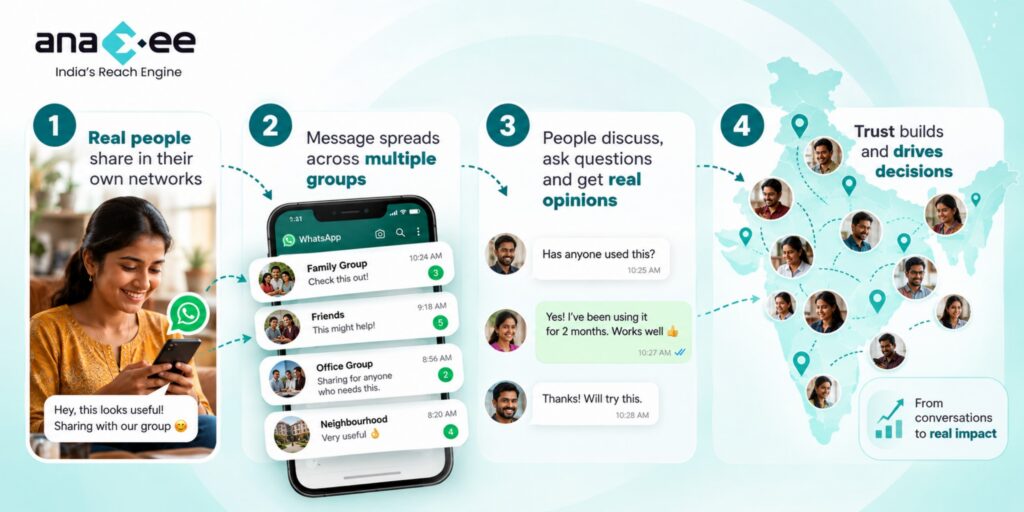
In practice, running structured word of mouth follows a simple loop.
Start with trusted locals. Find people who already have standing in the area you care about — a shopkeeper, a teacher, a society member, a medical rep. Not people with the biggest audience, people with the most trust. Their word is the raw material.
Give them a reason, not a script. Tell them clearly what the brand is and why it’s worth mentioning. Give them a real hook — a genuine benefit, a good offer — and let them talk in their own words. The moment it sounds rehearsed, it stops working.
Put it in motion locally. Hand them a light task: share this, mention this, pass this link to the people you’d naturally talk to. Usually it runs where the conversations already happen — WhatsApp, the shop counter, the community group — in the local language.
Track and learn. Log each person’s activity and connect it to what followed: clicks, sign-ups, sales. Now you can see which people, towns, and messages actually converted — and do more of what worked.
That last step is what makes it a loop rather than a one-off. Each round teaches you something, so the next round is sharper. Over time you’re not just running word of mouth — you’re getting better at it, with data telling you where to push.
This is exactly how the Prabhavak model operates on the ground. (More on that below, and in our guide to what a Prabhavak is.)
How it’s different from referral and affiliate marketing
Structured word of mouth gets confused with referral and affiliate programs, because all three involve people spreading the word. The difference is what drives them.
Referral marketing kicks in after the sale. A happy customer refers a friend and gets a reward. It’s great, but it only works once someone has already bought and loved your product — so it can’t help you reach a cold market, and it’s capped by how many delighted customers you already have.
Affiliate marketing is driven mainly by commission. Anyone with a link earns a cut per sale. That can scale, but it often pulls in strangers chasing a payout, and it can feel transactional or spammy — the affiliate’s own trust rarely enters into it.
Structured word of mouth leads with existing trust and a genuine reason to recommend. An incentive can be part of it, but the engine is a trusted person choosing to vouch for something they’d stand behind, to people who believe them. It doesn’t require the person to have bought first (unlike referral), and it isn’t built on strangers chasing commission (unlike affiliate).
Put simply: referral and affiliate programs bolt a reward onto a transaction. Structured word of mouth organises real trust. The reward, where it exists, is the smaller part — not the point.
The measurement question: the whole unlock
There’s an old line in marketing: you can’t measure word of mouth. For decades, that was true, and it’s the real reason the channel never made the budget. You can’t defend a spend you can’t measure.
Structured word of mouth exists mostly to solve that one problem.
Because the activity runs through chosen people, on a channel you can see, tied to trackable links or codes, you can now connect a conversation to an outcome. Which town produced sign-ups. Which type of person converted best. Which message actually moved people. The recommendation was always powerful — now it’s also accountable.
That changes what kind of thing word of mouth is to a marketer. It stops being a soft, feel-good idea you nod along to, and becomes a line you can put in a plan, fund with a straight face, and optimise like any other channel. You can start small, read the numbers, and scale what works — the same discipline you’d apply to paid ads.
Measurability is the quiet revolution here. Not that structured word of mouth invented trusted recommendation — that’s as old as markets. It’s that, for the first time, you can prove it worked and do more of it on purpose.
Why this matters especially in India
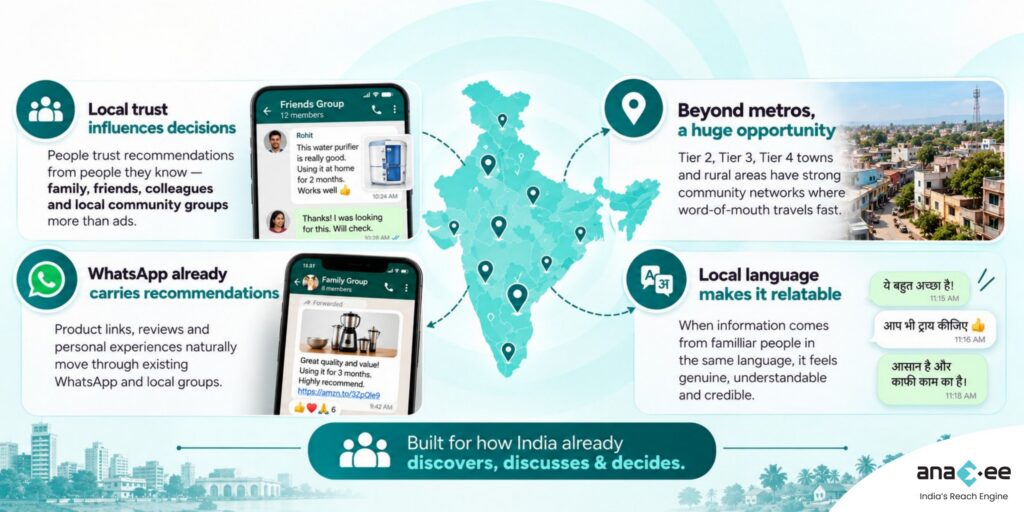
Structured word of mouth is a strong idea anywhere. In India, it fits the market almost perfectly.
Trust decides purchases here. Across much of the country, and especially outside the big metros, people buy on the word of someone they know far more than on the strength of an ad. A neighbour’s opinion, a shopkeeper’s nudge, a relative’s recommendation — these carry the day. That’s the exact force structured word of mouth organises.
The real market is beyond the metros. A huge share of India’s consumers live in Tier 2, 3, and 4 towns and villages. National ad campaigns reach them thinly, and big online creators barely reach them at all. But local trust runs deep there. Structured word of mouth is built for precisely this ground.
WhatsApp is already the channel. Recommendations in India increasingly travel on WhatsApp — links forwarded, products vouched for, “ye le lena” from a friend. Structured word of mouth simply runs along the rails people already use.
Language matters. A message in the language someone thinks in, from a familiar local voice, lands in a way a polished national campaign never will.
Put those together and you can see why a model built on trusted local recommendation isn’t a nice-to-have in India — for many brands trying to grow in real markets, it’s the most natural way to actually get bought.
How brands can build structured word of mouth
If you want to run this yourself, here’s what it takes.
- A network of trusted locals in each market you care about — the hardest ingredient to assemble, because you need people with real standing, not just contacts.
- An onboarding system to bring them on, tell them what they’re representing, and give them a genuine reason to talk.
- A simple task and channel so activity actually flows — usually WhatsApp, with a clear message and a trackable link.
- Tracking that ties each conversation back to a result, so you can measure and improve.
None of that is complicated in theory. The hard part is coordination at scale. Finding genuinely trusted people across dozens of districts, onboarding them, keeping them active, and tracking it all is a real operation — and done loosely, it slides right back into the invisible, uncountable word of mouth you were trying to escape.
That’s the honest catch. Structured word of mouth is powerful, but the structure has to be built and run properly, or it isn’t structure at all. Which is why most brands don’t do it from scratch — they work with a network that already has the trusted people and the tracking in place.
Structured word of mouth in practice: Anaxee’s Prabhavak
If structured word of mouth is the idea, the Prabhavak model by Anaxee is one of the clearest examples of it running in the real world.
Anaxee operates a large last-mile network across India — 40,000+ trained “Digital Runners” reaching 540+ districts — and has run on-ground campaigns for 350+ brands. Prabhavak puts that network to work as structured word of mouth: trusted local people carrying a brand’s message into real conversations, with each activity tracked back to a result. Chosen people, a real reason to talk, local delivery, measurement — the four ingredients, already assembled and running.
The positioning Anaxee is careful about is the same honest one this whole article rests on: it doesn’t replace your existing marketing — it amplifies it. Your ads and campaigns create awareness; Prabhavak turns that awareness into trusted recommendations on the ground, where the buying decision actually happens.
And because it’s structured, you don’t have to bet big to try it. The usual starting point is a single district — run it, read the numbers, then scale what works.
If you’d like to go deeper on the model itself, start with what a Prabhavak is, then see how it stacks up against creators in Prabhavak vs influencer marketing.
Frequently asked questions
What is structured word of mouth in simple terms? It’s word of mouth made deliberate — organised so a brand can run it, aim it at specific markets, and measure it, instead of waiting for recommendations to happen on their own.
How is it different from normal (organic) word of mouth? Organic word of mouth happens by chance, usually after a good experience, and can’t be tracked. Structured word of mouth is set in motion on purpose, through chosen trusted people, and tied to measurable results.
Can word of mouth really be measured? Yes — that’s the whole point of structuring it. Because activity runs through known people and trackable links, you can connect conversations to clicks, sign-ups, and sales.
Is structured word of mouth the same as referral marketing? No. Referral marketing rewards existing customers for referring others, and only works after a purchase. Structured word of mouth leads with local trust and a genuine reason to recommend, and can reach people who haven’t bought yet.
Does it replace advertising? No. It amplifies it. Advertising builds awareness; structured word of mouth turns that awareness into trusted recommendations that drive action.
Why does it work so well in India? Because trust drives most purchases here, a huge share of buyers live in smaller towns where ads reach thinly, and recommendations already travel on WhatsApp in local languages — exactly the conditions structured word of mouth is built for.
How can a brand start with structured word of mouth? The practical route is to work with a network that already has trusted local people and tracking in place. In India, Anaxee runs this as its Prabhavak model, usually starting with a single district so you can see results before scaling.