


Is Your Pharma Doctor Database Outdated? Find Out
Imagine this.
Thank you for reading this post, don't forget to subscribe!It is the beginning of a new month at a pharmaceutical company.
The sales team has its targets. The regional managers have reviewed their territories. Medical representatives, or MRs, have their doctor lists ready. The monthly visit plans are prepared, and everyone knows which doctors they are expected to meet.
The system looks organised.
Thousands of doctor records sit inside the company’s database. Each record has a name, a clinic address, a speciality and, hopefully, a contact number. The sales team uses this information to plan visits, build relationships and promote its products.
But there is one simple question that rarely gets enough attention.
How much of this database still reflects reality on the ground?
Does the doctor still practise at the same clinic? Is the clinic still operating? Has the doctor moved to another hospital? Is the same doctor listed twice under slightly different names? And when an MR reports a visit, is the address in the system actually the right place?
These questions may sound basic. Yet their answers can affect how a pharmaceutical company spends its money, plans its field activities and measures sales performance.
The problem is not necessarily that the database was created incorrectly. It may simply have become old.
And in a business that depends on regular doctor engagement, old information can become an expensive problem.
The database was correct when someone entered it. What about today?
Most doctor databases are built over time.
A new MR joins a territory and adds doctors. Another representative takes over the area a few years later. A doctor changes clinics. A hospital opens a new branch. Someone retires, relocates or stops practising at a particular address.
The business continues to move, but does the database move with it?
Sometimes, yes. A good MR may update the information promptly. A manager may review the records. A CRM system may make it easier to maintain consistent information.
But updating a database across thousands of doctors and multiple territories is not a one-time task.
It is an ongoing responsibility.
Consider a simple example.
A company has a doctor listed at a clinic in Indore. The doctor later moves to another practice. The old address remains in the system because nobody updates it.
The MR assigned to that doctor continues to plan visits using the old record. Perhaps the MR eventually discovers the new address. Perhaps the visit is marked unsuccessful. Perhaps the information is updated several weeks later.
Now imagine similar cases spread across multiple cities and states.
One outdated record may have little impact. Thousands of records with similar issues can create a much bigger operational challenge.
The key question is not whether your database was accurate when it was created. It is whether it is accurate enough to support today’s decisions.
When an MR’s monthly plan depends on old information
Medical representatives work with targets, routes, schedules and limited time.
Their day may involve visiting several doctors, travelling between clinics, waiting for appointments and covering different parts of a territory. Companies invest in salaries, travel, training, management and the systems that support this work.
Now consider what happens when the information behind the visit plan is wrong.
An MR reaches a clinic and finds that the doctor has moved.
Another visits a location where the doctor no longer practises.
A third discovers that two entries in the database refer to the same practitioner.
In each case, the problem goes beyond a wrong field in an Excel sheet. Someone has spent time acting on information that needed to be checked.
The immediate loss may be a wasted journey or an unsuccessful visit. The wider impact could include repeated attempts, poor territory planning, unreliable coverage reports and management decisions based on incomplete information.
There is also an important distinction here.
An unsuccessful visit does not automatically mean an MR has done anything wrong. The underlying record may be inaccurate, the doctor may have been unavailable, or the clinic may have changed its schedule.
Without independent verification, management may struggle to distinguish between a field execution problem and a data quality problem.
That is why doctor database accuracy deserves attention in its own right.
The hidden problem with measuring activity
Pharmaceutical companies often track field activity closely.
How many doctors were visited? How many calls were completed? Was the monthly plan followed? Which territories achieved their coverage targets?
These are useful questions. But they depend on the quality of the underlying doctor list.
Suppose a territory contains 250 doctor records. The MR reports regular coverage against the list, and the monthly dashboard shows the expected number of visits.
That appears reassuring.
But what if some records are outdated? What if some doctors are duplicated? What if the clinic address is wrong?
The company may be measuring activity against a list that no longer represents the real market.
The dashboard may still look complete. The numbers may still add up. Yet the information used to plan the next month could be unreliable.
This creates a difficult situation for management: the company may be measuring how consistently its team follows a plan without knowing whether the plan itself is built on accurate information.
This is not an argument against CRM systems or MR reporting. Those systems remain important.
It is an argument for checking the quality of the data that feeds them.
A good system can organise information, track activity and generate reports. It cannot automatically guarantee that every doctor record reflects the current situation at a clinic.
That requires a process for verifying ground reality.
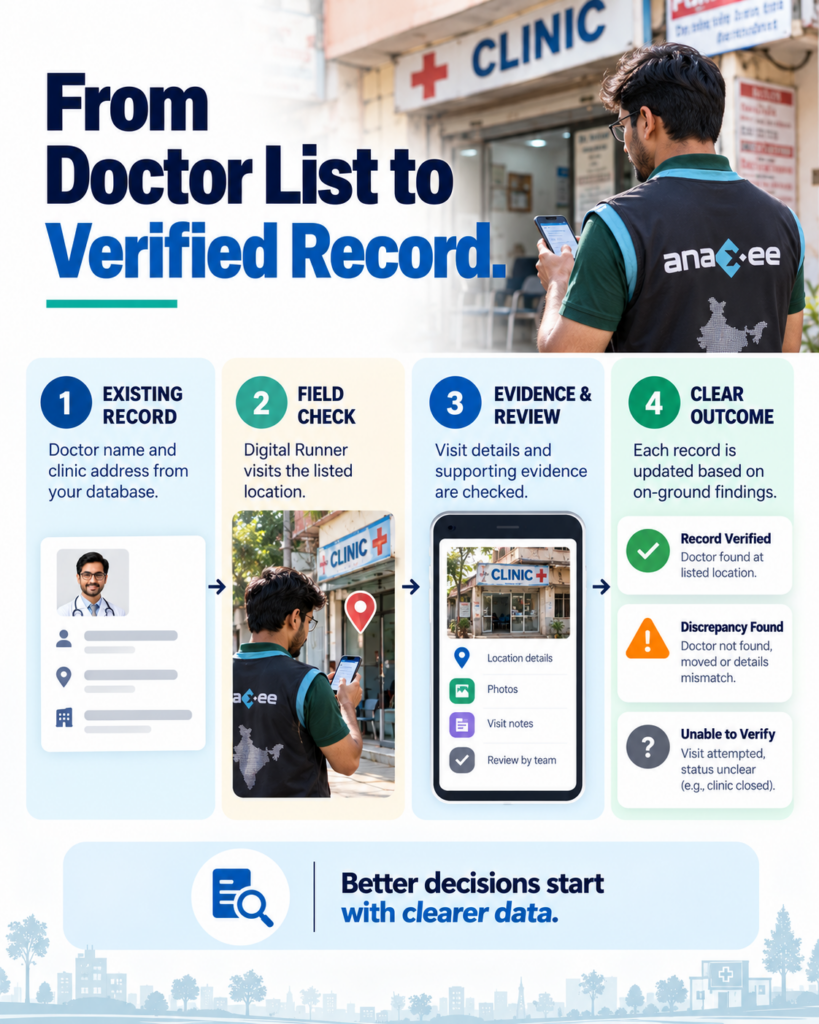
Why asking MRs to verify their own doctor lists may not be enough
Medical representatives are an important source of local knowledge.
They often know their doctors, understand clinic schedules and maintain long-standing professional relationships. Their updates are valuable and should remain part of the database management process.
However, there is a difference between maintaining a database as part of daily work and conducting an independent audit of that database.
An MR’s primary responsibility is to manage the territory, engage with doctors and meet business objectives. Verifying every record through a separate, documented process can add to that workload.
There may also be differences in how people interpret and report information.
One representative may mark a doctor as inactive after one unsuccessful visit. Another may retain the record because they believe the doctor will return. A third may know that the doctor has shifted but may not have updated the system yet.
None of these situations necessarily indicates misconduct.
They do, however, show why a common verification method matters.
A company needs a consistent way to establish whether a doctor exists at the recorded location, whether the practice is active, whether the speciality is correct and whether the available information is current.
An independent verification exercise can provide that additional layer of confidence without replacing the MR’s role.
The real cost is not always visible in one report
Let us take a hypothetical example.
A pharmaceutical company has a master database of 50,000 doctors. It decides to check the records independently and discovers that some doctors have shifted, some records are duplicates, and some clinics are no longer operating at the recorded addresses.
We do not need to assume a particular error rate to understand the business problem.
Every confirmed issue gives the company an opportunity to correct its records and review the field plan.
The financial impact depends on what the audit finds and how the company uses the results.
For example:
- If a doctor has shifted, the company can update the clinic address and reduce the chance of future misdirected visits.
- If two records belong to the same doctor, the company can review the duplication and improve coverage reporting.
- If a clinic is permanently closed, the company can update the record and reconsider the assigned visit plan.
- If the speciality is incorrect, the company can improve segmentation and make its engagement more relevant.
- If the doctor cannot be located, the company can flag the record for further investigation instead of treating it as confirmed.
These improvements may support better use of field time, more reliable reports and clearer territory planning.
However, a responsible business case should measure the actual findings rather than assume a fixed percentage of bad records or promise a guaranteed financial return.
The first step is to establish the facts.
Only then can management estimate the potential savings and decide where to act.
Why physical verification still has a role
Digital tools have made it easier to collect and organise doctor information. Existing databases, online listings, telephone calls and other available sources can all help validate records.
But some questions are best answered by checking the location itself.
Does the clinic exist at the recorded address? Is the doctor’s name displayed or otherwise confirmed? Is the practice operational? Does the location match the information in the master database?
A physical visit can help answer these questions and capture supporting evidence.
For a nationwide exercise, this requires careful planning. Cities, towns and rural locations present different travel conditions. Some records may be easy to confirm; others may need additional research or follow-up.
Not every record will require the same effort.
A sensible verification programme therefore combines a clear process, suitable verification methods, structured data collection and quality checks.
The aim is not simply to send people to locations. It is to produce a consistent, usable record of what was verified, how it was verified and what remains uncertain.
That distinction matters when the results are used for business decisions.
What should a pharmaceutical company verify?
A doctor database audit should begin with a clear set of fields and agreed definitions.
Depending on the company’s requirements, the verification may cover:
Doctor identity: Does the practitioner match the record provided?
Speciality: Is the recorded speciality correct, based on the available evidence?
Clinic address: Does the location match the database?
Practice status: Is the clinic operating, closed, shifted or otherwise unavailable for confirmation?
Contact information: Are the available contact details current and usable?
Duplicate records: Could multiple entries refer to the same doctor or practice?
Evidence and timestamp: What evidence supports the verification result, and when was it collected?
Unresolved cases: Which records need a second attempt, additional research or confirmation from the client?
The exact scope should be agreed before fieldwork begins. Some companies may also require clinic mapping, nearby medical store mapping or additional fields for future analysis.
The important thing is to avoid treating every record as a simple yes-or-no question. Some records will be confirmed, some will require correction, and others will remain unresolved until more evidence is available.
A well-designed audit makes those differences visible.
From an old doctor list to a reliable business asset
Doctor database verification is often treated as a one-time clean-up exercise.
That is a useful starting point, but it should not be the end of the conversation.
Once a company has established a verified baseline, it can introduce a regular process for updating records. New doctors can be checked before being added. Clinic shifts can be recorded. Unresolved cases can be reviewed. Periodic checks can identify records that need attention.
Over time, this can support a more reliable doctor master database.
It can also create a stronger foundation for analytics and future AI applications. But those applications should come after the data has been structured, checked and maintained. AI cannot make outdated source information trustworthy simply by processing it.
The immediate goal is much simpler: make sure that the information used to plan field activities reflects reality as closely as possible.
How Anaxee can help pharmaceutical companies see the ground reality
At Anaxee Digital Runners, our approach is built around distributed field execution supported by digital workflows and structured data collection.
For a doctor database verification programme, the approach can be designed around the client’s existing master list, agreed verification fields, physical location checks where required, supporting evidence, quality review and structured delivery of the results.
The scope can be tailored to the size of the database, the locations involved and the level of verification required. A pilot can help establish practical field productivity, common data issues, verification success rates and the cost of scaling the exercise.
This gives pharmaceutical leaders a way to assess the real condition of their doctor database before committing to a larger programme.
The goal is not to replace medical representatives or question every report they submit. It is to give the company an independent view of its data so that its field teams and managers can work with greater confidence.
Because before a company can improve its coverage, it needs to know what it is covering.
And before it can make better decisions using data, it needs to know whether that data is still true.
Is Your Doctor Database Ready for an Independent Reality Check?
You may already have a CRM, a national doctor master list and a field force that works hard every day.
But when was the last time you independently checked whether the records still match what is happening at clinics across your territories?
Anaxee can help you explore a practical approach to doctor database verification, clinic mapping and large-scale ground-level data collection.
Book a conversation with our team to discuss your database, your verification requirements and how a pilot could help you understand the scale of the opportunity.
Let’s Talk About Your Doctor Database →
Your next productivity improvement may not begin with more doctor visits. It may begin with making sure you have the right doctors, at the right locations, in your database.