


The Hidden Cost of Inaccurate Doctor Data: Are Your Medical Representatives Spending Time on the Wrong Visits?
Imagine a pharmaceutical company with hundreds of medical representatives working across India.
Thank you for reading this post, don't forget to subscribe!Every month, the sales team prepares its targets. Regional managers review performance. Medical representatives plan their routes and visit doctors across cities, towns and smaller markets.
The company tracks the number of visits, checks coverage reports and reviews progress against targets.
On paper, everything looks organised.
Now consider a different question.
What if some of those visits are being planned using outdated information?
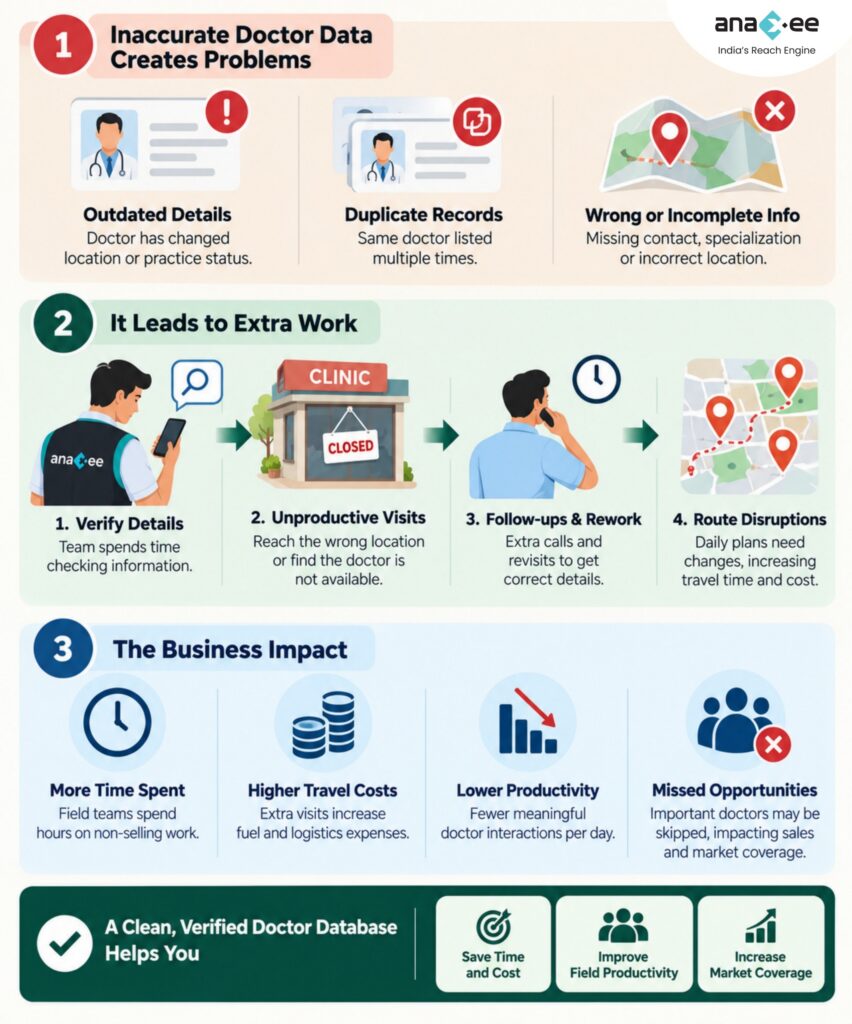
A doctor may have shifted clinics. A practice may have closed. Two records may refer to the same doctor. A specialist may no longer be practising at the address recorded in the company’s system.
The medical representative may still be working hard. The manager may still be reviewing reports. The company may still be spending money on salaries, travel and field operations.
But the information guiding those activities may no longer be correct.
This is where an old doctor database becomes more than a data management problem. It can become a field productivity problem.
And the cost may be spread across thousands of small incidents that are difficult to see in a monthly sales report.
The visit is planned. But is the information correct?
Let’s take a simple example.
A pharmaceutical company has a doctor listed in its master database in Jaipur. The record includes the doctor’s name, speciality, clinic address and a planned visit frequency.
The MR includes the doctor in the monthly route plan.
On the day of the visit, the MR reaches the location and discovers that the doctor moved to another clinic several months ago.
The MR now has a choice.
They can ask around, try to find the new location, call someone for information or move on to the next doctor.
Whatever they decide, the original plan has already been disrupted.
The time spent travelling to the wrong location cannot be recovered. If the MR searches for the new clinic, other planned visits may be delayed. If the visit is postponed, another attempt may be required.
Now imagine that this happens repeatedly across a territory.
One incident may be manageable. Repeated incidents can affect the productivity of the entire field team.
The important point is that the MR’s effort was not necessarily the problem. The information used to plan the visit was.
When the doctor database is inaccurate, even a well-managed field team can lose productive time.
The cost of one wrong address is bigger than the journey
It is tempting to think that an incorrect clinic address creates only a small travel expense.
But the full cost can include several elements.
First, there is the time spent travelling to the wrong location.
Second, there is the time spent discovering that the information is incorrect.
Third, there may be an attempt to locate the correct clinic or contact the doctor.
Finally, the MR may need to rearrange the rest of the day’s schedule.
The impact is not limited to fuel or travel allowance. The company is also paying for the working time of the representative and the management systems supporting the field operation.
There is another cost that is harder to measure: the opportunity to use that time for a productive visit elsewhere.
That does not mean every unsuccessful visit is wasteful. Doctors can be unavailable, emergencies can arise, and schedules can change even when the database is accurate.
The real question is how many avoidable failures occur because the company is working with information that should have been updated earlier.
Without reliable data, it is difficult to answer that question.
What happens when the same doctor appears twice?
Incorrect addresses are only one part of the problem.
Duplicate records can create a different type of confusion.
Suppose a doctor is listed under two slightly different names. One record uses the doctor’s full name, while another uses an abbreviation. The clinic address may also be written differently.
The two entries may be treated as separate doctors even though they refer to the same practitioner.
This can affect several parts of the business.
- The doctor count may appear higher than the actual number of unique practitioners.
- Territory planning may assign unnecessary attention to duplicate entries.
- Visit coverage reports may become difficult to interpret.
- Management may struggle to understand the true size of a territory.
- CRM data may become harder to maintain as more records are added.
Duplicate records do not automatically lead to two physical visits. Good MRs may recognise the duplication and correct it.
However, if the problem remains unresolved in the master database, it creates a risk of inconsistent planning and reporting.
The same issue can occur when doctors work at multiple clinics. In that case, the company needs to distinguish between a duplicate doctor and a genuine additional practice location.
That distinction requires proper data checks, not simply deleting records that look similar.
The monthly target can hide the real problem
Many pharmaceutical companies measure their field teams through monthly visit targets.
These targets are useful. They help managers understand activity, identify gaps and maintain regular engagement with doctors.
But a visit count alone does not tell the whole story.
Consider two hypothetical territories.
In Territory A, the doctor database is current, addresses are correct, and the field team can plan routes with confidence.
In Territory B, several records are outdated, some doctors have moved, and the team regularly needs to resolve location problems.
Both territories might report the same number of completed visits.
Yet the effort required to achieve those numbers could be very different.
Territory B may need more travel, more calls to locate doctors, more rescheduling and more management attention.
The monthly report may not clearly show how much of that extra effort came from inaccurate data.
This is why pharmaceutical leaders should look beyond activity numbers and ask whether the underlying doctor list supports efficient field execution.
A good productivity review should consider both the work completed and the quality of the information used to plan that work.
How much could inaccurate doctor data cost a pharmaceutical company?
There is no single number that applies to every company.
The financial impact depends on the size of the doctor database, the frequency of visits, the actual error rate, the distance between clinics, the cost of field operations and how often errors cause additional work.
But companies can build a practical estimate using their own data.
Let’s use a hypothetical example.
Suppose a pharmaceutical company maintains a database of 75,000 doctors and plans to visit each doctor once a month.
That represents a planned 900,000 doctor visits over a year if the full list is covered every month.
Now suppose an independent audit finds that 5% of the records need correction because of outdated locations, duplicate entries or other issues that affect visit planning.
That would represent 3,750 records requiring attention.
It does not automatically mean 3,750 visits are wasted every month. Some errors may be discovered quickly, some may affect only the address, and some may be corrected before the next visit.
However, the example shows why even a modest data quality issue deserves attention in a large database.
If the company wants to estimate the financial impact, it should measure:
- The number of records requiring correction.
- The number of visits actually affected by those records.
- The average additional time or travel per affected visit.
- The fully loaded cost of MR time and travel.
- The proportion of the problem that can realistically be prevented through better data.
This creates a business case based on evidence rather than an assumed error rate or an exaggerated savings promise.
The result may show that some territories need urgent correction while others are already well maintained.
Either way, management gets a better basis for deciding what to do next.
Why adding more MRs may not solve a data problem
When a sales territory struggles to achieve its targets, one possible response is to review staffing, routes or visit frequency.
Sometimes that is the right decision.
But before increasing field resources, it is worth asking whether the existing team has accurate information.
Adding more representatives does not automatically correct outdated addresses. Increasing visit frequency does not resolve duplicate records. A new CRM system cannot guarantee that a clinic is still operating at the recorded location.
If the underlying database is unreliable, additional activity may fail to address the root cause.
The smarter approach is to examine the problem before deciding on the solution.
That means separating three questions:
Is the field team productive? Are representatives using their time effectively?
Is the territory designed correctly? Are routes, visit frequencies and doctor allocations appropriate?
Is the doctor database accurate? Are the records used for those decisions current and reliable?
These questions are connected, but they are not interchangeable.
A company needs to understand each one before making changes to its field operations.
What an independent doctor database audit can reveal
An independent audit can help a pharmaceutical company understand how well its master database reflects the current situation on the ground.
Depending on the agreed scope, the audit may examine:
Doctor existence and identity: Does the practitioner match the record provided?
Clinic location: Is the doctor practising at the recorded address?
Practice status: Is the clinic active, shifted, closed or still awaiting confirmation?
Speciality and practice details: Do the available details match the agreed verification requirements?
Duplicate records: Are multiple entries referring to the same doctor or practice?
Unresolved cases: Which records require additional research or another attempt?
The findings can then be organised by territory, region or other agreed business dimensions.
This helps leadership understand where the database is reliable, where corrections are needed and where further verification would provide the greatest value.
Importantly, the audit should distinguish between an inaccurate record and an unsuccessful verification attempt. A doctor who could not be reached is not automatically a fake doctor. A clinic that was closed during one visit is not necessarily permanently closed.
Clear status definitions and evidence are essential.
The objective is to establish what is known, what needs correction and what remains uncertain.
Why the verification process matters as much as the field visit
A field visit can generate useful information, but only if that information is captured and checked consistently.
A well-designed verification workflow may include digital task assignment, location and timestamp capture, clinic photographs where appropriate, structured responses and quality checks.
The resulting records should be reviewed for completeness, consistency and potential duplication before they are delivered to the client.
This creates a traceable process from the original master list to the final verified dataset.
For a nationwide programme, the approach must also account for differences between urban and rural markets, travel conditions, clinic availability and the quality of the original addresses.
Some records will be straightforward to verify. Others will need additional effort.
A pilot can help establish realistic productivity, common failure reasons, the cost of resolving difficult records and the verification methods best suited to different locations.
That evidence can then guide the design of a larger programme.
Better doctor data can support better field decisions
The goal of verification is not to produce a report that sits unused in a folder.
It is to give the company information it can act on.
Once the database has been checked, the company can update clinic addresses, resolve duplicates, flag inactive practices and review records that remain uncertain.
Sales managers can use the corrected information to reassess territory plans and identify where further attention is required.
Over time, a regular refresh process can help reduce the risk of the database becoming outdated again.
The same foundation can also support more reliable CRM reporting, analytics and future AI applications. But those benefits depend on having structured, trustworthy data first.
Better data will not automatically make every MR more productive or guarantee higher sales. It can, however, remove some avoidable obstacles and help managers make decisions with greater confidence.
That is a worthwhile objective in its own right.
How Anaxee helps pharmaceutical companies connect field reality with business decisions
Anaxee Digital Runners works at the intersection of distributed field execution, digital data collection and ground-level verification.
For pharmaceutical companies looking to audit a doctor master database, Anaxee can help design a structured programme based on the client’s records, geography, required evidence and quality standards.
Depending on the agreed scope, the process can combine physical clinic verification, location evidence, structured data capture, backend quality checks and organised data delivery. Clinic mapping and nearby medical store mapping can also be considered where they serve a clear business purpose.
The approach can begin with a pilot to establish the actual condition of the database and the effort required to verify it at scale.
This allows the client to make decisions using measured findings rather than assumptions about data quality or field productivity.
The aim is not to replace medical representatives or question their contribution. It is to ensure that the people managing doctor relationships have a reliable database to work with.
Because a field team can only plan as well as the information available to it.
And when a company invests heavily in doctor engagement, the quality of that information deserves the same attention as the activity itself.
Is Your Field Force Losing Time to a Data Problem?
Your medical representatives may already be working hard. Your sales managers may already be tracking their performance closely.
But are you certain that the doctor database behind those activities is accurate enough to support the next month’s plans?
Anaxee can help you explore how independent doctor verification and clinic mapping could improve visibility into your field operations.
Let’s discuss your current database, the challenges your teams face and whether a pilot could help quantify the opportunity.
Book a Conversation with Anaxee
The first step towards improving field productivity may not be asking your team to make more visits. It may be finding out how many avoidable problems begin before the visit even starts.