
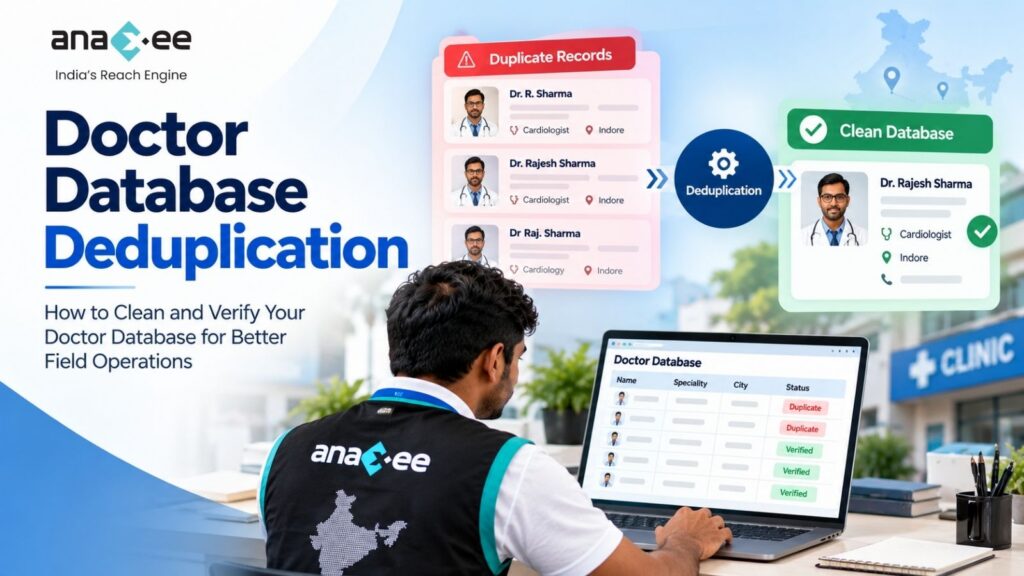

Doctor Database Deduplication: Why AI Alone Is Not Enough for Pharma Companies
A pharmaceutical company’s doctor database is only as useful as the accuracy of the information it contains.
Thank you for reading this post, don't forget to subscribe!When the same doctor appears multiple times under different names, clinic addresses or internal identification codes, teams can struggle to determine which record should be treated as the correct one. These inconsistencies can affect reporting, territory planning, medical representative (MR) workflows and the reliability of downstream analytics.
AI-assisted matching can help identify records that appear to belong to the same doctor. But identifying a likely duplicate and confirming the correct real-world record are two different tasks.
For pharmaceutical companies managing large doctor masters across multiple divisions, a more dependable approach combines automated doctor database deduplication, structured data validation and physical field verification where required.
This guide explains how that process works, where AI helps, and when on-ground verification adds value.
What Is Doctor Database Deduplication?
Doctor database deduplication is the process of identifying and resolving multiple records that may refer to the same medical professional.
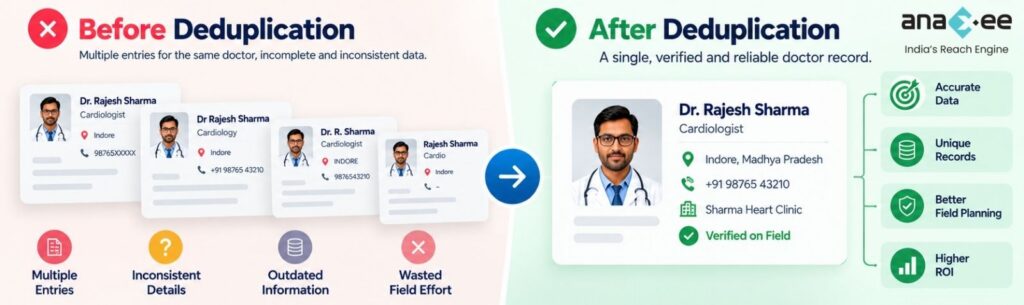
For example, a doctor might appear in a database as:
- Dr. R. Sharma
- Dr. Rajesh Sharma
- Dr. Rajesh K. Sharma
These entries could refer to one person—or to different doctors with similar names. The name alone is not enough to establish a reliable match.
Duplicates may also occur when the same doctor is associated with different clinics, practices in multiple locations, or is entered into separate systems by different teams.
A proper doctor database deduplication process therefore needs to distinguish between:
- Confirmed duplicates: Records supported by sufficient evidence as referring to the same doctor.
- Potential duplicates: Records with similarities that require further review.
- Distinct doctors: Records that look similar but represent different individuals.
- Incomplete or outdated records: Entries that need correction, verification or an explicit unresolved status.
This classification matters because an aggressive deduplication process can be just as problematic as leaving duplicates untouched. Merging two different doctors creates incorrect data rather than improving it.
Why Do Duplicate Doctor Records Accumulate?
Duplicate records rarely arise from one source alone. They often build up as databases grow, business structures change and multiple teams update information over time.
1. Variations in names and spellings
A doctor’s name may be entered with initials, expanded initials, different spellings or inconsistent formatting. Automated systems may treat these as different records even when they refer to the same person.
2. Different specialty classifications
The same medical professional may be categorised differently across systems or business divisions. Specialty labels, abbreviations and classification conventions can make matching more difficult.
A specialty mismatch should trigger investigation, not automatically establish that two records are different people.
3. Multiple practice locations
Doctors may consult at more than one clinic, hospital or nursing home. If each location generates a separate entry, a database may contain multiple records for the same doctor.
The correct solution is not necessarily to delete every additional entry. Depending on the database design, the doctor may need one master identity linked to multiple verified practice locations.
4. Changes to internal codes
When systems are migrated, records are recreated, or internal codes are deleted and reassigned, the relationship between an existing doctor and a new database entry may become unclear.
Internal codes can support matching, but they should not be treated as permanent proof of identity unless their reliability and uniqueness are established.
5. Independent data entry across divisions
In organisations with multiple divisions, teams may maintain records using different processes, naming conventions and update schedules.
Without clear ownership and common data standards, similar records can accumulate across the organisation.
Can AI Solve Doctor Database Deduplication?
AI and rule-based matching can significantly assist the deduplication process. They can compare names, identifiers, specialties, addresses and other available fields to identify records that may refer to the same person.
However, AI output should be treated as a decision-support mechanism—not unquestionable proof of identity.
Where automated matching helps
An automated process can:
- Standardise name formats and common abbreviations.
- Identify similar spellings and probable name variations.
- Compare available identifiers and contact or location fields.
- Flag records with overlapping details.
- Group likely duplicates for review.
- Prioritise ambiguous records for manual investigation.
- Apply consistent matching rules across large datasets.
This can reduce the volume of records requiring individual attention and make the review process more systematic.
Where automated matching can go wrong
Consider two doctors with similar names practising in the same city. A matching system may assign a high similarity score even though they are different people.
The reverse can also happen: one doctor with multiple practice locations and inconsistent name formats may receive a low matching score, despite the records referring to the same person.
The quality of the result depends on several factors:
- The completeness of the source database.
- The reliability of available identifiers.
- The quality of the matching rules or model.
- The handling of uncertain matches.
- The validation process used before records are merged.
The objective should not be to maximise the number of records removed. It should be to establish a more accurate, traceable doctor master.
Why Field Verification Matters After Deduplication
Automated deduplication primarily works with the information already available in the database. It cannot independently establish whether a clinic address is current, whether a doctor still practises at that location or whether an uncertain identity match is correct.
These questions may require a different verification method.
A structured doctor field verification programme can help pharmaceutical companies validate selected records against real-world information, subject to access, permissions and an appropriate verification protocol.
Depending on the approved scope, field verification may include:
- Confirming the doctor’s name and relevant professional details.
- Checking the reported clinic or practice address.
- Capturing the clinic’s GPS coordinates.
- Recording clinic operating hours, where available and appropriate.
- Capturing clinic photographs when authorised and necessary.
- Documenting discrepancies between the database and the field findings.
- Assigning an explicit status to records that cannot be verified.
Field verification should not be presented as a substitute for every digital check. Rather, it complements automated matching by validating the specific facts that require on-ground evidence.
A Practical Framework for Doctor Database Deduplication and Verification
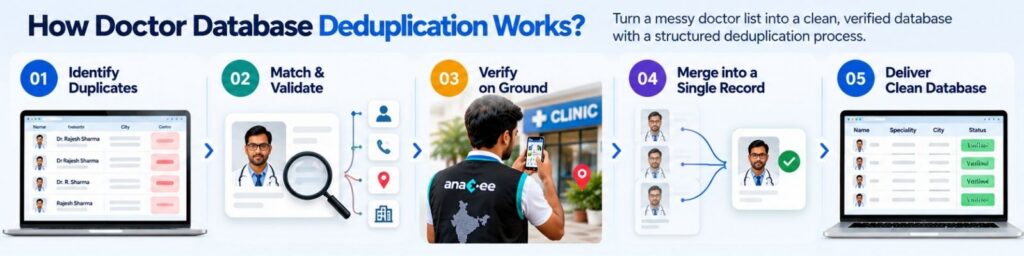
Pharmaceutical companies can structure the process into six stages.
Stage 1: Audit the existing doctor master
Start by understanding the database before changing it.
Review available fields such as doctor name, specialty, practice address, internal identifiers and other appropriately collected identifiers. Examine missing values, inconsistent formats, outdated entries and possible duplicates.
The audit should also identify the systems or divisions contributing records and document the rules currently used to create or update doctor entries.
Output: A baseline view of data quality and the main categories of duplication.
Stage 2: Standardise the data
Normalise fields that can be compared consistently. This may include name formatting, address structure, specialty labels and approved code formats.
Standardisation makes matching more meaningful, but it does not establish that two records belong to the same doctor.
Output: A cleaner dataset ready for matching.
Stage 3: Run automated matching
Use suitable deterministic rules, similarity matching or AI-assisted methods to group probable duplicates.
The process should preserve the original records and make it possible to understand why records were flagged. Matching thresholds should be tested against reviewed examples rather than selected solely to maximise the number of matches.
Output: Groups of confirmed, potential and rejected matches, with uncertain cases clearly separated.
Stage 4: Review ambiguous cases
Route uncertain matches for additional review. Depending on the available evidence, this may involve checking approved identifiers, comparing practice details or conducting a field verification.
Avoid automatically merging records when the evidence is insufficient.
Output: A documented decision for each reviewed group—or an unresolved status where the evidence remains inconclusive.
Stage 5: Verify priority records in the field
Not every record necessarily requires a physical visit. The verification plan can prioritise records based on business importance, uncertainty, data gaps and the intended use of the database.
A field team can use structured forms, location capture and authorised photographs to document findings. Quality checks should examine completeness, consistency and whether the submitted evidence supports the reported result.
Output: Verified records, correction recommendations and documented exceptions.
Stage 6: Maintain the database over time
Deduplication is not a one-time exercise. New entries, doctor movements, clinic changes and changes to internal systems can introduce inconsistencies again.
Pharmaceutical companies should establish clear rules for creating new doctor records, updating existing profiles, resolving possible duplicates and reviewing exceptions.
Output: A repeatable data-quality process rather than a one-off cleanup.
What Should a Doctor Verification Report Include?
A useful report should show more than the number of records processed. It should help the client understand what was checked, what evidence was collected and what remains uncertain.
Depending on the agreed scope, reporting fields may include:
| Field | Purpose |
|---|---|
| Source record ID | Links the result to the original database entry |
| Verification status | Shows whether the record was verified, discrepant or unresolved |
| Name and professional details | Documents the fields checked within the approved scope |
| Practice address | Records the reported or verified location |
| GPS coordinates | Supports location validation and operational mapping |
| Clinic hours | Helps plan visits when this information is available |
| Evidence reference | Links authorised supporting evidence to the result |
| Discrepancy notes | Explains what differed from the original record |
| Quality-control status | Records whether the submission passed the agreed checks |
The final schema should reflect the business purpose and the minimum information required. Collecting additional personal information without a clear need can increase risk without improving data quality.
How Doctor Database Verification Can Support MR Planning
A more reliable doctor master can provide a better foundation for medical representative operations.
For example, verified practice coordinates and clinic timings—when accurate and maintained—can help teams assess territory coverage, organise visits and identify outdated location information.
However, a verified database does not automatically guarantee better productivity. Outcomes also depend on territory design, visit frequency, doctor availability, operational policies and how well the information is integrated into the systems used by the field force.
Companies should evaluate the operational impact using measurable indicators, such as:
- Percentage of targeted records with a confirmed status.
- Rate of duplicate matches confirmed after review.
- Address discrepancy rate.
- Percentage of records with usable location coordinates.
- Share of records requiring follow-up.
- Time and cost per accepted verified record.
- Frequency of repeated data errors after cleanup.
These measures make it easier to evaluate whether the project is delivering reliable data at a sustainable cost.
Where Anaxee Digital Runners Fits In
Anaxee Digital Runners can support the field-verification component of a doctor data-quality programme through structured on-ground data collection.
Depending on the agreed scope, this can include visits to practice locations, collection of approved verification fields, GPS-based location capture, authorised photographs and backend quality checks.
The operational approach should begin with a defined verification protocol. This establishes which fields must be checked, what evidence is acceptable, how discrepancies should be recorded and when a record should remain unresolved.
For pharmaceutical companies, this helps connect database-level cleanup with real-world verification where it is needed.
Anaxee’s role should be evaluated against the actual project requirements: geographic coverage, language requirements, record complexity, visit productivity, evidence standards, quality-control processes and the cost per accepted record.
Start with a pilot, not an assumption
Before scaling a large doctor database project, run a representative pilot.
A useful pilot should test:
- Whether the matching rules identify genuine duplicates accurately.
- How many uncertain records require additional investigation.
- Whether field teams can locate and verify the targeted practices.
- How much time each type of verification takes.
- Whether submitted evidence meets the agreed quality standard.
- What the full cost per accepted record is likely to be.
The pilot results can then guide the final scope, staffing model, quality thresholds and rollout plan.
Planning a doctor database cleanup or verification programme? Discuss your database challenges, target geography and verification requirements with Anaxee Digital Runners.
CTA: Schedule a discussion with Anaxee
Data Privacy and Responsible Verification
Doctor database projects should be designed around a clear purpose and a defined set of permissions.
Before collecting or processing information, organisations should determine which fields are necessary, who is authorised to access them, how evidence will be stored and how long it will be retained.
Photographs, identifiers and location information should be collected only when justified by the approved scope and handled through appropriate access controls. Information unrelated to the verification purpose should not be collected.
Where the work involves sensitive information or interactions with healthcare professionals, the collection protocol should be reviewed by the appropriate client stakeholders before field activity begins.
These safeguards help make verification more controlled, transparent and fit for purpose.
Frequently Asked Questions
1. What is the difference between doctor database cleaning and deduplication?
Doctor database cleaning is the broader process of improving data quality, including correcting formats, updating missing fields and addressing inconsistencies. Deduplication focuses specifically on identifying and resolving records that refer to the same doctor.
2. Is AI-based doctor database deduplication reliable?
It can be effective when the input data and matching rules are suitable. However, similar names, inconsistent addresses and incomplete identifiers can produce false matches or missed duplicates. Ambiguous cases should be reviewed before records are merged.
3. Why is physical doctor verification required after database cleaning?
Database cleaning can improve the information already available, but it cannot independently confirm every real-world detail. Field verification may be needed to check practice locations, capture GPS coordinates and investigate discrepancies that cannot be resolved digitally.
4. Does every doctor record need a physical visit?
Not necessarily. A risk-based approach can prioritise records with significant data gaps, uncertain matches or high operational importance. The appropriate coverage depends on the project’s objectives and the level of confidence required.
5. How should pharmaceutical companies measure verification quality?
Useful measures include verification completion, confirmed duplicate accuracy, address discrepancies, location-data completeness, unresolved records, quality-control acceptance and cost per accepted record. The project should define these measures before work begins.
6. Can doctor clinic geotagging help pharmaceutical field operations?
Geotagging can associate a verified practice location with GPS coordinates, supporting mapping and territory planning. Its usefulness depends on coordinate accuracy, location permissions and the frequency with which records are updated.
7. How can a pharmaceutical company begin a large-scale doctor database verification project?
Begin with a data audit, agree on matching and verification rules, select a representative pilot sample, define quality and acceptance criteria, and measure the cost and productivity achieved. Use the results to determine whether and how to scale the programme.
Conclusion
Doctor database deduplication is not simply about reducing the number of records in a system. It is about establishing which records represent the same medical professional, which details can be trusted and which uncertainties still need to be resolved.
AI-assisted matching can make the initial process faster and more systematic. Structured review and field verification can then help address cases where existing data is insufficient.
For pharmaceutical companies, the stronger approach is to combine automation, evidence-based decisions, quality control and ongoing database governance. That produces a more dependable foundation for doctor data management and field operations.
Need support with doctor database verification in India? Connect with Anaxee Digital Runners to discuss your project scope and pilot requirements.