

Doctors Survey in India: Why Collecting Doctor Data Is Only the First Step
India has a large and geographically diverse healthcare ecosystem. Doctors may practise in hospitals, nursing homes, private clinics and multiple locations. Their practice details can change, and the same doctor may appear in the records of several pharmaceutical divisions.
Thank you for reading this post, don't forget to subscribe!For pharmaceutical companies, maintaining accurate doctor information is therefore an ongoing challenge.
A database may contain thousands—or even lakhs—of records. But how many represent unique doctors? How many have the correct clinic address? How many contain reliable location coordinates? And how many records can the field team actually use without spending additional time confirming the details?
These are the questions a well-designed doctors survey in India should help answer.
A survey or field verification exercise is not simply about collecting names and addresses. Depending on the objective, it may involve checking existing records, confirming clinic locations, identifying discrepancies, capturing GPS coordinates and preparing the information for use in business systems.
For pharmaceutical companies, this work becomes particularly important when multiple divisions maintain overlapping doctor databases or when existing records have accumulated over several years.
Artificial intelligence can help identify likely duplicates. Digital systems can organise information. But when the goal is to confirm what exists on the ground, field verification can provide an additional layer of evidence.
The strongest approach combines these methods instead of expecting any one of them to solve every data quality problem.
1. What does a doctors survey in India involve?
The phrase “doctors survey” can describe different types of activities. Defining the objective is the first step towards choosing the right approach.
Doctor database verification
This involves checking selected details in an existing doctor database.
Depending on the project, the team may verify the doctor’s name, clinic address, practice location, relevant professional details and current association with a listed facility.
The purpose is to determine which records can be confirmed, which need correction and which remain unresolved.
Doctor database deduplication
Deduplication identifies records that may refer to the same doctor.
For example, a doctor could appear under a full name in one record and initials in another. Different divisions might also maintain separate records for the same individual.
Matching rules and available identifiers can help identify potential duplicates. Uncertain matches should be reviewed before records are merged.
Doctor clinic geotagging
Geotagging associates a clinic or practice location with geographic coordinates.
This can help pharmaceutical companies map doctors more accurately and improve the location data used for territory planning, field force systems and route planning.
The coordinates must be linked to the correct practice location. A GPS point by itself does not establish that the doctor currently practises at that address.

Healthcare market research surveys
Some projects seek information about doctors’ professional experiences, preferences, clinical practices or opinions. These are research activities rather than straightforward database verification.
They require a different questionnaire, recruitment process, consent framework and research methodology.
A project may combine more than one of these activities, but the scope should be clear from the beginning. Verifying a doctor record, identifying a duplicate and conducting a physician market research survey are not interchangeable tasks.
2. Why pharmaceutical companies struggle with duplicate doctor records
Consider a pharmaceutical company with several divisions promoting different products to doctors.
Each division may have a legitimate reason to maintain information about the doctors it engages with. Over time, however, independently created records can become difficult to reconcile.
The same doctor may appear several times because of:
- Variations in spelling or the use of initials.
- Different specialty classifications.
- Multiple practice locations.
- Separate records created by different divisions.
- Missing or inconsistent professional identifiers.
- Records deleted and recreated during system changes.
- Incomplete or outdated address information.
The result can be a database containing far more entries than unique doctors.
In one large pharmaceutical data-management discussion, a company described how its doctor database had grown substantially through duplication across divisions. AI-assisted deduplication had already reduced the number of records, but further verification was still being considered.
The broader lesson is that reducing duplicate records and confirming real-world doctor information are two different stages of data management.
A system can identify likely duplicates without confirming whether the remaining addresses, specialties or practice locations are correct.
That is why deduplication should be followed by a verification process designed around the information the company actually needs.
3. Can AI solve doctor database deduplication?
AI and automated matching can make large-scale data cleaning more efficient.
Depending on the quality and availability of the information, matching systems can compare:
- Doctor names and spelling variations.
- Professional registration identifiers, where available and appropriate.
- Specialty and qualification fields.
- Clinic or hospital names.
- PIN codes and addresses.
- Geographic coordinates.
- Other reliable, authorised identifiers.
The system can then flag records that appear similar and group likely matches for review.
For example, two records with slightly different name spellings but matching professional identifiers and clinic details may be strong candidates for the same doctor.
However, two doctors can have similar names. A single doctor can also practise at more than one location or have multiple specialty-related classifications.
Automatically merging every similar record can therefore create errors of its own.
A robust process should preserve the original records, define matching rules, review uncertain cases and maintain a traceable history of merge decisions.
AI is valuable because it can help prioritise and organise the work. It should not be treated as proof that every resulting record is correct.
4. Why on-ground doctor verification still matters
Once likely duplicates have been identified, pharmaceutical companies may need to confirm selected information in the real world.
A field verification exercise can help establish whether a listed clinic exists at the recorded location and whether the doctor can be reliably associated with that practice.
Depending on the agreed scope, a fieldworker may capture:
- Doctor name and relevant professional details.
- Clinic or hospital name.
- Address and PIN code.
- GPS coordinates of the practice location.
- Practice timings, where they can be confirmed.
- Relevant clinic photographs, where appropriate and permitted.
- Differences between the existing record and the observed information.
- Verification status and supporting evidence.
Each field needs a clear verification rule.
For example, locating a building does not automatically establish that the listed doctor practises there. The process may need an additional confirmation step.
Likewise, if the doctor is unavailable during a visit, the correct outcome may be “unable to verify during this attempt”—not “incorrect record.”
A reliable survey workflow distinguishes between what was confirmed, what differed and what remains unknown.
This makes the final dataset more useful than a list containing only a “visited” status.
5. How doctor geotagging helps pharma field operations
Addresses are useful, but they may be incomplete, inconsistent or difficult to interpret.
Geotagging adds a geographic layer to doctor data by associating a practice location with latitude and longitude coordinates.
When the location has been checked and linked to the correct record, it can support several operational use cases.
Territory planning: Teams can visualise doctor locations, understand geographic concentration and identify areas where the database may need further work.
Medical representative route planning: Reliable location coordinates and practice timings can provide better inputs for visit scheduling and route optimisation. Actual results will still depend on travel conditions, visit duration and other operational constraints.
Field staff transitions: When representatives move between territories, a structured location database can help incoming staff identify clinics and understand the geography of their assigned area.
Sales force automation: Verified location information can improve the quality of data used by sales force automation and sales force effectiveness systems.
Geotagging is not a substitute for verification, though. A coordinate must correspond to the intended clinic, and the underlying information needs to be updated when a doctor changes practice locations.
6. Should a doctors survey also include nearby chemists?
In some pharmaceutical projects, yes.
A company may want to map selected chemists or pharmacy outlets near a doctor’s clinic, alongside doctor verification.
This can help build a more complete geographic dataset for relevant sales operations, outlet mapping and other authorised business uses.
A chemist verification workstream may capture:
- Outlet name and location.
- Address and GPS coordinates.
- Relevant business identifiers, where accessible and appropriate.
- Duplicate outlet records.
- Verification status and supporting evidence.
The project should define what “nearby” means and what relationship is actually being recorded.
For example, identifying a pharmacy within a specified radius of a clinic establishes geographic proximity. It does not, by itself, prove that the doctor directs prescriptions to that pharmacy or that a particular medicine is available there.
The scope should also clarify whether the goal is to map every outlet in an area or identify a particular outlet meeting defined criteria.
Doctor and chemist data can complement each other, but each dataset needs its own verification standards.
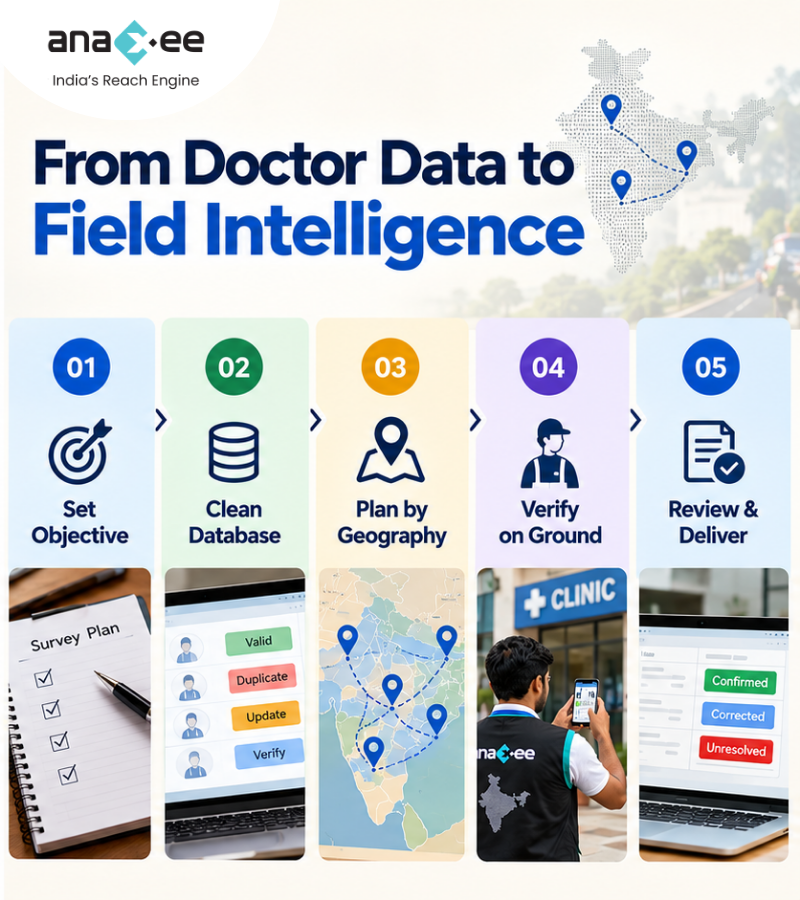
7. How to plan a large-scale doctors survey in India
A nationwide survey needs more than a target number of records and a list of locations.
The operational plan should account for geography, data quality, verification requirements and the effort needed to review the results.
Step 1: Define the outcome
Specify whether the project requires deduplication validation, physical clinic verification, geotagging, professional detail checks, chemist mapping or a combination of these activities.
Define what constitutes an accepted record.
Step 2: Review the existing data
Check for missing addresses, inconsistent fields, duplicate entries and gaps in geographic information.
This can help identify records that need additional preparation before field deployment.
Step 3: Prioritise geographic coverage
Group records by state, district, city and locality wherever possible.
Dense urban areas and geographically dispersed locations can have very different travel requirements. The deployment plan should reflect these differences.
Step 4: Conduct a representative pilot
Test the workflow across a selection of locations with different operating conditions.
Measure actual field productivity, address issues, verification outcomes, evidence acceptance, repeat visits and backend review effort.
Use the results to refine the process and estimate the requirements for wider deployment.
Step 5: Standardise field instructions
Every fieldworker should understand which fields must be checked, what evidence is acceptable and how to report a discrepancy or unresolved record.
Standardised instructions help improve consistency across locations.
Step 6: Review quality throughout execution
Use structured validation, evidence review, exception handling and sample rechecks.
The client and service provider should agree on acceptance criteria before scaling so that both sides assess quality using the same rules.
Step 7: Deliver a traceable dataset
The final output should link verified information to the original record and show relevant changes, verification outcomes and unresolved issues.
This allows the client to reconcile the results with existing systems rather than starting another disconnected database.
8. How Anaxee Digital Runners can support doctor data collection
Anaxee Digital Runners Pvt Ltd supports field-based data collection and verification through a distributed network of smartphone-equipped Digital Runners, structured task workflows and backend coordination.
For a pharmaceutical company planning a doctors survey in India, the approach can be configured around the required geography, data fields and verification standards.
Depending on the agreed scope, a project may include:
- Reviewing the existing database and defining verification fields.
- Preparing standardised field instructions.
- Deploying Digital Runners across selected locations.
- Capturing clinic details and GPS coordinates.
- Recording appropriate location evidence.
- Identifying discrepancies and unresolved cases.
- Conducting backend quality checks.
- Delivering structured data for reconciliation with the original records.
The operating model described by Anaxee includes field coordination, technology support and backend quality review. Coverage and feasibility should be confirmed for the specific states, languages and locations included in each project.
A pilot is a practical way to test the requirements, identify geographic constraints and measure actual field and backend effort before a larger rollout.
The objective is not merely to collect more records. It is to help the client understand which records have been confirmed, which require correction and which still need attention.
9. What about paid physician surveys?
The phrase “paid physician surveys” usually refers to market research in which doctors are invited to participate in a survey and may receive compensation for their time.
This is different from a doctor database survey or a field verification project.
A paid physician research programme may involve recruiting eligible doctors, checking that they meet the study criteria, administering a questionnaire and managing participant consent and compensation according to the study’s rules.
By contrast, doctor database verification focuses on confirming agreed information such as practice locations, record accuracy and geographic coordinates.
Organisations searching for paid physician surveys should therefore confirm whether they need a physician research panel, a market research recruitment partner or an on-ground data verification provider.
Anaxee’s field verification capabilities should not be confused with a paid physician survey panel unless such recruitment and compensation services are explicitly included in the offering.
This distinction helps buyers choose the right provider and ensures that the project is designed around its actual objective.
10. How should doctor data be handled responsibly?
Doctor database projects should follow a defined purpose and appropriate data governance practices.
Before collection begins, organisations should identify which fields are necessary, establish the appropriate permissions and legal basis, limit access to authorised personnel, and define retention and deletion practices.
Professional identifiers and personal information should only be collected where justified, authorised and appropriately protected.
Photographs should be captured only where appropriate and permitted. They should not expose patients, patient records or unrelated personal information.
A location verification project should also remain separate from recording confidential conversations or collecting patient information.
These safeguards should be built into the workflow rather than considered only after fieldwork has started.
Conclusion: A better doctors survey starts with a clear objective
A doctors survey in India can serve different purposes—from healthcare market research to doctor database cleaning, physical clinic verification and geotagging.
For pharmaceutical companies, the right approach depends on what the business needs to establish.
AI-assisted matching can identify likely duplicate records. Field verification can help confirm selected information on the ground. Geotagging can improve geographic data, while backend quality checks can help ensure that the final dataset meets the agreed standard.
No single method solves every data problem.
The stronger approach combines the right methods, clearly defines what counts as verified and records uncertainty instead of hiding it.
For organisations managing large doctor databases across multiple divisions and geographies, this can provide a more dependable foundation for field operations, territory planning and ongoing data maintenance.
Planning a doctors survey or doctor database verification project in India?
Discuss your requirements with Anaxee Digital Runners and explore a structured approach to field data collection, clinic geotagging and data quality.
Book a conversation with Anaxee
Frequently asked questions
What is a doctors survey in India?
A doctors survey in India can refer to collecting or validating information about doctors. Depending on the purpose, it may involve market research, doctor database verification, clinic location checks, geotagging or other structured data collection.
What is doctor database verification?
Doctor database verification is the process of checking agreed details in existing records, such as a doctor’s identity, practice location and selected professional information. The verification method depends on the fields and level of evidence required.
Can AI identify duplicate doctor records?
AI-assisted matching can identify likely duplicates using available information such as name variations, professional identifiers, specialty and location. Uncertain matches should be reviewed before records are merged.
Why is doctor geotagging important?
Doctor geotagging associates practice locations with geographic coordinates. When those coordinates are accurate and linked to the correct records, they can support mapping, territory planning and field force operations.
What are paid physician surveys?
Paid physician surveys generally refer to market research studies in which eligible doctors participate in questionnaires and may receive compensation for their time. These programmes differ from field verification of doctor databases.
Does a doctors survey include chemist mapping?
Not automatically. Chemist mapping is a separate workstream that can be included when required. The project should define the outlets to be mapped, the required fields and the relationship between each outlet and the doctor’s location.
How do you plan a large-scale doctor verification project?
Start by defining the required fields and acceptance criteria, reviewing the existing database, grouping records geographically, running a pilot, measuring actual productivity and quality, and scaling with consistent review processes.