
Most social programmes do not fail in the strategy deck. They fail in the last mile — in the village four hours past the district headquarters, where the field team never quite arrived, and the beneficiary who was counted on paper was never actually reached.
Thank you for reading this post, don't forget to subscribe!If you are commissioning a large programme — a public-health drive, a scheme enrollment, a rural survey, a CSR activation — the agency you pick to execute it on the ground decides whether your budget turns into measurable impact or a report full of reasons. Here is how to evaluate a last-mile implementation partner before you commit.
1. Start with reach you can verify
Anyone can promise pan-India coverage. Ask for specifics: how many districts, talukas and pincodes can they actually cover, and how many people do they already have on the ground there — today, not after a recruitment drive once your cheque clears? A partner with a standing field network can start in days; one that recruits per project loses weeks and quality at the start. Ask to see a live coverage map.
2. Find out who actually knocks on the door
Rural outreach lives or dies on trust. A familiar local face — a son or daughter of the soil who speaks the dialect and knows the panchayat — earns a conversation a stranger never will. Ask whether the field workers are local community members or teams parachuted in for the assignment. In hesitant or low-trust communities, this single factor often decides whether people engage at all.
3. Is it run on technology, or on spreadsheets and promises?
At scale, manual coordination collapses. The right partner runs onboarding, training, task allocation and reporting through an app, so you are not waiting on WhatsApp forwards and end-of-month Excel sheets. Ask what each field worker sees on their phone, how tasks are assigned, and how data flows back — in real time, or in a scramble before the review meeting.
4. Can you see the work as it happens?
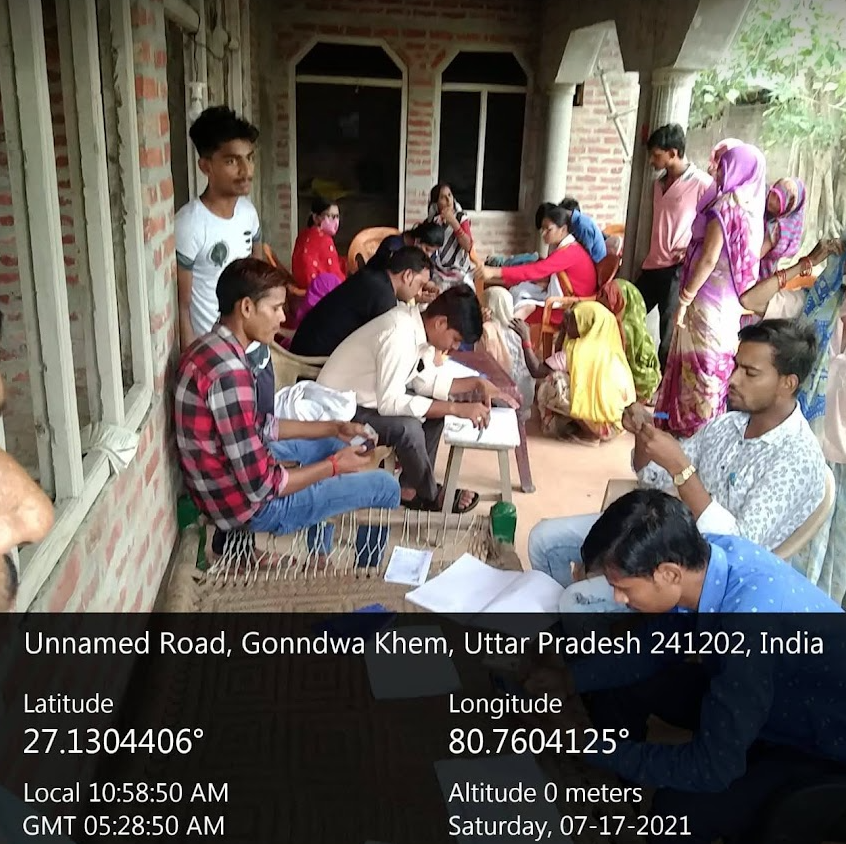
Insist on a live dashboard. Every visit logged, with photo, geo-tag and timestamp, visible district by district — that is the difference between a programme you can audit and one you take on faith. Monitoring and evaluation should be built into the execution, not bolted on at the end as a separate invoice.
5. How is accountability built in?
There is a world of difference between paying for activity and paying for outcomes. Ask how field workers are paid. A partner that pays its runners per verified result — a confirmed vaccination, a completed enrollment, a validated survey — has its incentives aligned with yours. You are buying delivery, not effort.
6. Can they work with government?
Most large rural programmes touch a district administration somewhere. Ask whether the partner has signed MOUs with state or district governments, handled compliance, and coordinated camps or drives with local authorities. Experience here removes a great deal of on-ground friction.
7. Ask for proof at your scale
Finally, ask for a programme they have run at the size of yours — not a pilot in two districts, but execution across states. The honest ones will show you the numbers, the dashboard, and the gaps they hit along the way.
See what this looks like at national scale
In Project Swaraksha, Anaxee’s Digital Runners counselled 29.8 lakh rural citizens and facilitated 17.4 lakh vaccinations across 19 states — door to door, tracked on a live dashboard. If you are planning a programme that has to reach the last village, see how we execute it.
Anaxee runs on a network of 40,000+ trained Digital Runners across 540 districts and 11,000+ pincodes. Whether it is a health drive, a scheme rollout or a hyperlocal awareness campaign, the model is the same: real local people, tech-tracked, paid on results.