
Introduction: How Accurate Is Your Doctor Database?
For pharmaceutical companies, a doctor database is much more than a list of names, phone numbers and clinic addresses. It is an important business asset that supports sales planning, medical representative (MR) visits, product promotion and market expansion.
Thank you for reading this post, don't forget to subscribe!But there is an important question that many pharmaceutical companies overlook:
How many doctors in your database are actually reachable, correctly mapped and available at the recorded locations?
A database may contain thousands of doctor records, but outdated phone numbers, incomplete addresses, duplicate entries and incorrect clinic information can make a significant portion of it unusable.
The problem becomes more serious when medical representatives depend on this information for their daily field visits.
An MR may spend time travelling to a clinic that has shifted, searching for a doctor whose address is incomplete, or attempting to contact someone using an inactive phone number.
These problems directly affect field productivity and increase operational costs.
This is where doctor database verification becomes important.
1. What Is Doctor Database Verification?
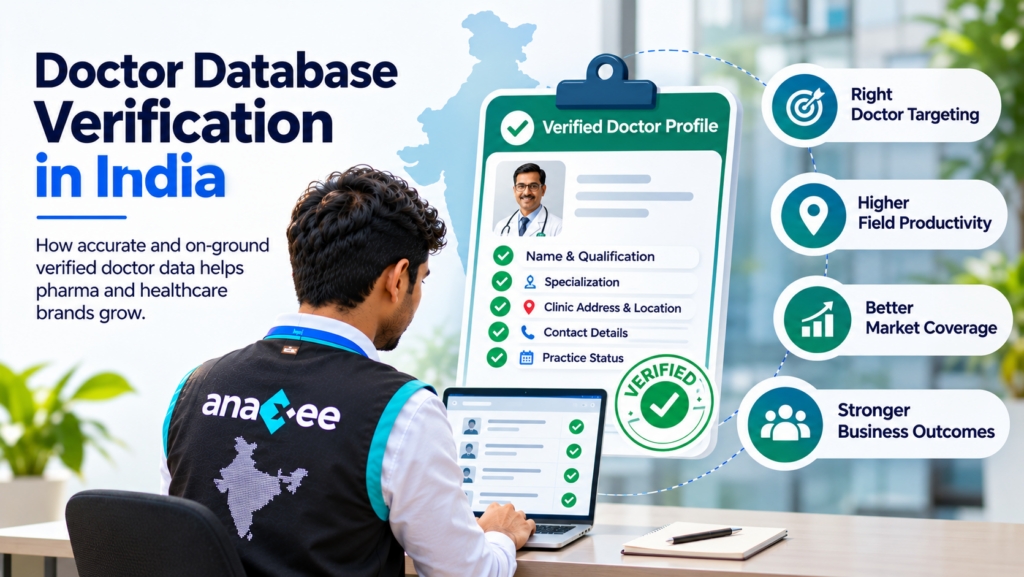
Doctor database verification is the process of checking, validating and updating doctor information to ensure that pharmaceutical companies have accurate and usable records.
It involves verifying essential information such as:
- Doctor’s full name
- Medical specialization
- Clinic or hospital name
- Clinic address
- City, district and locality
- Contact number
- WhatsApp availability, where relevant
- GPS coordinates of the clinic
- Clinic existence and operational status
The objective is not simply to collect information. It is to make the database reliable enough for actual business operations.
For pharmaceutical companies, verified doctor data can support better territory planning, more effective MR visits and improved sales coverage.
2. Why Do Pharmaceutical Companies Need Doctor Database Cleaning?
Doctor databases are often built over several years through field visits, market research, third-party data providers and internal sales teams.
Over time, information can become outdated.
Doctors may change clinics, relocate to another city, change their contact numbers or stop practising at a particular location.
Some databases also contain incomplete records from the beginning.
Common problems include:
A. Incomplete Doctor Addresses
A record may mention only a locality, landmark, road or broad area.
For example:
A doctor is listed at “Double Chowki” without a specific clinic name, street or building location.
For a person familiar with the locality, this may provide some direction. But for a medical representative visiting the area for the first time, it creates uncertainty.
The MR may need to make multiple phone calls, ask local shopkeepers or spend additional time searching for the clinic.
B. Incorrect or Inactive Phone Numbers
A doctor database may contain:
- Disconnected numbers
- Incorrect digits
- Numbers belonging to another person
- Old contact numbers
- Numbers that are not reachable
Checking whether a number is valid and whether it is available on WhatsApp can provide additional information for communication planning.
However, number validity and actual doctor identity must be treated as separate verification checks.
C. Duplicate Doctor Records
The same doctor may appear multiple times under slightly different names or clinic addresses.
For example:
- Dr. Amit Sharma
- Amit Sharma
- Dr. A. Sharma
Without proper deduplication, pharmaceutical companies may overestimate their doctor coverage and make inefficient field allocation decisions.
D. Doctors Who Have Relocated
Healthcare professionals may shift their practice from one clinic to another or start consulting at multiple locations.
If the database is not updated, the MR may continue visiting an outdated address.
E. Incorrect Clinic Information
Sometimes the doctor exists, but the clinic name, operating status or recorded location is incorrect.
This makes it important to verify not just the doctor but also the associated healthcare establishment.
3. How Inaccurate Doctor Data Affects Pharmaceutical Sales
The impact of poor-quality data extends beyond database management.
It directly affects the economics of pharmaceutical field operations.
Consider an illustrative pharmaceutical company operating in Madhya Pradesh.
Suppose the company has:
| Parameter | Assumption |
|---|---|
| Doctor and chemist records | 2,400 |
| Estimated inaccurate records | 20% |
| Inaccurate records | 480 |
| Monthly visits per MR | 240 |
| Internal cost per visit | ₹250 |
| Additional samples and promotional expenses | ₹250 per visit |
If 20% of the database is inaccurate, 480 records may require correction or re-verification.
If those records lead to one unsuccessful visit each month, the potential annual cost can be estimated as follows:
Step 1: Calculate potentially wasted visits
480 visits per month × 12 months = 5,760 visits annually.
Step 2: Calculate field-force expenses
5,760 × ₹250 = ₹14,40,000.
Step 3: Calculate additional promotional expenses
5,760 × ₹250 = ₹14,40,000.
Total illustrative annual exposure: ₹28,80,000.
This calculation demonstrates how inaccurate database information can create a substantial financial burden.
Actual losses will depend on the percentage of inaccurate records, visit frequency, field costs and the extent to which unsuccessful visits can be avoided.
4. Why Google Searches Alone May Not Be Enough for Data Cleaning
One common approach to doctor database cleaning is assigning a backend resource to search for doctors and clinics on Google.
This approach can work for records with sufficient information.
For example, if the database contains:
- Doctor’s full name
- Clinic name
- City
- Complete locality
A backend executive may be able to locate the clinic and update its details.
However, what happens when the database contains only a doctor’s name and a broad locality?
Consider a record containing:
Doctor: Dr. Sunil Meena
Address: Double Chowki
A Google search may identify multiple possible results, but it may not establish which clinic belongs to the doctor.
This is an important limitation of desk-based data cleaning.
Online information can help identify potential locations, but physical verification is sometimes necessary to confirm the actual clinic, its existence and its location.
The most effective approach is often a combination of desk-based research and ground-level verification.
5. Field Verification vs. Desk-Based Doctor Database Cleaning
Both methods have their own advantages.
| Parameter | Desk-Based Verification | Field-Based Verification |
|---|---|---|
| Google search | Yes | Can be used |
| Contact number checks | Yes, with suitable tools | Yes, with direct confirmation |
| Incomplete addresses | Limited accuracy | Local discovery and navigation |
| Clinic existence | Online evidence | Physical verification |
| GPS coordinates | Available from online sources, subject to accuracy | Captured at actual location |
| Local intelligence | Limited | Stronger local context |
| Record updates | Backend-based | Captured during field activity |
A hybrid approach can be more effective than depending entirely on either method.
Start with backend cleaning to remove obvious errors, identify duplicates and enrich available information.
Then deploy field resources to validate records that cannot be reliably resolved online.
6. Open Surveys vs. Customer-Provided Doctor Lists
Another important consideration is the difference between an open survey and verification of an existing database.
Open Survey Approach
In an open survey, field representatives visit a defined geographical area and discover doctors, clinics or chemists operating there.
They create new records by collecting information directly from the field.
For example, a pharmaceutical company wants to map dental clinics across Indore.
The field team visits the target localities, identifies clinics and captures:
- Clinic name
- Doctor name
- Specialization
- Contact details
- Address
- GPS location
This approach is useful for market mapping and discovering previously unidentified establishments.
Existing Database Verification
The situation is different when a pharmaceutical company provides a specific list of doctors.
The field team is expected to locate and verify those particular records rather than discover any doctor in the locality.
If the address is incomplete, identifying the correct doctor becomes more difficult.
This is why accurate GPS coordinates, clinic names and locality information are valuable inputs when sharing an existing database for verification.
The two approaches solve different problems and should not be treated as identical assignments.
7. How Anaxee Helps Pharmaceutical Companies Verify Doctor and Chemist Databases
Anaxee Digital Runners Pvt. Ltd. provides field-based data collection, verification and market intelligence services through its distributed Digital Runners network.
For pharmaceutical companies, Anaxee can support doctor and chemist database verification through a combination of field operations and backend data management.
The approach can include:
1. Doctor and Clinic Verification
Field teams visit the recorded locations to validate doctor and clinic information.
2. Address Validation
Incomplete addresses can be investigated using local knowledge, landmarks and physical location checks.
3. GPS Location Capture
Geotagging helps pharmaceutical companies identify the actual location of verified clinics.
4. Contact Number Validation
Available tools and field-level checks can help assess phone number validity and communication availability.
5. Chemist Mapping
Field teams can identify and map chemist shops, capturing information useful for understanding local retail distribution and market presence.
6. Database Cleaning
Backend resources can support deduplication, data standardization, record correction and phone number checks.
7. Digital Reporting
Collected information can be structured and delivered through digital databases and dashboards, depending on project requirements.
The objective is to convert an existing list of records into a more reliable, actionable database.
8. Why Pharmaceutical Companies Should Start With a Pilot Project
Instead of immediately undertaking a large-scale verification exercise, pharmaceutical companies can begin with a pilot in selected districts.
For example, a company operating across Madhya Pradesh could start with two or three districts.
A pilot can help answer important questions:
- What percentage of existing doctor records is accurate?
- How many addresses are incomplete?
- How many doctors can be successfully located?
- How many phone numbers are valid?
- How many duplicate records exist?
- What is the actual cost of verifying one record?
- How much field-force time could be saved through better data?
The pilot also helps establish a realistic cost and operational model before expanding to other districts.
Most importantly, it allows pharmaceutical companies to evaluate the business impact using actual field findings rather than assumptions.
Conclusion: Better Doctor Data Means Better Field Decisions
Pharmaceutical companies invest significantly in medical representatives, promotional activities, samples and market development.
But these investments depend on one fundamental requirement: reliable information about the doctors and chemists they want to reach.
An inaccurate database can lead to unnecessary travel, unsuccessful visits, incorrect territory planning and missed market opportunities.
Doctor database verification helps address these problems by combining data cleaning, contact validation, location verification and ground-level intelligence.
With a structured verification process, pharmaceutical companies can improve database quality, strengthen field-force productivity and make better-informed decisions about their market coverage.
Looking to verify your doctor and chemist database in India?
Anaxee helps businesses with field-level data collection, verification, geotagging and retail intelligence across India.
Visit www.anaxee.com to explore our data collection and verification capabilities.
Frequently Asked Questions
1. What is doctor database verification?
Doctor database verification is the process of checking and updating doctor information, including names, specializations, clinic addresses, contact numbers and GPS locations, to improve database accuracy.
2. Why is doctor database cleaning important for pharmaceutical companies?
It helps reduce duplicate records, identify incorrect contact information, locate clinics and improve the effectiveness of pharmaceutical field-force operations.
3. Can doctor addresses be verified through Google Maps?
Google Maps can help identify potential clinic locations, but incomplete addresses and similar doctor names may require additional investigation or physical field verification.
4. What is the difference between doctor mapping and doctor database verification?
Doctor mapping focuses on discovering and recording doctors in a geographical area. Database verification focuses on validating and correcting existing doctor records.
5. Can Anaxee verify doctor and chemist databases across India?
Anaxee provides field-based data collection and verification capabilities through its Digital Runners network. Project coverage, feasibility and timelines depend on the required locations and scope.
6. What information is required to start a doctor database verification project?
Ideally, pharmaceutical companies should provide doctor names, clinic names, specializations, city, locality, addresses and available contact details. Better starting information generally improves verification efficiency.
7. How can verified doctor data improve MR productivity?
It helps MRs identify correct clinic locations, reduce time spent searching for doctors and plan more efficient territory visits.
 About Anaxee
- ★ National Startup Award 2021
- Trusted by 350+ brands
- India’s Reach Engine since 2016
Explore Anaxee: Go-To-Market · Field data collection · Platform & API · Drone & MRV · Climate
Planning field execution, a GTM rollout or data collection across India?
Tell Anaxee the outcome and the geography — our team will map it across 540 districts and 11,000+ pincodes.
Book a meeting WhatsApp Email sales