India’s Petroleum Refineries on the Carbon Radar (CCTS Draft 2025)
“Refining crude is messy business—both for your white shirt and the planet.”
Thank you for reading this post, don't forget to subscribe!
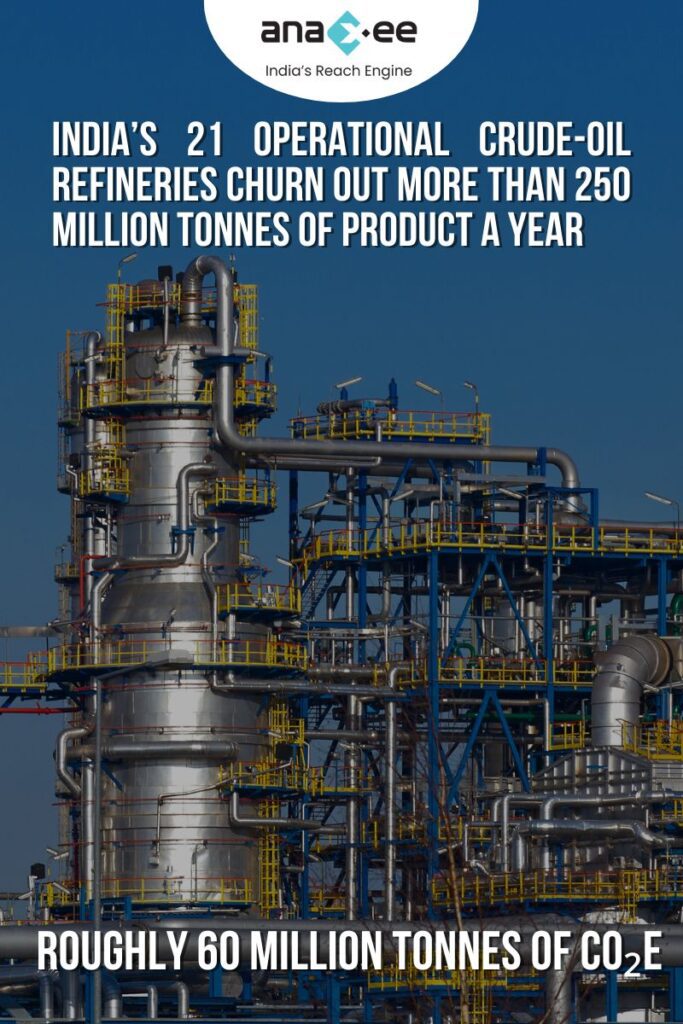
India’s 21 operational crude-oil refineries churn out more than 250 million tonnes of product a year and roughly 60 million tonnes of CO₂e while they’re at it.
Now, under the draft Carbon Credit Trading Scheme (CCTS) 2023, each site has been handed a Greenhouse-gas Emission Intensity (GEI) target for 2025-26 and 2026-27. Miss the number and the owner must buy credits—hit it early and they can sell the surplus.
Below you’ll find:
-Five snack-size observations (so you don’t drown in data).
-A ranked table of every refinery—baseline intensity plus both targets.
-A plain-English explainer on what those numbers even mean.
-Quick ideas on where credits might come from (spoiler: bio-pellets, flare-gas recovery, and a little last-mile magic from Anaxee).
Feel free to skim straight to the table; the story will be waiting when you scroll back up.
1. Five Things That Jump Out
Intensity swings are wild Reliance’s SEZ Jamnagar sits at 4.74 tCO₂e per barrel (already decent by global standards) while IOCL’s ageing Guwahati unit hovers near 7.77 t. That’s a 64 % spread—proof that age and fuel mix still matter.
BPCL’s Bina outlier Land-locked and pipeline-fed, Bina is India’s youngest BPCL plant yet sports the highest energy factor in the BPCL stable. Expect an aggressive heat-integration retrofit or a credit-buying spree.
Paradip proves new ≠ perfect IOCL Paradip was designed as a showcase, but at 5.38 t it still needs to cut almost 4 % in three years. Easy on paper, painful if crude slate swings heavier.
Guwahati’s uphill climb To drop nearly 10 % intensity, the 1962-era unit must either flip from furnace oil to natural gas or offset externally. Betting man’s guess: they’ll lean on credits.
A new market for every percent Each decimal point above target converts directly into fresh demand for credits. Renewable developers and agro-offset suppliers—time to shine.
2 Rank-wise List of Every Refinery
Note on units: The official schedule expresses intensity as tCO₂e per thousand barrels of throughput. For simplicity we quote the raw numbers; ranking is by baseline intensity, highest to lowest, because the dirtiest plants are where action (and credits) will concentrate first.
Refinery
State
Baseline GEI 2023-24 (tCO₂e/MBBLS)
Target 2025-26
Target 2026-27
BPCL – Bina
MP
5.231
5.081
4.855
BPCL – Kochi
KL
4.574
4.514
4.423
BPCL – Mumbai
MH
3.978
3.907
3.801
CPCL – Manali
TN
4.948
4.817
4.621
HPCL – Mumbai
MH
5.686
5.542
5.326
HPCL – Visakh
AP
5.523
5.37
5.141
HPCL-Mittal – Bathinda
PB
5.096
5.01
4.882
IOCL – Barauni
BR
5.544
5.435
5.271
IOCL – Bongaigaon
AS
7.027
6.837
6.552
IOCL – Gujarat (Vadodara)
GJ
4.862
4.743
4.564
IOCL – Haldia
WB
6.548
6.331
6.006
IOCL – Mathura
UP
4.783
4.676
4.516
IOCL – Panipat
HR
4.205
4.123
4
IOCL – Digboi
AS
5.784
5.585
5.286
IOCL – Paradip
OD
5.381
5.292
5.16
IOCL – Guwahati
AS
7.765
7.472
7.031
MRPL – Mangalore
KA
5.024
4.903
4.722
Nayara – Vadinar
GJ
4.562
4.464
4.317
NRL – Numaligarh
AS
4.098
4.012
3.883
Reliance – Jamnagar DTA
GJ
4.949
4.889
4.8
Reliance – Jamnagar SEZ
GJ
4.744
4.702
4.638
(Source: Draft CCTS refinery schedule, June 2025)
3 What on Earth Is GEI?
Think of GEI (Greenhouse-gas Emission Intensity) as grams of guilt per barrel. It’s the CO₂e a refinery emits—fuel combustion, flaring, power imports—divided by every thousand barrels processed.
-Why thousand barrels (MBBL)? Industry convention. Easy to benchmark against global peers.
-Why two targets? The scheme sets a halfway target (FY 25-26) and a sharper one (FY 26-27). Plants must stay at or below both.
-What if they miss? Buy carbon credits from the voluntary pool, or pay double the shortfall as a fine. Regulators haven’t priced the fine yet, but word on the street is “painful”.
If you’re a refinery planner, the calculation is simple math; if you’re a sustainability manager, GEI is your new KPI tattooed on the quarterly board deck.
4 Who’s on Track and Who’s Not?
Likely Credit Buyers
Likely Credit Sellers
IOCL Guwahati, IOCL Bongaigaon – ageing, coal-heavy, remote gas supply.
Reliance SEZ, BPCL Mumbai – modern energy integration, captive power from gasification.
External Offsets – Agroforestry, biochar, or improved cook-stove credits—exactly the field projects Anaxee audits with its 50 000 Digital Runners.
6 Where Do Carbon Credits Come In?
Picture this: IOCL Haldia overshoots by 200 000 tCO₂e in 2026-27. They can:
-Buy solar-park credits from Rajasthan.
-Fund a rice-husk briquette switch for east-India textile mills.
-Partner with a biochar producer in Assam and claim a share.
Each path needs MRV evidence—photos, farmer affidavits, GPS tags—often across dozens of villages. That’s where Anaxee’s last-mile network wipes weeks off your audit schedule.
7 FAQ (plain talk)
Q:Are these numbers final? A: Nope, the Gazette called them “draft for stakeholder comments.” Expect minor tweaks but the order of magnitude stands.
Q:Why is Jamnagar listed twice? A: Reliance runs two legal entities: the older DTA (Domestic Tariff Area) and a newer SEZ (Special Economic Zone). Each files separately.
Q:Is 4.0 tCO₂e/MBBL good? A: On par with top-quartile US Gulf Coast refineries. Anything above 6 is “fix-it-or-offset” territory.
8 Final Word
Cutting refinery CO₂ isn’t a one-and-done project- it’s a relay race of fuel switches, pinch-studies, and offset deals. Whether you’re an EPC firm chasing revamp contracts, or a sustainability head scrambling for credits, remember: proof beats promises. Anaxee’s army of Digital Runners can collect that proof across 11 000 pin codes- so you only fly in for the board photo-op.
▶️ Reach out to us at sales@anaxee-wp-aug25-wordpress.dock.anaxee.com
Free interactive tool
How many carbon credits could your project generate?
Model indicative credits and value for cookstove, agroforestry, biochar, biogas and rice projects with Anaxee’s Carbon Credit Calculator.



 About Anaxee


