

Imagine this…
Two brands launch the same product.
Both spend ₹1 crore on advertising.
Both run Meta campaigns.
Both invest in Google Ads.
Both hire influencers.
Six months later…
One brand has disappeared from conversations.
The other keeps getting recommended.
People tell friends about it.
Retailers suggest it.
Communities discuss it.
WhatsApp groups share it.
What changed?
Not the product.
Not the advertising.
The difference is simple.
One brand bought attention.
The other built word-of-mouth.
Every marketer wants word-of-mouth
Ask any CMO what the most effective marketing channel is.
Very few will say Facebook Ads.
Or Google Ads.
Most will answer:
Word-of-mouth.
Because recommendations do something advertisements rarely achieve.
They remove doubt.
A customer believes another customer long before believing a brand.
Which is why recommendations consistently outperform advertisements when trust matters.
But there’s one problem…
Word-of-mouth has always been treated like luck.
“If customers love the product…”
“They’ll naturally recommend it.”
Sometimes they do.
Often they don’t.
Even excellent products disappear because nobody talks about them.
Meanwhile average products become market leaders simply because conversations keep happening.
The biggest mistake brands make is assuming
Great products automatically generate great conversations.
They don’t.
Word-of-mouth doesn’t start with customers.
It starts with experiences worth sharing.
Think about the last product you recommended.
Why did you talk about it?
Maybe it solved a real problem.
Maybe someone asked you.
Maybe you saw others using it.
Maybe you had a memorable experience.
Recommendations happen because people receive a reason to talk.
Marketing’s job is to create those reasons.
Organic word-of-mouth has a ceiling
Traditional word-of-mouth spreads like ripples.
Someone tells two friends.
Those friends tell a few more.
Sometimes it grows.
Sometimes it dies immediately.
Brands have almost no control over this process.
Which means growth becomes unpredictable.
That’s fine for a neighbourhood café.
It’s not fine for a national brand.
So what is Structured Word-of-Mouth?
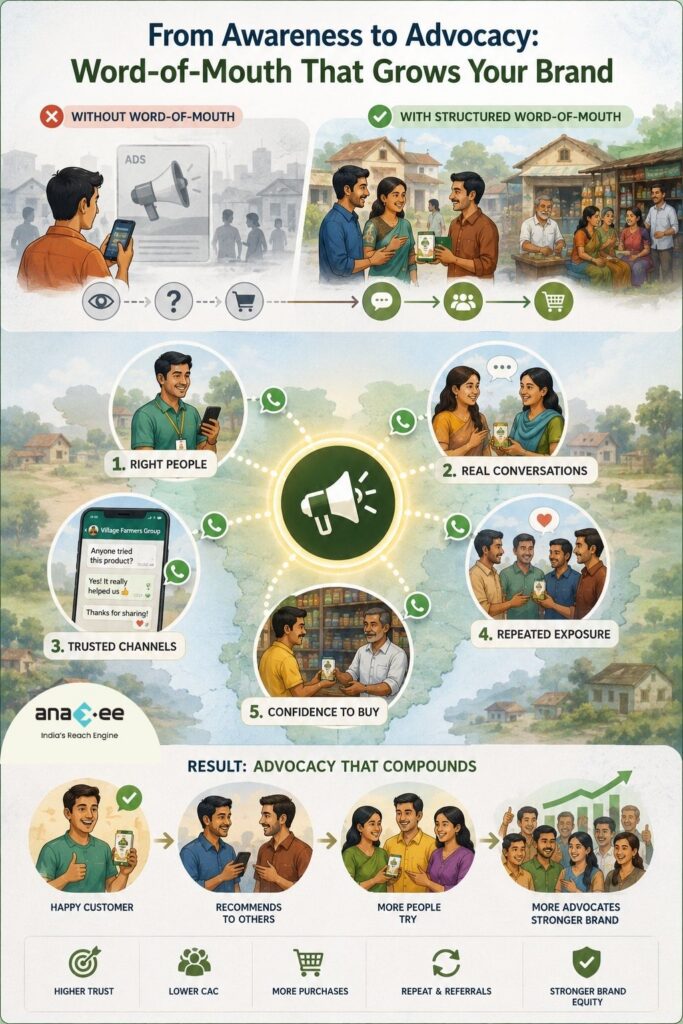
Structured Word-of-Mouth is the process of creating consistent opportunities for authentic recommendations to happen repeatedly across many local communities.
Notice what’s missing.
It isn’t fake reviews.
It isn’t paid testimonials.
It isn’t influencer marketing.
It isn’t spam.
Instead, it answers one simple question:
How do we make real conversations happen consistently?
Why consistency matters more than virality
Marketing teams often chase viral campaigns.
But brands aren’t built through one viral post.
They’re built through thousands of small conversations.
Someone recommends a product.
A retailer confirms it.
A neighbour talks about it.
Someone forwards information in a community group.
Another person finally tries it.
This cycle repeats.
That’s how trust compounds.
India already has the perfect infrastructure
Here’s the interesting part.
Brands don’t need to build new communities.
India already has them.
- Resident Welfare Groups
- Farmer Communities
- Retailer Networks
- Self Help Groups
- Business Associations
- Local Clubs
- WhatsApp Groups
- Village Committees
Millions of conversations already happen every day.
The opportunity isn’t creating communities.
It’s participating in them respectfully.
The role of WhatsApp in structured recommendations
Across India, WhatsApp has become one of the most trusted communication channels.
Families coordinate.
Businesses operate.
Communities organise.
Recommendations spread naturally.
Unlike advertisements, messages inside trusted communities often arrive with context.
Someone you know shared them.
That alone changes how they’re received.
Structured doesn’t mean scripted
This is where many brands get it wrong.
Structured Word-of-Mouth does not mean scripting conversations.
People immediately recognise forced marketing.
Instead, structure means:
- identifying relevant communities
- enabling genuine information sharing
- maintaining consistency
- respecting local context
- measuring participation
The conversations remain human.
Only the system becomes organised.
Why retailers matter
Retailers have always been influencers.
Not social media influencers.
Real influencers.
Every day customers ask:
“Which one should I buy?”
That recommendation often matters more than weeks of advertising.
Structured Word-of-Mouth recognises that influence already exists.
It works with existing trust instead of trying to replace it.
Where Anaxee helps
Building Structured Word-of-Mouth across hundreds of towns isn’t easy.
Every region behaves differently.
Every community has different dynamics.
Every recommendation network looks different.
This is where Anaxee helps.
Instead of relying only on advertising platforms, Anaxee helps brands activate human-led recommendation networks across India’s hyperlocal markets.
The objective isn’t to manufacture conversations.
It’s to make meaningful conversations possible at scale.
What brands gain
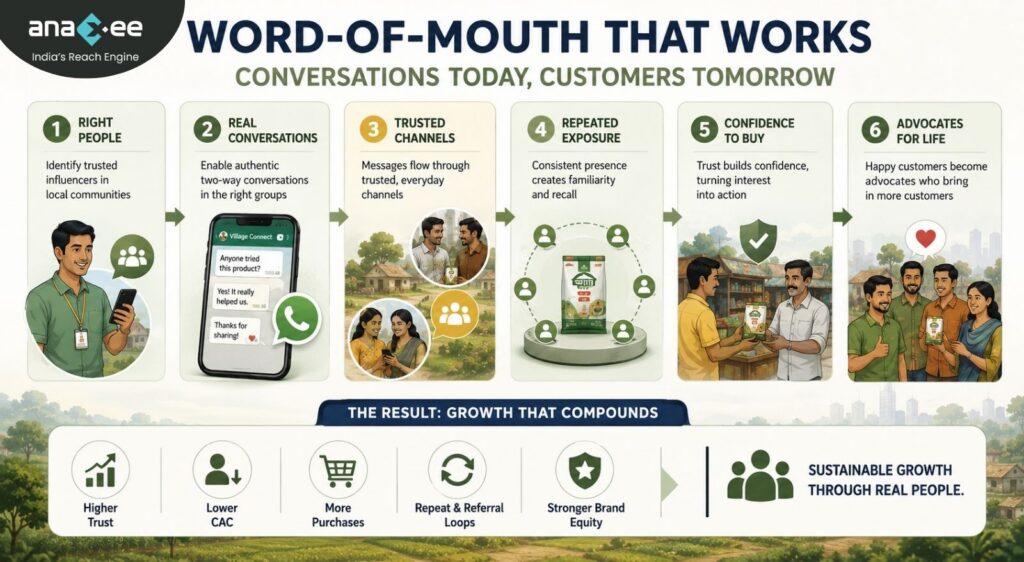
When recommendations become consistent,
something interesting happens.
Marketing becomes more efficient.
Retail confidence improves.
Customer hesitation reduces.
Communities become familiar with the brand.
Demand starts building before people even search online.
That changes everything.
The future belongs to recommendation-driven brands
Advertising will always matter.
But advertising alone won’t create preference.
Brands that combine digital visibility with structured human recommendations will have a significant advantage.
Because while advertisements create awareness,
people create belief.
And belief is what ultimately creates demand.
Final thoughts
The question for marketers is no longer,
“How many people saw our campaign?”
It’s becoming,
“How many people talked about it afterwards?”
That’s the metric that quietly predicts long-term growth.
Structured Word-of-Mouth isn’t replacing advertising.
It’s giving advertising something it has always needed.
Human credibility.
And that’s where Anaxee helps brands transform conversations into sustainable demand.