

What Is Egocentric Data — and Why Every Robotics Company Suddenly Needs It
If you’ve noticed AI companies quietly paying people to strap phones to their heads and record themselves cooking dinner, you’ve seen the newest gold rush in artificial intelligence. It has a name: egocentric data. And for the companies building the next generation of robots, it’s become one of the most valuable things in the world.
Here’s what it is, why demand exploded almost overnight, and what it takes to collect it well.
What is egocentric data?
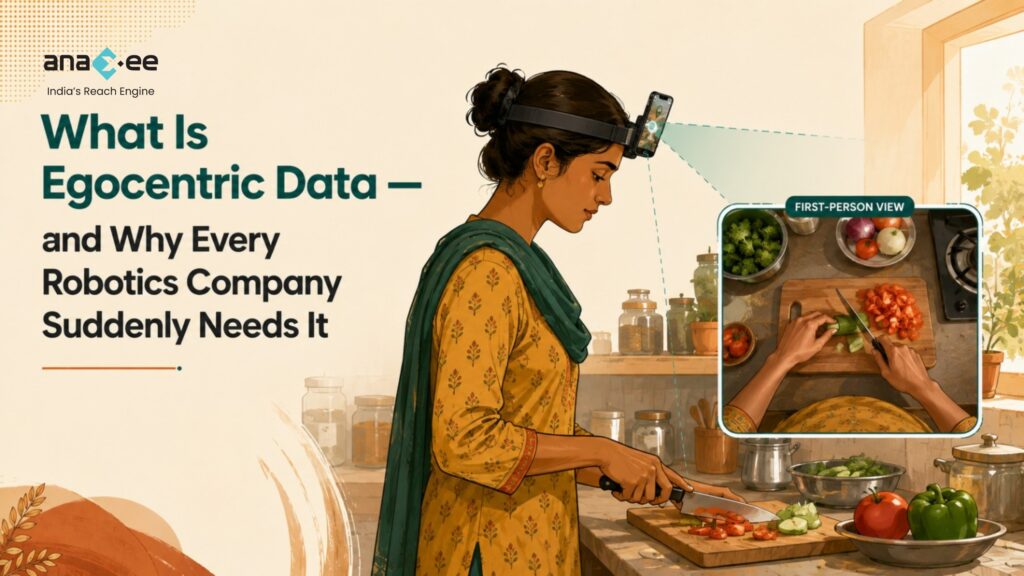
Egocentric data is data recorded from a first-person point of view — the world as seen through the eyes of the person doing something, usually captured by a camera mounted on their head or body. Instead of filming someone chop an onion from across the kitchen, egocentric capture records what their own eyes see: their hands, the knife, the board, the onion, all from their perspective.
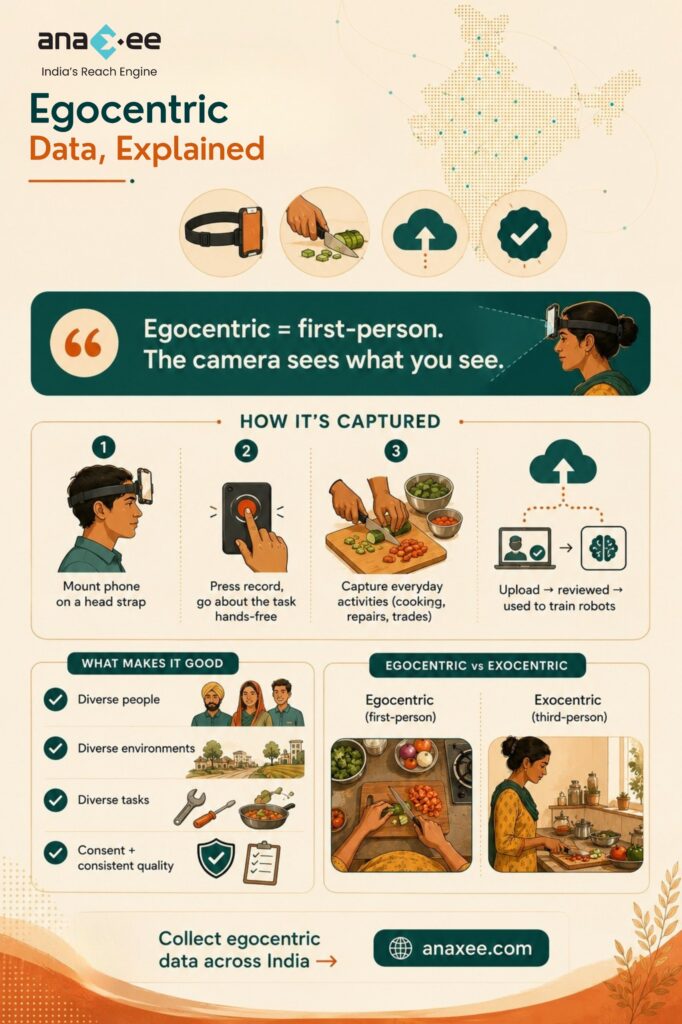
That single change in viewpoint is the whole point. “Egocentric” just means first-person — the camera sees what you see.
The opposite, a camera watching from across the room, is called exocentric or third-person data. It’s useful, but it’s not how a robot experiences the world. A robot, like a person, has to act from inside its own point of view. So that’s the data it learns best from.
Why do robots need first-person data?
For years, AI learned from third-person, internet-sourced footage. It worked well enough for models that only had to recognize things. It falls apart for models that have to do things.
A robot that needs to pick up a cup has to understand the task the way a human performs it — the approach, the grip, the adjustment when the cup is heavier than expected. That information lives in first-person recordings of real hands doing real tasks. Researchers now treat egocentric data as a cornerstone for robotics and embodied AI, because it’s the closest match to how a machine will actually operate.
First-person data captures the things third-person footage misses:
- Hand-object interaction — exactly how humans grip, turn and manipulate things
- Point-of-view motion — how the head and body move while doing a task
- Real context — genuine homes, workplaces and lighting, not staged sets
- The full sequence — the natural order of steps in an everyday activity
How is egocentric data collected?
The setup is deliberately low-tech, because it has to scale to thousands of ordinary people. Most programs use a smartphone mounted on a lightweight head strap. The contributor presses record and goes about a task, hands free, while the phone captures everything from their viewpoint.
Smartphones are the workhorse here — modern phone cameras, especially ultrawide lenses, capture both hands and the workspace at once, which is why many projects require newer iPhone or high-end Android models. Higher-end research uses dedicated smart glasses, but the phone-on-a-strap approach is what makes large-scale collection possible.
The activities are usually everyday ones: cooking, cleaning, organizing, repairs, and hands-on trades like construction, warehousing or food service. Ordinary life, recorded from the inside, is exactly what these models are starving for.
What makes egocentric data actually good?
Not all first-person footage is equal. The value is in the variety:
Diverse people. A dataset recorded only by young men in one city produces a robot that only understands young men in one city. Range across age, gender, body type and background is what makes the data hold up.
Diverse environments. A cramped urban kitchen, a rural home, a small workshop — the more real-world settings, the more robust the model.
Diverse tasks. The wider the range of activities, the more general the AI can become.
Consistent quality and consent. Right camera angle, stable footage, clear task, and properly obtained consent from every contributor. Miss any of these and the data is worth little.
That last point is the quiet hard part. Anyone can collect some footage. Collecting footage that’s diverse, high-quality and properly consented, at volume, is a different job entirely.
Why demand is exploding
This went from niche to frenzy in about a year, and the numbers show it. One platform reports around 4,000 contributors across 71 countries producing more than 160,000 hours of video every month. A major Chinese company is working to generate 10 million hours of robotics training data over two years. Even DoorDash launched a standalone app for this kind of task-recording work in early 2026.
The reason is simple: the robotics and embodied-AI boom needs enormous volumes of first-person human data, and there isn’t nearly enough of it. Whoever can collect it — diverse, clean and consented — holds something every robotics lab wants.
Collecting egocentric data in India
Volume is only half the story. The other half is who and where. A dataset that’s all one demographic, from a handful of cities, produces narrow AI no matter how many hours it contains.
This is where a country like India — and a network that actually reaches across it — changes the equation. Anaxee runs a field network of 40,000+ Digital Runners across 540+ districts and 11,000+ pincodes, reaching the Tier 2/3/4 towns and villages most collection never touches. That’s the range that turns a large egocentric dataset into a genuinely diverse one, collected with consent from real people living real lives across the country.
If you’re building robotics or computer-vision models and need first-person data that represents more than one slice of the world, that reach is worth a conversation.
The bottom line
Egocentric data is first-person video that teaches machines how humans actually move through the world. It’s become essential because robots have to learn from the inside out, and there isn’t enough of this data to go around. The winners will be whoever can collect it at scale, cleanly, and across the full diversity of real people.
Building an AI that needs first-person data? Talk to Anaxee about collecting it across India.
Frequently asked questions
What is egocentric data in simple terms? Egocentric data is video and sensor data recorded from a first-person point of view — what a person sees and does from their own perspective, usually captured by a head- or body-mounted camera. It’s used to train AI and robots to understand how humans perform everyday tasks.
What is the difference between egocentric and exocentric data? Egocentric data is recorded from the first-person perspective of the person doing an activity. Exocentric (third-person) data is recorded from an outside viewpoint, like a camera across the room. Robots learn better from egocentric data because they have to act from their own point of view.
Why do AI and robotics companies need egocentric data? Robots have to perceive and act in the physical world from their own perspective. First-person recordings of humans doing real tasks capture the hand movements, viewpoint and context that robots need to learn from — information that third-person or internet data doesn’t contain.
How is egocentric data collected? Most commonly with a smartphone mounted on a lightweight head strap. The contributor records everyday activities from their point of view, hands-free. The best datasets come from a wide range of people, environments and tasks, collected with informed consent.