
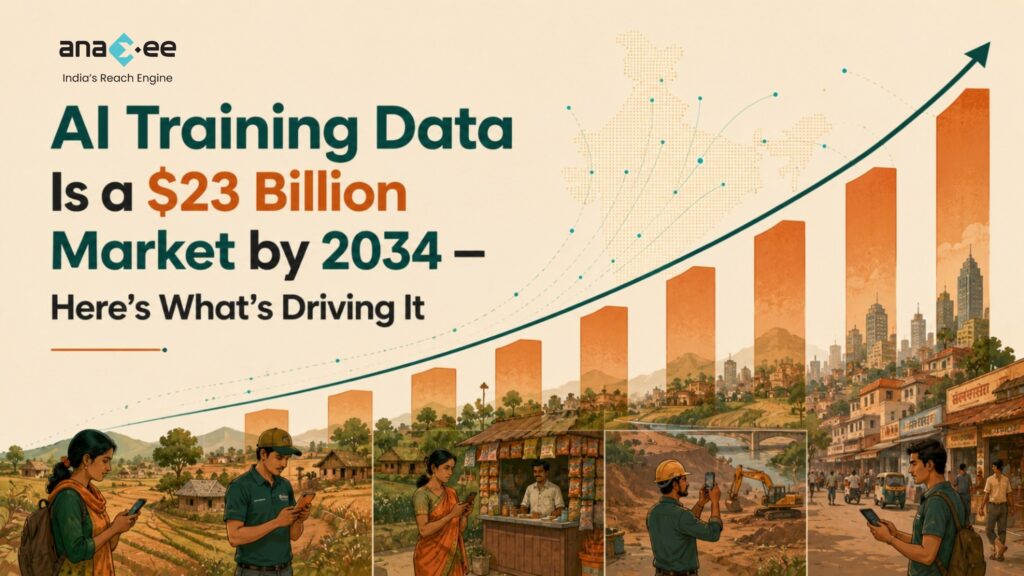

AI Training Data Is a $23 Billion Market by 2034 — Here’s What’s Driving It
Every AI model, from the chatbot on your phone to the robot in a warehouse, is built on one thing: training data. And the business of collecting and preparing that data has quietly become one of the fastest-growing markets in tech.
Here’s how big it is, what’s fueling the growth, and where it’s heading next.
How big is the AI training data market?
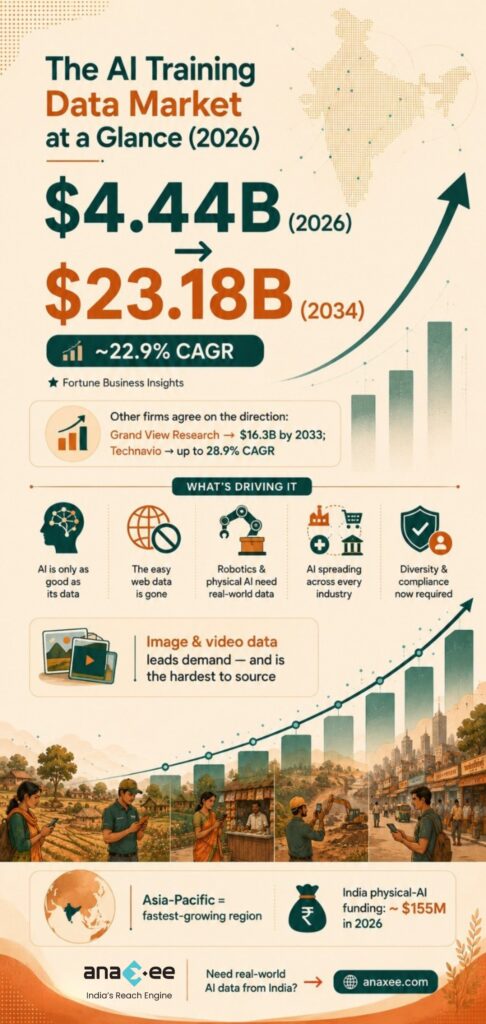
Depending on which research firm you ask, the global AI training dataset market sits somewhere between $3.4 billion and $4.4 billion in 2026. Fortune Business Insights puts it at $4.44 billion in 2026, growing to $23.18 billion by 2034 — a compound annual growth rate of roughly 22.9%.
Other firms land in the same neighborhood: Grand View Research projects growth to $16.3 billion by 2033, and Technavio pegs the near-term rate as high as 28.9%. The exact figure varies, but the direction doesn’t. Every serious estimate shows the market more than quadrupling within a decade.
For a sector most people have never heard of, that’s a remarkable trajectory — and it tells you how foundational data has become to the entire AI economy.
What’s driving the growth?
Five forces are pushing this market up and to the right.
1. AI is only as good as its data. As models get more capable, the bottleneck has shifted from algorithms to data. Better, more diverse, higher-quality datasets directly improve how well AI performs — so demand for them scales with AI itself.
2. The easy data is gone. The public internet has largely been scraped. To improve further, AI teams need fresh data that doesn’t already exist online, which means it has to be collected on purpose.
3. New kinds of AI need new kinds of data. Robotics, autonomous systems and embodied AI can’t learn from text and web images. They need real-world, physical, first-person data — a category that barely existed a few years ago and is now in frantic demand.
4. AI is spreading into every industry. Healthcare, automotive, retail, finance and agriculture are all deploying AI, and each needs domain-specific data. Rising deployment across sectors has pushed dataset demand sharply upward.
5. Diversity and compliance became requirements. Models that only work for some people are now recognized as a business and legal risk. That’s driving demand for demographically diverse, ethically sourced, properly consented data — which is harder to collect and more valuable.
Why image and video data lead
Not all training data is equal in demand. Image and video consistently sit at the top, and the gap is widening as visual AI, computer vision and robotics grow. These are also the hardest data types to source well, because they can’t be generated at a desk — they have to be captured from the real world, from real people, in real settings.
That difficulty is precisely why this part of the market commands attention. The supply of genuinely diverse, real-world visual data is far smaller than the demand for it.
The next battleground: real-world and physical AI data
The clearest signal of where this market is heading is the money flowing into “physical AI” — AI that operates in the real world. In India alone, physical-AI startups attracted around $155 million in 2026, including companies building human-motion datasets and robotics data factories.
This is the frontier. As AI moves off the screen and into physical space, the demand shifts from data that can be scraped to data that has to be collected — on the ground, from real people, across diverse environments. It’s a harder problem than web data ever was, and it’s where the next decade of this market will be won.
Where India fits
Asia Pacific is the fastest-growing region in the AI training data market, with India, China and Japan leading adoption. India’s position is specific and strong: unmatched demographic and linguistic diversity, deep reach into non-urban populations, and a large, mobile-savvy workforce able to collect data at scale and competitive cost.
As the market shifts toward real-world and physical data, that combination moves India from a supporting role to a central one. The country isn’t just a consumer of AI — it’s becoming one of the most important places on earth to collect what AI runs on.
What this means if you’re building AI
If you’re training models, the takeaway is that your data strategy is now your competitive strategy. The teams that pull ahead will be the ones that can source fresh, diverse, real-world data — not the ones relying on the same public datasets as everyone else.
And sourcing that data increasingly means having a way to reach real people, in real places, at scale. Anaxee operates one of India’s largest field networks — 40,000+ Digital Runners across 540+ districts and 11,000+ pincodes — built to collect exactly this kind of real-world, consented data across the full range of the country. Here’s how that works for AI teams.
The bottom line
The AI training data market is on track to more than quadruple to over $23 billion by 2034, driven by the exhaustion of web data, the rise of physical AI, and the growing premium on diverse, ethically collected datasets. The center of that market is shifting from data you can scrape to data you have to go out and collect — and that plays directly to India’s strengths.
Need real-world AI training data from India? Book a call with Anaxee.
Frequently asked questions
How big is the AI training data market? Estimates for 2026 range from about $3.4 billion to $4.4 billion globally. Fortune Business Insights projects growth to $23.18 billion by 2034, at a compound annual growth rate of around 22.9%. Other research firms report similar strong growth.
Why is the AI training data market growing so fast? Growth is driven by AI’s dependence on high-quality data, the exhaustion of easily scraped web data, the rise of robotics and physical AI that need real-world data, AI’s spread across industries, and rising demand for diverse, ethically sourced datasets.
What type of AI training data is in highest demand? Image and video data lead demand and the gap is widening, driven by computer vision, robotics and visual AI. These are also the hardest data types to source, because they must be captured from the real world rather than generated digitally.
Where does India fit in the AI training data market? Asia Pacific is the fastest-growing region, with India among the leaders. India’s demographic diversity, linguistic range, reach into non-urban areas, and large workforce make it an increasingly central place to collect the real-world data modern AI needs.