
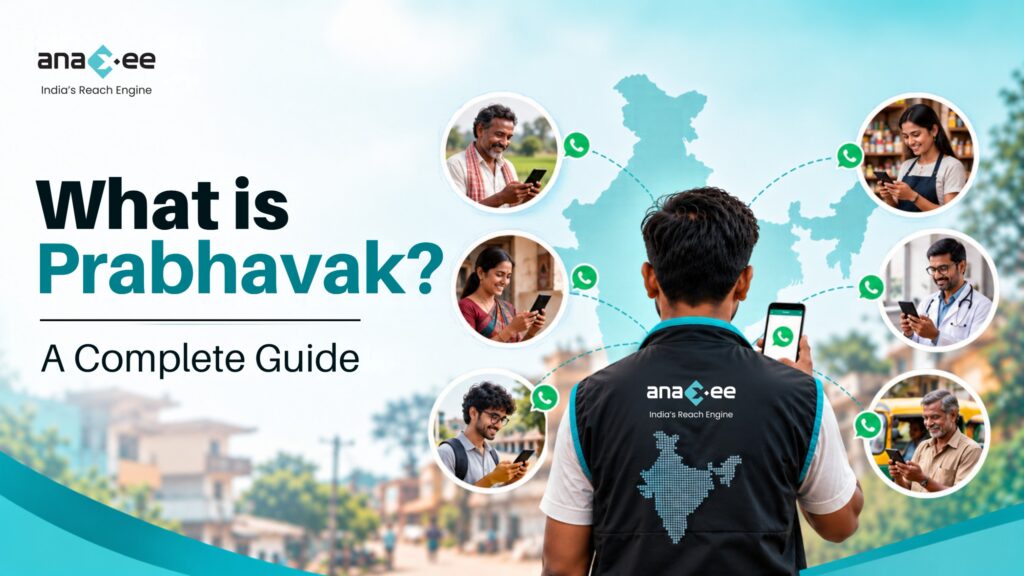

Prabhavak is a marketing model where a brand’s message is carried by trusted local people — not celebrities or big online creators — through real, everyday conversations in their own community. The word itself means “one who influences.” So a Prabhavak is an influencer in the truest sense: someone whose recommendation already carries weight with the people around them, before any brand pays them a rupee.
If you’ve landed here, you’ve probably seen the term used by Anaxee, or heard it in the context of rural and small-town marketing in India. This guide explains what it actually means, where it comes from, how the model works, and how it’s different from influencer marketing, affiliate marketing, and the other things it often gets confused with.
No jargon, no hype. Just a clear picture of an old idea — word of mouth — given a modern structure.
Prabhavak meaning: where the word comes from
Start with the word itself, because it explains the whole idea.
“Prabhavak” comes from the Hindi and Sanskrit root prabhav (प्रभाव), which means influence, effect, or impact. Add the suffix, and prabhavak (प्रभावक) becomes “one who creates influence” — a person who moves opinion, who leaves an impression on the people around them.
In other words, the literal translation of Prabhavak is influencer.
That’s a useful thing to sit with. When most people hear “influencer” today, they picture someone with a big Instagram following, a ring light, and a rate card. But that’s a recent, narrow version of a much older idea. Long before social media, every village and every neighbourhood had its own influencers — the schoolteacher everyone respected, the shopkeeper who never oversold, the neighbour whose opinion on a purchase you simply trusted.
They had no followers. They had something rarer: standing. When they recommended something, people listened, and often acted.
That is exactly the kind of person the Prabhavak model is built around. The term brings the word “influencer” back to its real meaning — influence based on trust, not on reach.
What does a Prabhavak actually do?
A Prabhavak is a real person in a real place who agrees to carry a brand’s message into their own community.
That’s the short version. Here’s what it looks like day to day.
Say a newspaper wants more subscribers in a small town. Instead of buying billboards nobody stops to read, it works with 20 local Prabhavaks — a society committee member, a stationery shop owner, a coaching-class teacher, a few others people already know. Each of them, over the month, mentions the paper to the people they naturally talk to. A WhatsApp message here. A word at the shop counter there. A recommendation that sounds like a recommendation, because it is one.
The Prabhavak isn’t reading a script. They’re not pretending to be a fan of something they’ve never used. They’re doing a light, honest version of what they already do every day — telling people about things worth knowing about.
What makes it a model, and not just chance, is that this activity is organised. Each Prabhavak knows which brand they’re talking about, has a genuine reason to bring it up, and their activity is tracked — so the brand can actually see what happened, instead of hoping.
So the Prabhavak’s job isn’t to shout. It’s to recommend, in the places where recommendations still change minds.
How does the Prabhavak model work?
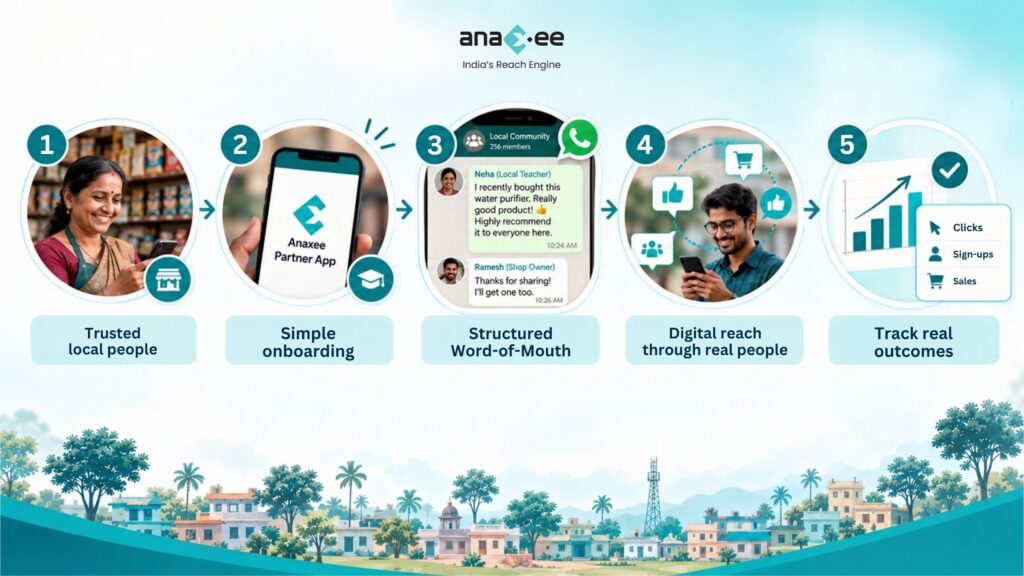
The Prabhavak model turns something unpredictable — word of mouth — into something a brand can actually run. Here’s how it works, step by step.
1. Find the trusted locals. The starting point is people who already have standing in a specific area: shop owners, teachers, society members, advocates, medical reps, small business owners. Reach is not the filter. Trust is. The question is never “how many people follow them” but “whose recommendation do people here actually act on.”
2. Onboard them properly. Each person is brought on board, told clearly which brand they’ll represent, and given the basics — what the product is, why it’s worth talking about, and a real, honest reason to bring it up. No scripts to memorise. A script is what makes word of mouth sound fake.
3. Give them a task, not a speech. A Prabhavak gets a simple task: share this message, mention this offer, pass on this link to the people you’d naturally talk to. Often it runs through WhatsApp, because that’s where these conversations already happen in India.
4. Let the conversation happen locally. This is the part no ad can copy. The message lands in the local language, from a familiar face, at a moment when the person is actually listening. A neighbour saying “I use this, it’s good” does what a banner never will.
5. Track everything. Each Prabhavak’s activity is logged and tied back to a result — a click, a sign-up, a sale. This is the step that separates the model from luck. The brand can see which conversations led to conversions, and scale what works.
That last point is the whole difference. Ordinary word of mouth is invisible and uncountable. The Prabhavak model makes it visible, measurable, and repeatable — which is why people describe it as structured word of mouth.
Prabhavak vs influencer marketing: what’s the real difference?
This is the comparison people ask about most, and it’s a fair one, because the words are so close. Prabhavak means influencer, after all. But the marketing models are almost opposites.
Influencer marketing is built on reach. You pay a creator with a large following, they post about your product, and their audience sees it. It works best for awareness — getting a lot of people to notice you at once. The weakness is that reach and trust are not the same thing. A creator with a million followers is a broadcaster. Most of those followers know they’re watching an ad.
The Prabhavak model is built on trust. A Prabhavak might “reach” only a few dozen people — but they’re the right few dozen, and they take the recommendation seriously because it’s coming from someone they know in real life. It works best for the harder job: not awareness, but actually moving someone to buy.
A few practical differences:
- Broadcast vs. conversation. An influencer posts once to everyone. A Prabhavak talks to people one to one, in context.
- Online vs. on the ground. Influencer marketing lives on feeds. The Prabhavak model lives in towns, shops, and WhatsApp groups — including the Tier 2, 3, and 4 places where big creators have little pull.
- Rented audience vs. real relationship. When an influencer’s campaign ends, so does the connection. A Prabhavak’s trust was there before your brand and stays after.
- Follower count vs. standing. One is measured in numbers. The other in whether people actually listen.
Neither is “better” in the abstract. If you’re launching a phone and want national buzz, influencers make sense. If you’re trying to get families in 50 small towns to trust a new product enough to buy it, the Prabhavak model is built for exactly that.
How Prabhavak differs from affiliate, referral, employee advocacy, and paid ads
The Prabhavak model sits near a few things you already know. It’s worth seeing exactly where it overlaps and where it doesn’t, because the differences are what make it useful.
| Model | Who spreads the word | What drives them | The catch |
|---|---|---|---|
| Paid advertising | The brand itself | The media budget | People know it’s an ad and tune it out |
| Influencer marketing | Online creators | A fee, per post | Reach without real trust; ends when the post does |
| Affiliate marketing | Anyone with a link | Commission per sale | Often strangers online; can feel spammy, chases the sale not the relationship |
| Referral marketing | Your own happy customers | A reward for referring | Only works after someone has already bought and loved the product |
| Employee advocacy | Your staff | It’s their job | Limited to your headcount, and audiences discount what employees say |
| Prabhavak model | Trusted locals in each area | A real reason to recommend, plus a small incentive | Needs a network and ground coordination to run well |
The honest way to read this table: the Prabhavak model borrows the best bit from each and drops the weak bit.
It has the reach ambition of advertising, but arrives as a recommendation instead of an interruption. It uses influence like influencer marketing, but grounds it in real trust. It can carry an incentive like affiliate or referral programs, but leads with a genuine reason to talk, not just a payout. And unlike employee advocacy, it isn’t capped by how many people you employ — it taps the far larger network of trusted people who already live in your market.
It’s not a replacement for these. It’s the layer that makes the rest work harder on the ground.
Real-world examples: how brands can use Prabhavaks
The model is easiest to grasp through examples. Here are four, across very different businesses.
A regional newspaper wants subscribers. Ads have stopped working, and the sales team can’t be everywhere. So the paper builds a network of local Prabhavaks in each town — a teacher, a society secretary, a mobile shop owner. Each shares the subscription offer with families in their circle over a month. The pitch isn’t “buy our paper.” It’s a neighbour saying the local news is worth keeping in the house. Conversions are tracked per Prabhavak, so the paper learns which towns and which profiles perform.
An FMCG brand is launching in small towns. A new product on the shelf is a gamble — nobody’s heard of it, so nobody picks it up. Prabhavaks who are trusted in that market start mentioning it, using it, recommending it. The first few trusted “I tried this” conversations are what get a new product over the line, because in a small town, one trusted opinion travels fast.
A fintech or services app needs real users. Downloads are easy to buy; trust isn’t. People hesitate to put money or documents into an app a stranger advertised. When a Prabhavak they know walks them through it, that hesitation drops. The recommendation carries the credibility the app can’t buy.
An auto or tyre brand wants retailers and mechanics onside. Here the trusted locals are the mechanics and shopkeepers whose word customers follow. A Prabhavak-style network turns them into advocates who bring the brand up at the exact moment a buying decision is being made — at the counter, mid-purchase.
The thread running through all four: the Prabhavak works where the decision actually happens, in the voice the buyer already trusts.
Who can become a Prabhavak?
Here’s the reframe at the heart of the idea: you’ve probably been an influencer your whole life. You just never called it that.
If people ask your opinion before they buy something. If a shopkeeper’s regulars trust what he stocks. If a teacher’s word carries weight with parents. That’s influence. It was influence before the internet gave the word a narrower meaning.
So the people who make good Prabhavaks are rarely “content creators.” They’re ordinary, respected people, such as:
- Shop and small-business owners, who talk to dozens of customers a day
- Teachers and coaching-class instructors, trusted by families
- Society and community committee members
- Advocates, insurance agents, and medical representatives
- Local professionals whose opinion people already seek out
What they share isn’t a following. It’s standing in a specific community, and a network of people who take their word seriously.
There’s an honest note to add here, because it matters. Being a Prabhavak isn’t a get-rich scheme, and any serious version of the model won’t pretend it is. It’s a way for people who already have local trust to earn a little on the side by doing a lighter, structured version of what they do anyway — recommending things they’d be happy to stand behind. The identity comes first: you become a recognised local influencer. The income is the smaller, secondary part.
What makes a Prabhavak effective?
Not everyone with a network moves opinion. The Prabhavaks who actually shift decisions tend to share a few things.
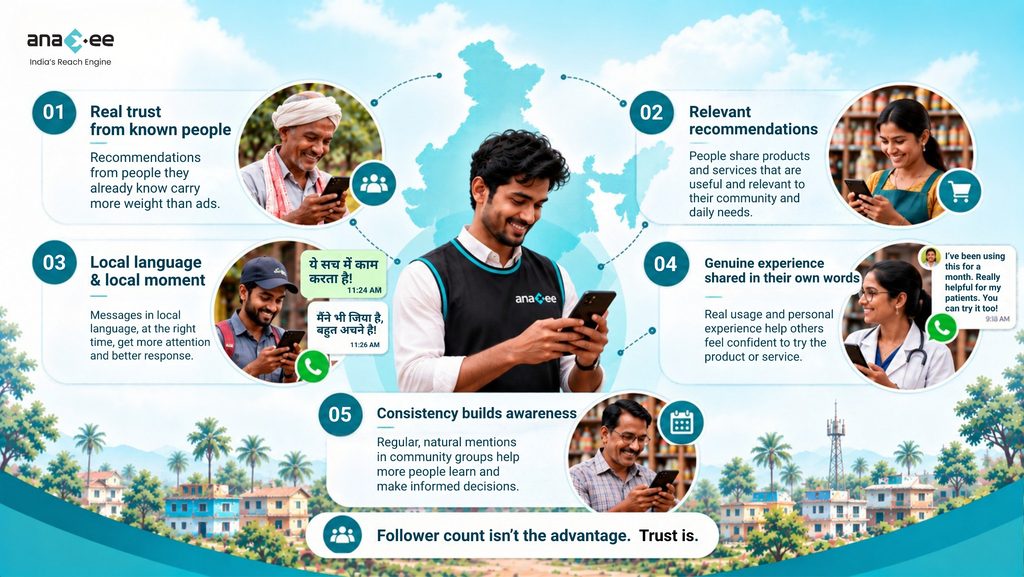
Real trust, not just contacts. A long contact list is not influence. The person’s recommendations have to already carry weight — people should have acted on their word before.
Relevance. A Prabhavak works best when the product fits their world. A chemist recommending a health product, a teacher recommending a newspaper, a mechanic recommending an auto part — the fit makes the recommendation believable.
The local language and the local moment. The message lands when it’s in the language people think in, delivered at a time they’re actually receptive. This is the home-ground advantage no national campaign has.
A genuine reason to recommend. The strongest Prabhavak activity happens when the person would recommend the thing anyway. The moment it becomes a paid script, people can smell it, and the trust that made it valuable evaporates.
Consistency. One mention is a blip. The same trusted person bringing something up naturally, more than once, over time, is what turns a name into a decision.
Notice what’s missing from that list: follower count. Effectiveness here has almost nothing to do with audience size and almost everything to do with whether people believe you.
Advantages and limitations of the Prabhavak model
No model is right for everything. Here’s an honest look at both sides.
Where it’s strong
- Trust that ads can’t buy. A recommendation from a known person clears the doubt that stops a first purchase.
- It reaches where ads don’t. Tier 2, 3, and 4 towns and villages, where big-creator marketing has little grip, are exactly where local trust is strongest.
- It’s measurable. Because activity is tracked and tied to conversions, you learn what works instead of guessing — the thing plain word of mouth never let you do.
- It amplifies what you already run. Your ads create awareness; Prabhavaks turn that awareness into a decision. The two stack.
- Cost-efficient for conversion. You’re not paying for a million impressions, most of them wasted. You’re paying for conversations that move real buyers.
Where it has limits
- It’s not instant mass awareness. If you need the whole country to know your name by Friday, a big campaign does that; a ground network doesn’t.
- It needs coordination. Recruiting, onboarding, tasking, and tracking a network of trusted locals is real operational work. Done loosely, it drifts back into ordinary, uncountable word of mouth.
- Trust is fragile. Push people to oversell, or pair them with a product that disappoints, and you burn the very trust the model runs on.
- It rewards patience. Recommendations compound over weeks, not hours. It’s a build, not a blast.
The short version: the Prabhavak model is a conversion and trust engine for real markets, not a shortcut to overnight fame. Judged as the second, it disappoints. Judged as the first, few things match it.
How brands can build a Prabhavak network
The idea is simple. The execution is where it gets hard.
To run a Prabhavak model well, a brand needs four things: a way to find genuinely trusted people in each target area, a system to onboard and task them, the local reach to actually be present in those towns, and the tracking to tie every conversation back to a result. Any brand can attempt this alone. Most find that identifying the right locals across dozens of districts, and coordinating them at scale, is a full operation in itself.
This is the gap Anaxee was built to fill. Anaxee runs a large last-mile network across India — 40,000+ trained “Digital Runners” reaching 540+ districts — and has run campaigns on the ground for 350+ brands. Its Prabhavak offering takes that reach and turns it into structured word of mouth for brands: real, trusted local people carrying your message into the exact markets where a recommendation still changes minds.
The positioning Anaxee is careful about is worth repeating, because it’s the honest one: Prabhavak doesn’t replace your marketing. It amplifies it. Your ads, your launches, your online campaigns build awareness. Prabhavak takes that awareness the last mile — into conversations, in the local language, from someone the buyer already trusts — and turns it into action. And because every activity is tracked, you see what’s working instead of hoping word of mouth shows up.
Think of it as giving your brand its own network of trusted local voices — running quietly on the ground, in the open, tied to real conversions.
If you want to see what a Prabhavak network could look like for your brand, that’s the conversation Anaxee is set up to have — usually starting with a single district, so you can see the model work before you scale it.
Frequently asked questions about Prabhavak
What is Prabhavak in simple words? It’s a marketing model where trusted local people recommend a brand to their own community through real conversations. “Prabhavak” literally means “one who influences” — an influencer in the original sense of the word.
Is a Prabhavak the same as an influencer? By the dictionary, yes — the word means influencer. As a marketing model, no. Influencer marketing runs on online reach; the Prabhavak model runs on offline, local trust. One broadcasts to a large audience; the other recommends, person to person, where people actually decide.
What does Prabhavak mean in marketing? It refers to structured word of mouth — organising trusted local recommenders so that word of mouth becomes something a brand can run, measure, and repeat, instead of leaving to chance.
How is Prabhavak different from affiliate or referral marketing? Affiliate and referral programs are driven mainly by a payout, and referral only kicks in after someone has already bought. A Prabhavak leads with a genuine reason to recommend and existing local trust; an incentive can be part of it, but it isn’t the whole engine.
Who can become a Prabhavak? Any respected local person whose word carries weight — shop owners, teachers, society members, advocates, medical reps, small business owners. It’s less about how many people you reach and more about how many people trust you.
What is Prabhavak in digital marketing? It’s the on-the-ground, trust-based layer that complements digital campaigns. Your digital ads create awareness online; Prabhavaks convert that awareness in the real world, especially in small towns and villages where online-only marketing struggles.
Does Prabhavak replace advertising? No. It amplifies it. Advertising builds awareness; the Prabhavak model turns that awareness into trusted recommendations that drive action.
Who offers Prabhavak as a service? Anaxee Digital Runners runs Prabhavak as a structured word-of-mouth offering, built on its last-mile network across 540+ districts in India.