
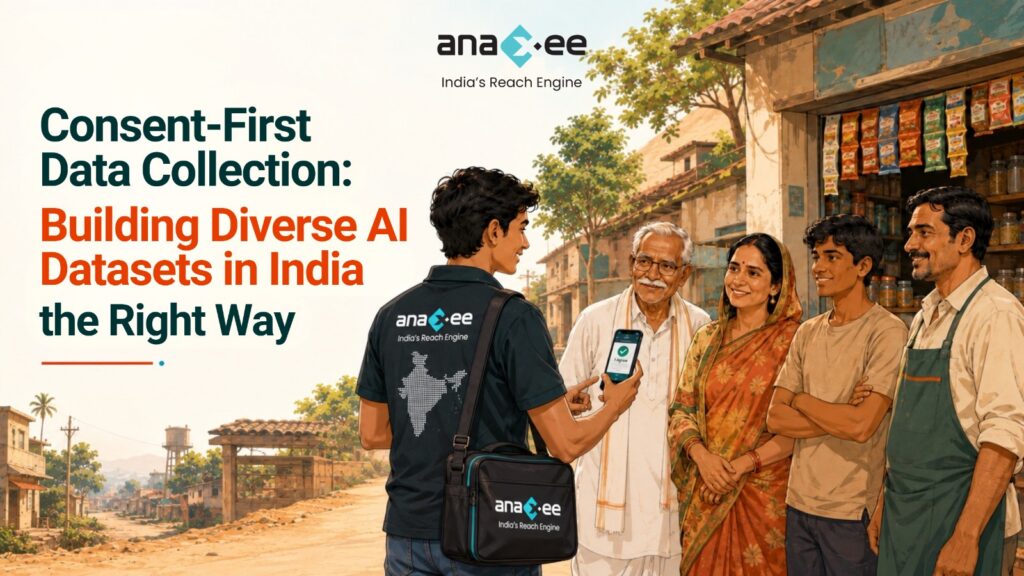

Consent-First Data Collection: Building Diverse AI Datasets in India the Right Way
There are two ways to collect the image and video data that computer-vision and facial-recognition models run on. One is fast and loose: pull faces and footage wherever you can, worry about the paperwork later. The other is consent-first: every person knows what they’re recording, why, and agrees to it before anything is captured.
For years the first way was common, because it was quick and nobody was checking. That era is ending. Between tightening data-protection law and AI teams that now audit their suppliers, data collected without proper consent has gone from a shortcut to a liability. The datasets that hold up — the ones a serious company can actually build a product on — are the ones collected the right way from the start.
Here’s what that means, and why India is the place to do it at scale.
Why AI needs diverse image and video data
Computer-vision models — face verification, object recognition, retail analytics, medical imaging, driver-assistance — learn from labelled images and video. The quality of what they learn is capped by the quality and range of what they’re shown.
And range is the hard part. A face-verification model trained mostly on light-skinned faces fails on darker ones. A retail model trained in glossy Western supermarkets doesn’t recognise an Indian kirana shop. A model trained on young adults struggles with the elderly. These aren’t edge cases — they’re the difference between a product that works for everyone and one that quietly fails for millions of people.
So AI teams need image and video data that spans the actual range of humanity: skin tones, ages, genders, settings, lighting, devices. The more genuine the diversity, the more robust the model.
The diversity problem is really a sourcing problem
Everyone agrees diversity matters. The trouble is where to get it.
Most datasets end up narrow not by intent but by convenience — they’re collected wherever collection is easy, which means a handful of cities and the same demographics over and over. You can’t fix that from a desk or an app. Genuine diversity has to be collected from genuinely diverse places, which means reaching people well beyond the metros, across regions, languages and communities.
That’s a logistics problem before it’s a data problem. And it’s the reason so many “diverse” datasets aren’t.
Why consent is the asset, not the fine print
Here’s the part teams used to treat as an afterthought and now can’t.
When you collect a person’s face, likeness or personal video, how you obtained it determines whether you’re allowed to use it. Under India’s Digital Personal Data Protection Act, informed consent is the legal foundation for handling personal data — not a checkbox at the end. Consent has to be freely given, specific, and understood by the person giving it.
Data collected without that isn’t just ethically shaky. It’s commercially worthless the moment a client runs a compliance audit, because they can’t lawfully build on it. A cheap dataset that can’t be used is the most expensive kind there is.
Consent-first flips this. When every contributor has knowingly agreed — in their own language, understanding what the data is for — the dataset comes with a clean provenance that survives scrutiny. In a market where buyers increasingly demand exactly that, consent isn’t the cost. It’s the value.
What consent-first collection looks like on the ground
The difference shows up in the method:
Real explanation, real understanding. A trained field agent explains what’s being collected and why, in the participant’s own language — not a form in English that no one reads.
Consent recorded before capture. Agreement is obtained and documented first, so every asset in the dataset is traceable to a person who said yes.
Right to decline, respected. People who don’t want to participate simply don’t, which also keeps the data honest.
Quality managed by people, not left to a crowd. A trained, accountable field team produces consistent, usable data — the right framing, lighting and labelling — rather than whatever an anonymous online contributor uploads.
This is slower than scraping. It’s also the only version that produces an asset a company can stand behind.
The India advantage — diversity and reach, done right
India is the best place in the world to collect diverse, real-world visual data, because the diversity is already here: skin tones, faces, ages, regions, settings, ways of living, across a billion-plus people. What’s been missing is a way to reach across all of it responsibly.
That’s the gap Anaxee was built to close. Our network of 40,000+ Digital Runners spans 540+ districts and 11,000+ pincodes — roughly 60% of India, deep into the Tier 2/3/4 towns and villages most collection never touches. Because our Runners live in the communities they work in, they collect data with local language and local trust, and they obtain consent properly because they’re explaining it to their own neighbours.
The result is what AI teams actually need: genuine demographic range, collected with clean consent, at a scale one company can deliver.
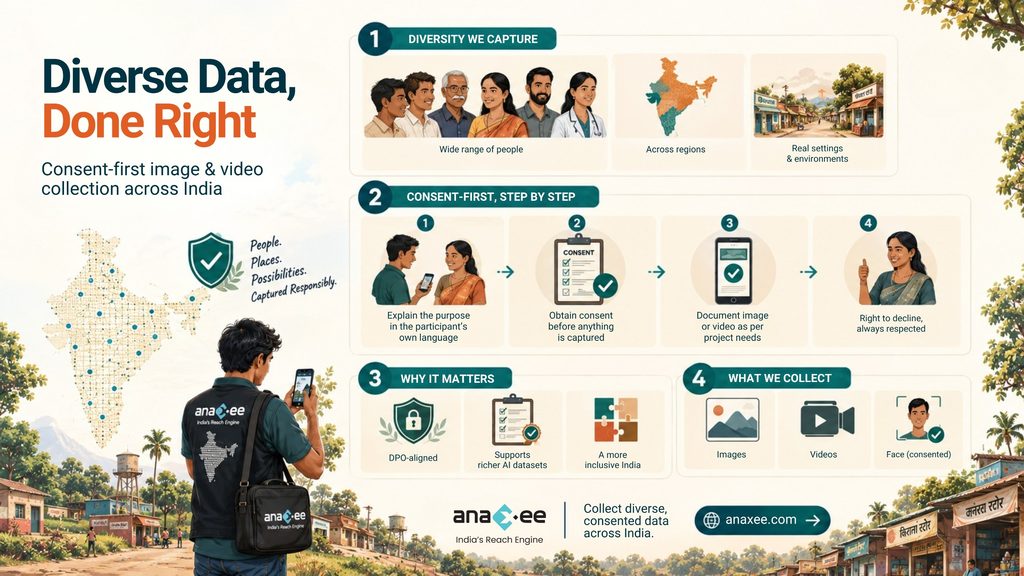
What Anaxee collects
- Image data — faces, objects, scenes, documents, across demographics, regions and real conditions
- Video data — short clips, activity and task recordings
- Face and biometric-adjacent data — collected only with explicit, informed, documented consent
- Egocentric / first-person data and speech and audio data — for teams that need more than images
All of it consent-first. All of it sourced from real people across real India.
The bottom line
The market has moved. Diverse image and video data is in higher demand than ever, and the way it’s collected now decides whether it’s usable at all. Consent-first collection isn’t the compliant-but-slow option — it’s the only one that produces datasets a serious AI team can build on. India has the diversity. Anaxee has the reach to collect it the right way.
Need diverse, consented image or video data from India? Book a call with Anaxee.
Frequently asked questions
What is image and video data collection for AI? It’s the process of gathering labelled images and video used to train computer-vision and other AI models — for tasks like face verification, object recognition and activity detection. The data’s diversity and quality directly determine how well the resulting model works.
Why does diversity matter in AI training data? Models only work reliably on the kinds of people and settings they were trained on. Datasets that lack diversity in skin tone, age, gender or environment produce AI that fails for large groups of people, which is both a performance problem and a reputational and legal risk.
What does consent-first data collection mean? It means every participant is informed about what’s being collected and why, and gives explicit consent before any data is captured — in line with India’s Digital Personal Data Protection Act. This produces datasets with clean provenance that can be lawfully used and survive client audits.
How does Anaxee collect image and video data ethically? Data is collected by trained Digital Runners who explain the purpose and obtain documented consent in the participant’s own language, across 11,000+ pincodes. Quality and consent are managed by an accountable in-house team rather than an anonymous crowd.