
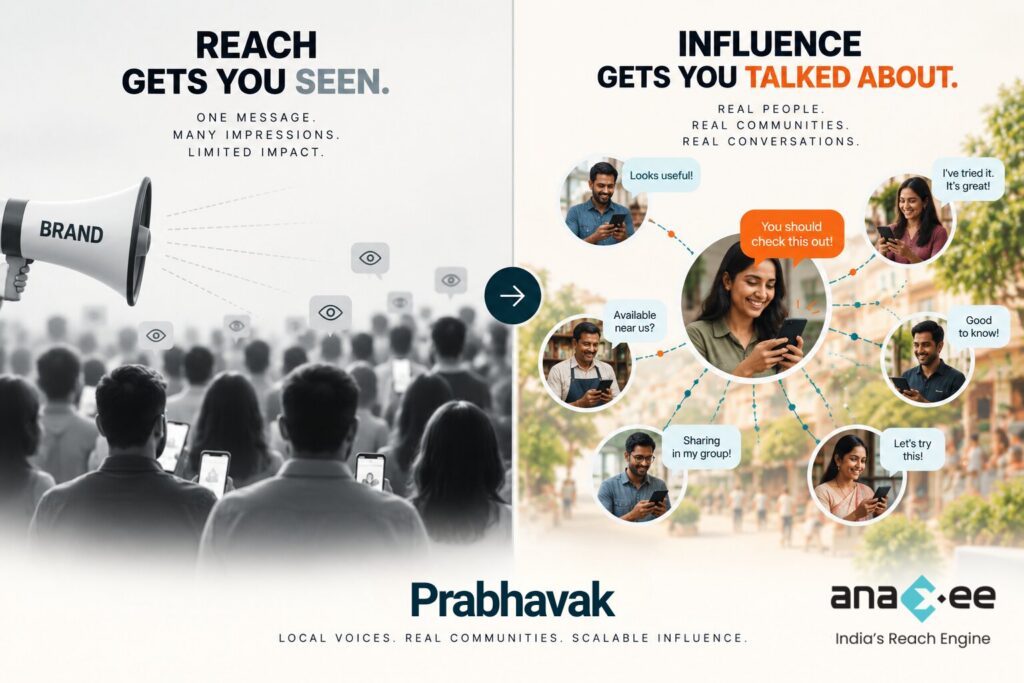

Reach Is Not Influence: Why Brands Need Local Networks
A brand can reach one million people and still struggle to make people care.
That sounds strange, especially in a world where marketing dashboards are full of impressive numbers.
10 lakh impressions.
5 lakh views.
1 lakh clicks.
Thousands of likes.
The campaign looks successful.
But then someone asks a simple question:
“How many people actually talked about your brand?”
That is where things get interesting.
Because reach and influence are not the same thing.
Reach tells you how many people saw your message.
Influence tells you what happened after they saw it.
Did they remember it?
Did they discuss it?
Did they ask someone about it?
Did someone they trust recommend it?
Did the message move from a screen into a real conversation?
For many brands, that second part is becoming increasingly important.
And this is where local networks can change the game.
The Problem With “Just Reach More People”
The easiest way to think about marketing is:
More people = better marketing.
So brands buy more ads.
More impressions.
More placements.
More creators.
More platforms.
It makes sense.
If 10,000 people see your campaign, reaching 100,000 should be better.
But there is a limit to this thinking.
Imagine you are launching a new product in a city where your brand is not well known.
You can show an advertisement to 100,000 people.
They may see it while scrolling Instagram.
They may see it on YouTube.
They may see it while reading the news.
They may even remember the name.
But now imagine something different.
Someone they already know says:
“I came across this brand. You should check it out.”
That is not just another impression.
It is a conversation.
And conversations work differently.
People Don’t Experience Marketing Like a Dashboard
A marketing report might say:
500,000 impressions.
But a person doesn’t experience an “impression.”
They experience a message.
They experience a recommendation.
They experience a conversation with a friend.
They see something shared in a WhatsApp group.
Someone mentions a product at work.
A neighbour talks about a service.
A local creator explains something in a way that makes sense to people around them.
This is why context matters.
The same brand message can feel very different when it comes directly from a company versus when it appears inside a conversation between people.
The brand says:
“Our product is great.”
A local voice might say:
“I came across this. It could actually be useful for people here.”
The information may be similar.
But the experience is different.
This Is Where Local Influence Comes In
Local influencers are not necessarily celebrities.
In fact, they often don’t need to be.
A local influencer can simply be someone who has a connection with a particular community.
They know the area.
They understand the people.
They know what conversations are happening.
And importantly, people in that community may already recognise them.
That gives them something traditional advertising cannot easily manufacture:
proximity.
A national celebrity can give a brand visibility.
A local voice can give the same brand context.
And when brands are trying to enter new cities, districts, towns or communities, that context can become extremely valuable.
The BJP IT Cell Offers an Interesting Lesson
This is also one reason the BJP’s IT Cell has been studied so closely by marketers and political communication researchers.
Whatever one’s political views may be, the underlying communication model is worth examining.
The BJP’s digital strategy has involved networks of volunteers, WhatsApp groups, social media workers and communication structures extending into local levels. Reports around the 2017 Delhi elections, for example, described ward-specific WhatsApp groups and a large network of workers and volunteers connecting digital communication with local-level activity.
The important lesson for marketers isn’t politics.
It is distribution through networks.
Instead of thinking only:
Organisation → Message → Audience
a networked model looks more like:
Organisation → People → Communities → Conversations
The message has more places to travel.
And more importantly, it has more opportunities to become part of an existing conversation.
That is a very different way of thinking about reach.
From Broadcast to Network
Traditional advertising is largely built around broadcasting.
The brand creates a message.
The media carries it.
The audience receives it.
Simple.
But today’s consumers are not only receivers.
They are also sharers, commenters, recommenders and participants.
A campaign can move from a brand’s social media page into a WhatsApp group.
From a WhatsApp group into a personal conversation.
From that conversation into another community.
And suddenly, the original message is travelling through people rather than only through media placements.
That is the power of a network.
Traditional Marketing
Brand → Ad → Audience
Networked Marketing
Brand → Local Voice → Community → Conversation → Influence
The second model doesn’t replace advertising.
It adds something advertising cannot provide on its own.
Human distribution.
Why Local Voices Can Make a Difference
There are three things local voices can bring to a campaign.
1. Context
A brand knows its product.
A local person knows the audience.
They can explain, share or discuss the message in a way that feels relevant to the people around them.
A national campaign might say:
“Now available in your city.”
A local voice can make that feel more real:
“This is now available near us.”
Small difference.
Big change in how the message is experienced.
2. Trust
People don’t automatically trust every advertisement they see.
But they may pay more attention when information comes through someone they already know or recognise.
This is one reason word-of-mouth marketing remains powerful.
People ask people.
“Have you tried this?”
“Is this actually good?”
“Where can I get it?”
“Does this work?”
These are not advertising questions.
They are human questions.
And brands need to find ways to become part of those conversations.
3. Repetition
One advertisement can disappear quickly.
A message that appears in multiple relevant conversations has a better chance of being remembered.
Not because people are being shown the same ad again and again.
But because the message is appearing in different contexts.
Different people.
Different conversations.
Different moments.
That creates a different kind of visibility.
The Real Opportunity: Build a Local Network Around Your Brand
This doesn’t mean brands should stop running ads.
They shouldn’t.
Paid media, search, social media, content and traditional advertising all have important roles.
The question is:
What happens after the advertisement?
Can the message travel further?
Can it enter local communities?
Can people discuss it?
Can someone explain it in their own context?
Can your campaign become more than something people see?
That is where a local influencer network can help.
Where Prabhavak Fits In
Prabhavak is built around this idea.
Instead of treating influence as a single celebrity with a large following, Prabhavak creates a network of verified local voices who can help brands take campaigns into real communities.
The idea is simple:
One brand.
Many local voices.
Many communities.
One scalable network.
The strength isn’t just in the number of people involved.
It is in the distribution.
A campaign can be designed centrally while being activated locally.
That gives brands a way to combine scale with proximity.
And that combination is difficult to achieve through traditional advertising alone.
Reach Gets You Seen. Influence Gets You Remembered.
Think about the difference.
You see an advertisement for a restaurant.
Then your friend says:
“I’ve been there. You should try it.”
Which one are you more likely to act on?
The answer isn’t always the friend.
But the friend’s recommendation changes the equation.
Now there is experience.
There is context.
There is social proof.
There is a reason to pay attention.
That’s what influence does.
It adds a human layer to distribution.
The Future of Marketing May Be Less About Bigger Audiences
For years, marketers have chased bigger audiences.
More followers.
More views.
More impressions.
More reach.
But perhaps the better question is:
How connected is your audience?
Because 100,000 disconnected impressions can sometimes be less useful than 10,000 people connected through relevant communities and conversations.
The goal isn’t simply to reach people.
It is to give your message somewhere to go.
From the brand.
To a person.
To a community.
To a conversation.
And then to another person.
That’s how a message starts moving.
Don’t Just Broadcast. Build a Network.
The biggest shift is simple.
Your brand doesn’t have to choose between advertising and people.
You can use both.
Let advertising create awareness.
Let content explain the product.
Let local voices add context.
Let communities create conversations.
And let those conversations carry the message further.
Because reach is a number.
Influence is movement.
And when that movement happens through thousands of real people in real communities, marketing starts to look very different.
That is the opportunity behind local influencer marketing.
Not simply getting more people to see your brand.
Getting more people to talk about it.
Frequently Asked Questions
What is the difference between reach and influence in marketing?
Reach measures how many people are exposed to a marketing message. Influence goes further by looking at whether that message affects attention, conversations, trust or behaviour.
Why is local influencer marketing important for brands?
Local influencer marketing can help brands connect with specific communities through people who understand the local audience and have an existing relationship or presence within that community.
What is community marketing?
Community marketing focuses on building relationships and conversations within specific groups rather than relying only on broad advertising. It can include local creators, community members, social groups and other trusted voices.
What can brands learn from the BJP IT Cell?
From a marketing perspective, one useful lesson is the power of distributed communication. Networks of people can help messages travel through communities rather than relying entirely on centralised broadcasting.
What is Prabhavak?
Prabhavak is a network of verified local voices designed to help brands activate campaigns across local communities. It focuses on taking brand communication from central campaigns into local conversations.
Final Takeaway
The next time someone shows you a campaign report with millions of impressions, ask one more question:
“How far did the message travel?”
Because marketing doesn’t end when someone sees your campaign.
Sometimes, that’s where it starts.
And the strongest campaigns don’t just reach people. They give people something worth talking about.