
Retail Reach vs Distributor Reach: The Hidden Growth Gap for Non-FMCG Brands
Walk into almost any kirana store in India and you’ll find Parle-G.
Whether you’re in a metro city, a small town, or a village, chances are there’s a packet sitting on a shelf somewhere.
Now think of an electronics brand.
Or an automotive battery brand.
Or a tyre company.
Or a kitchen appliance manufacturer.
Can any of them claim the same level of reach?
Probably not.
Of course, non-FMCG categories are different. Nobody buys a car battery on impulse while picking up groceries. A tyre doesn’t belong next to toothpaste, and a mixer grinder isn’t sold at a tea stall.
But that’s not the real question.
The real question is:
Within the shops that should be stocking your products, are you actually there?
For most non-FMCG brands, the answer is surprisingly uncomfortable.
Not even close.
The Illusion of Market Coverage
Many companies believe they have “covered” a market because they have appointed distributors in that region.
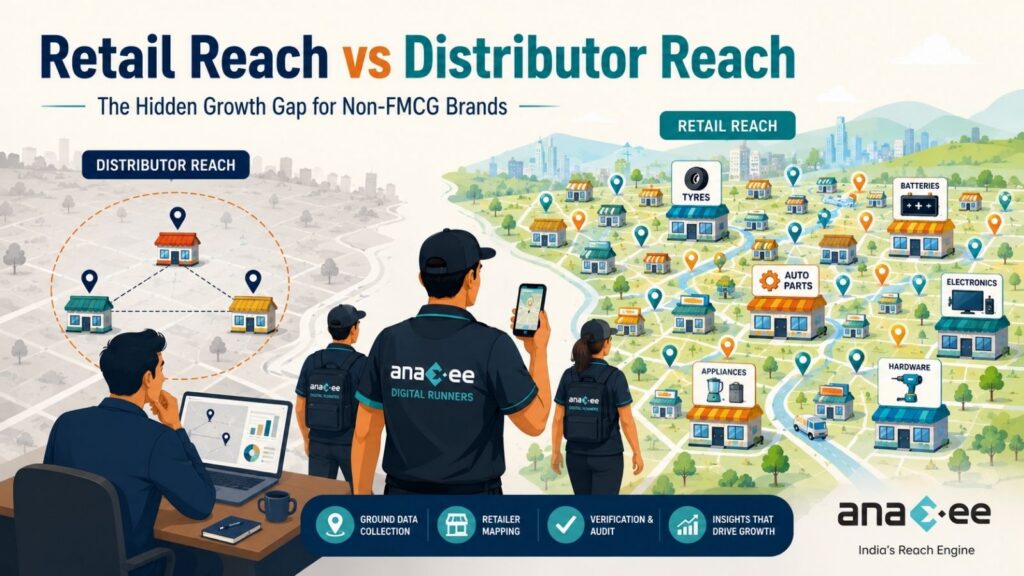
But market coverage and distributor coverage are not the same thing.
A distributor can only sell to retailers they know, retailers they can serve efficiently, and retailers they are willing to extend credit to.
Over time, a brand’s market presence starts reflecting the habits and limitations of its distributor network rather than the true size of the market.
Without realizing it, companies begin measuring their opportunity through a very narrow lens.
What they see is not the market.
It’s the distributor’s view of the market.
Distributor Reach Is Not Retail Reach
Distributors are the backbone of India’s distribution ecosystem.
No serious brand can scale without them.
But every distributor operates within practical constraints:
- Existing relationships
- Route convenience
- Delivery economics
- Credit exposure
- Sales team bandwidth
- Local familiarity
These constraints are perfectly reasonable.
The problem arises when brands mistake those constraints for market reality.
A distributor may be serving 500 retailers in a district.
But what if there are actually 1,500 relevant retailers?
The brand sees strong distribution.
The market sees untapped opportunity.
The Retailers You Don’t Know Exist
One of the biggest blind spots in non-FMCG distribution is that most companies don’t know the full universe of retailers in their target market.
Ask a sales leader:
“How many retailers currently buy from you?”
You’ll probably get an answer.
Ask:
“How many retailers should potentially buy from you?”
The answer becomes much harder.
Without knowing the total market, it’s impossible to understand:
- Market penetration
- Retail coverage
- White-space opportunities
- Territory potential
And if you can’t measure those things, you can’t systematically improve them.
A Real Example from Uttar Pradesh
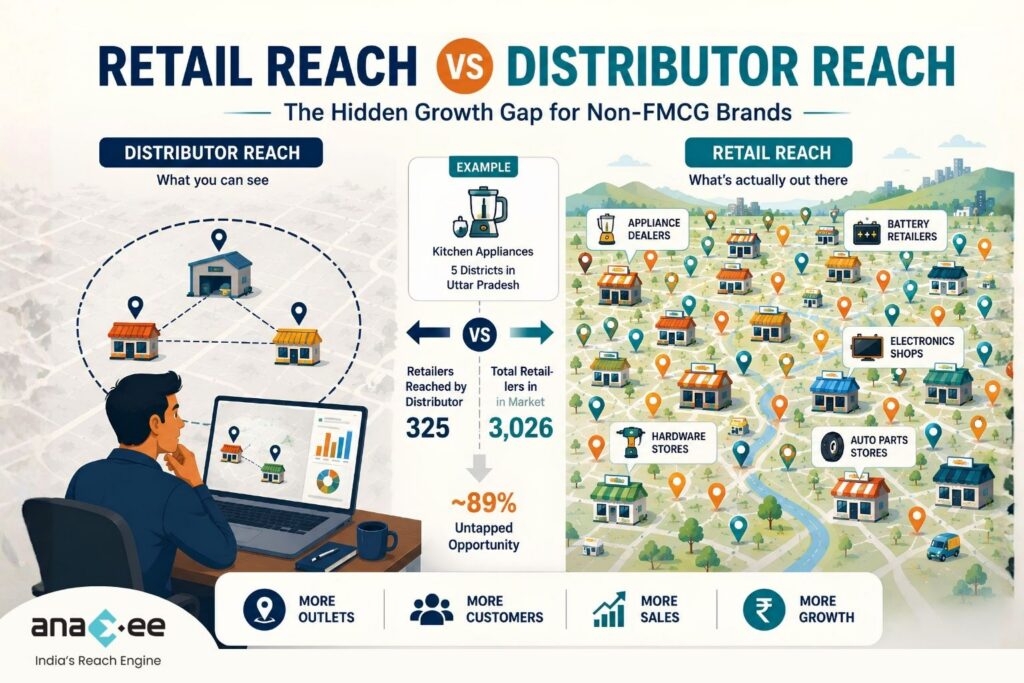
At Anaxee, we recently analyzed retail data across five districts in Uttar Pradesh.
For just one category—kitchen appliances and utensils—we identified 3,026 retail outlets.
Let that sink in.
One category.
Five districts.
More than 3,000 outlets.
The surprising part wasn’t the number itself.
The surprising part was realizing how difficult it would be for most brands to claim meaningful coverage across that retail universe.
Even some of the largest brands in the category are unlikely to be present in 90% of those outlets.
Not because they don’t want to be.
But because they simply don’t know where all those retailers are.
India’s Biggest Growth Markets Are Not in the Metros
When companies think about growth, they often focus on major cities.
But India’s consumption story looks very different on the ground.
Consider a few realities:
- Approximately 88% of Indians live outside metropolitan cities
- Around 70% of household consumption takes place outside metros
- A significant share of non-FMCG commerce still happens through offline retail channels
Whether you’re selling:
- Batteries
- Tyres
- Lubricants
- Kitchen appliances
- Electronics
- Hardware products
The neighbourhood retailer remains the most important point of purchase.
And many of these retailers are located in Tier 2, Tier 3, and Tier 4 markets.
These aren’t small markets.
They’re simply harder to see.
The Hidden Cost of Limited Visibility
When brands don’t have visibility into the retail universe, several problems emerge.
Missed Growth Opportunities
Potential retailers remain undiscovered and unserved.
Inaccurate Market Assessment
Brands believe they have strong coverage when penetration may actually be low.
Inefficient Sales Investments
Sales teams spend resources in familiar areas instead of high-potential white spaces.
Distributor Dependence
Market intelligence becomes entirely dependent on distributor feedback.
Slow Expansion
Growth slows because nobody knows where the next opportunities exist.
Why Retail Mapping Matters
Before a brand can grow in a market, it needs to understand the market.
That starts with visibility.
Retail mapping helps companies answer critical questions:
- Which retailers exist?
- Where are they located?
- What products do they sell?
- Which brands are already present?
- Which outlets have growth potential?
- Which territories are underserved?
Once these answers become available, expansion becomes much more strategic.
Instead of guessing where growth might come from, brands can identify and prioritize opportunities with confidence.
This Is Not About Replacing Distributors
Let’s be clear.
This isn’t a case against distributors.
It’s the opposite.
The goal is to empower distributors.
Imagine giving your distributor:
- A verified retailer database
- Store-level intelligence
- Category insights
- Territory opportunity maps
- Real-time market visibility
Suddenly, the same distributor can reach more retailers, serve more markets, and unlock more business.
The network becomes stronger because the information becomes better.
The Future Belongs to Brands That Can See the Market
Over the next decade, the winners in non-FMCG categories won’t necessarily be the brands with the largest distributor networks.
They’ll be the brands with the clearest understanding of the retail landscape.
Because growth rarely hides in places that don’t exist.
Growth hides in places that haven’t been mapped.
The retailers are already there.
The demand is already there.
The opportunity is already there.
The question is whether you can see it.
How Anaxee Helps Brands Expand Retail Reach
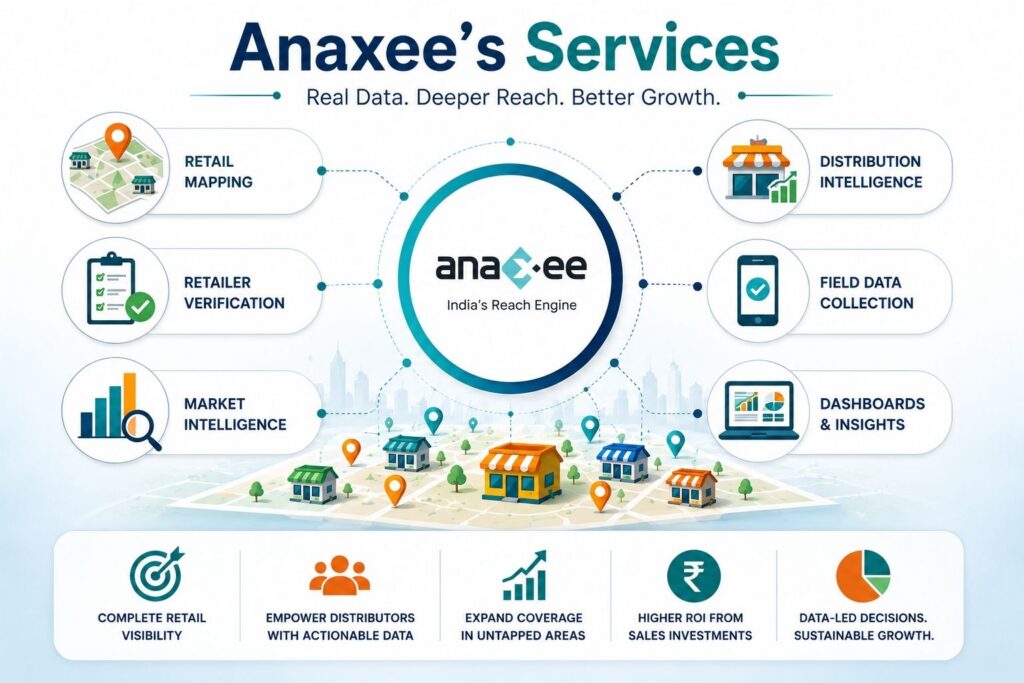
Anaxee helps brands build visibility beyond traditional distributor networks.
Using a combination of technology, retail intelligence, and last-mile execution capabilities, Anaxee enables companies to discover, verify, map, and activate retail outlets across India.
Our services include:
- Retail Mapping
- Retailer Verification
- Market Intelligence
- Distribution Intelligence
- Field Data Collection
- Dashboards & Insights
By creating a clear picture of the retail universe, we help brands identify untapped opportunities, support distributor expansion, improve market coverage, and make better growth decisions.
Because before you can grow your market, you need to see it.
Ready to Understand Your Real Retail Reach?
If you’re wondering how many relevant retailers actually exist in your target markets—and how many you’re missing—we’d be happy to help.
Let’s build visibility before we build distribution.