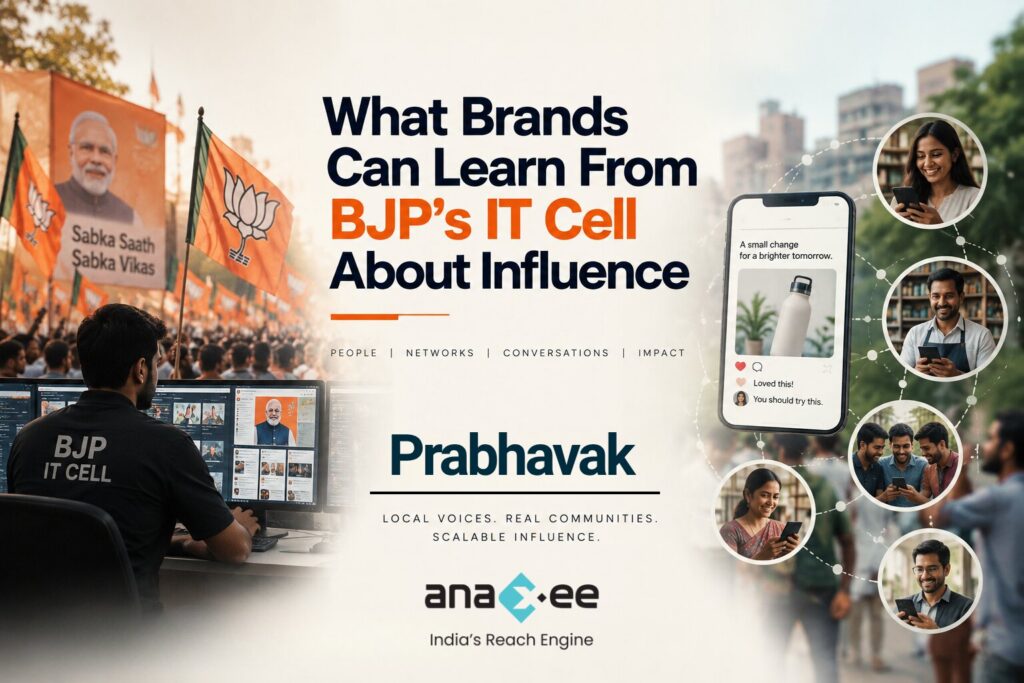

What Brands Can Learn From BJP’s IT Cell About Influence
A political campaign can teach marketers an uncomfortable lesson: reaching people is not the same as influencing them.
A brand can spend lakhs on advertising.
It can run Google campaigns.
It can buy Instagram ads.
It can work with influencers.
It can generate millions of impressions.
And still, something can be missing.
People talking about the brand when the brand isn’t in the room.
That is where the story of the BJP’s IT Cell becomes interesting for marketers.
Not because brands should copy a political party.
And certainly not because political communication and commercial marketing are the same thing.
The interesting lesson is simpler:
A message becomes more powerful when it doesn’t come only from the organisation sending it. It becomes more powerful when people carry it into their own networks.
That is the idea behind Prabhavak.
The BJP IT Cell Was Never Just About Posting on Social Media
When people hear “BJP IT Cell”, they often imagine a room full of people creating tweets, memes and social media posts.
That is only part of the story.
The BJP’s digital campaign infrastructure developed into a much broader network involving party workers, volunteers and local-level communication.
For example, reporting on the BJP’s Delhi operation described a system connecting the central team with ward-level workers and WhatsApp groups. The objective wasn’t simply to publish content from headquarters; local teams were also expected to identify issues and communicate with people on the ground.
During the 2017 Delhi municipal election campaign, NDTV reported that the BJP’s Delhi IT cell had hundreds of volunteers and hundreds of ward-specific WhatsApp groups. The party explicitly described its approach as connecting online activity with offline conversations.
That distinction matters.
Because there is a big difference between:
Publishing a message
and
building a system through which a message travels.
The Real Lesson: Distribution Changes the Message
Imagine a company launches a new product.
The marketing team creates a beautiful campaign.
The brand says:
“Our new product is faster, better and more affordable.”
The advertisement reaches 100,000 people.
But the message is still coming from the brand.
Now imagine something different.
A person in a local community says:
“I’ve actually tried it. It works pretty well.”
That is a different kind of communication.
The second person isn’t necessarily better at advertising.
They simply have something the brand doesn’t have:
a relationship with the person listening.
That relationship creates context.
And context creates relevance.
And relevance can create conversation.
This is one of the most interesting aspects of the BJP’s digital mobilisation model. Academic research on the BJP’s 2014 online campaign found that the party sought volunteers who were active online and had networks through which messages could be shared.
In other words, the network itself became part of the communication system.
From One Message to Many Conversations
This is where the idea gets interesting for brands.
Think about the difference between these two models.
Model 1: Traditional broadcast
Brand → Advertisement → Audience
The brand controls the message.
The audience receives it.
The communication largely ends there.
Model 2: Networked communication
Brand → Local Voice → Community → Conversation
The brand starts the message.
But other people carry it.
They add context.
They explain it.
They discuss it.
They share it with people they already know.
The message starts travelling.
And that changes the nature of the marketing.
You’re no longer asking only:
“How many people saw our campaign?”
You’re also asking:
“How many conversations did our campaign create?”
That’s a much more interesting question.
Why People Listen Differently to People
This isn’t a new discovery.
We have always relied on people around us to make decisions.
Ask yourself:
If a company says:
“This is a great product.”
You expect them to say that.
But if a friend says:
“I’ve used it. You should try it.”
Your attention changes.
The product hasn’t changed.
The messenger has.
That is the psychological gap between advertising and influence.
Advertising can create awareness.
People can add trust, context and social proof.
That doesn’t mean advertising is ineffective. It means brands don’t necessarily have to choose between the two.
The smarter question is:
How can advertising create the initial reach, while people help the message travel further?
This Is Where Prabhavak Comes In
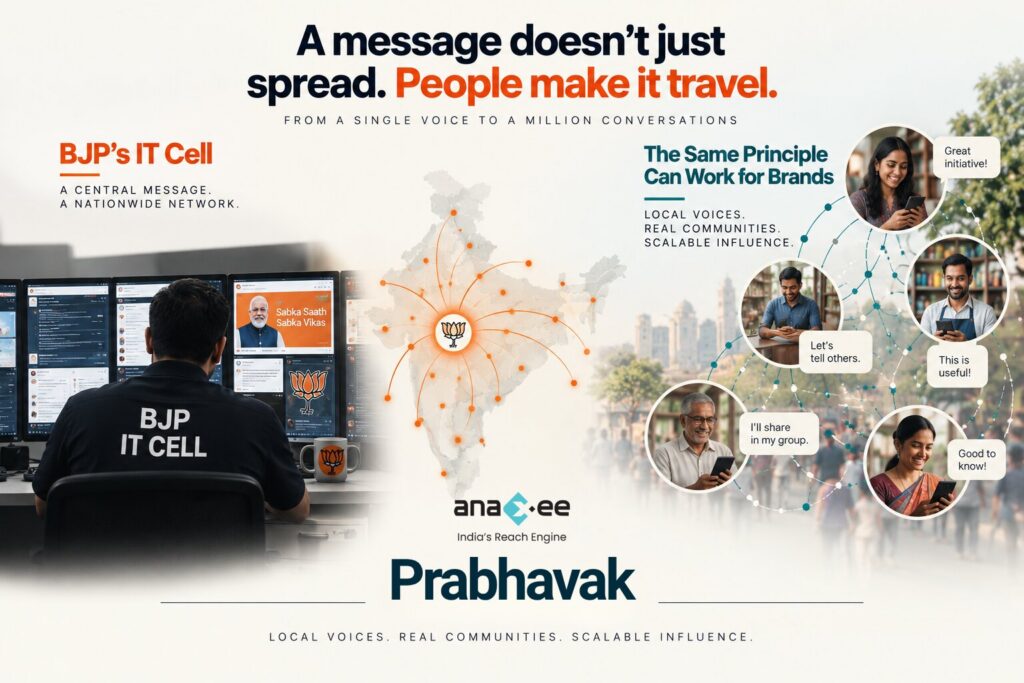
Prabhavak is built around that exact idea.
Instead of asking a brand to depend only on its own channels, Prabhavak helps activate verified local voices who can take campaigns into the communities they already belong to.
The basic flow is simple:
1. The brand creates the campaign
Your brand still owns the message.
The objective, creative and campaign strategy remain yours.
2. Local voices receive the campaign
Prabhavak activates people who are connected to specific communities and locations.
3. The message enters local networks
Instead of stopping at an advertisement, the campaign can move through conversations, groups and personal networks.
4. Influence starts travelling
One person can introduce the message to another.
One conversation can lead to another.
One locality can connect to another.
The network starts doing part of the distribution.
That is the difference.
The BJP IT Cell vs. Prabhavak: Don’t Copy the Politics. Understand the Principle.
This distinction is important.
Prabhavak is not a political communication platform.
And brands shouldn’t blindly copy political campaign tactics.
What is worth studying is the underlying communication principle:
Don’t depend entirely on one central voice when you can build a network of voices.
Political organisations have understood the value of distributed communication for years.
Brands are increasingly discovering the same thing through influencer marketing, creator communities, employee advocacy, referral programs and community-led growth.
Prabhavak takes that principle and applies it to local brand marketing.
Why Local Voices Matter
There is another layer here that gets missed when we talk about “influencer marketing.”
A person doesn’t need a million followers to influence someone.
A person can have 500 followers and still have enormous influence within a neighbourhood.
A shopkeeper can influence customers.
A community member can influence a WhatsApp group.
A local creator can influence people in a particular city.
A professional can influence colleagues.
A parent can influence other parents.
The value isn’t always in audience size.
Sometimes it’s in audience proximity.
That’s why the future of influence isn’t necessarily:
One celebrity → millions of followers
It can also be:
Thousands of relevant people → their own communities
And that is where local networks become commercially interesting.
Reach Is Not the Same as Influence
This may be the biggest lesson marketers can take from the entire discussion.
A campaign can have:
10 million impressions
and still generate very little meaningful conversation.
Another campaign can reach fewer people but create strong local awareness because the message travelled through people who were already trusted.
The question isn’t:
“How many people did we reach?”
It’s:
“What happened after we reached them?”
Did they remember it?
Did they discuss it?
Did they ask someone about it?
Did they recommend it?
Did they act?
That’s where marketing starts moving from reach to influence.
The Next Marketing Network May Not Look Like an Influencer Campaign
This is also why we shouldn’t reduce Prabhavak to “another influencer marketing platform.”
Influencer marketing usually starts with:
Find someone with an audience.
A network-led model starts with:
Find people who matter in the communities you want to reach.
Those are different questions.
One optimises for audience.
The other optimises for distribution through relevant people.
And for brands operating across India’s diverse cities, towns and local markets, that distinction can matter.
A central campaign may look perfect nationally and still feel distant locally.
Local voices can help bridge that gap.
From Brand Message to Community Conversation
This is the shift Prabhavak is trying to create.
Not:
Brand → People
But:
Brand → People → Communities → Conversations → Influence
The brand still starts the story.
But it doesn’t have to be the only one telling it.
That is the real lesson worth taking from the BJP IT Cell.
Not the politics.
Not the party.
Not the slogans.
The network.
Because when a message travels through people, something changes.
It gets context.
It gets repetition.
It gets social proof.
And, if the message is actually useful, it gets talked about.
So, What Can Your Brand Learn From the BJP IT Cell?
Three things.
1. Don’t confuse reach with influence.
Getting your message in front of people is only the first step.
2. Don’t make the brand the only messenger.
People can carry messages into places and conversations that brand channels cannot.
3. Build networks, not just campaigns.
A campaign ends.
A network can keep creating opportunities for conversations.
And that may be the more valuable asset in the long run.
The Bigger Idea
The internet made it possible for brands to speak to millions.
The next opportunity is figuring out how to make millions of relevant conversations possible.
That’s a very different problem.
And it requires a different kind of marketing infrastructure.
Prabhavak is built around that infrastructure: verified local voices, real communities and scalable influence.
Because sometimes the best way to make your message travel further isn’t to make the brand speak louder.
It’s to give more people a reason to carry it.
Want to See What This Could Look Like for Your Brand?
Prabhavak helps brands activate verified local voices and take campaigns into real communities.
From reach → to influence.
[Book a free call]
A note on the BJP reference
This article discusses the BJP’s IT and social-media operations as a marketing and communication case study. It does not imply political affiliation, endorsement or association with the BJP.